


CaliberFocus partnered with a multi-hospital healthcare network to design and deploy real-time operational intelligence dashboards that unified clinical, operational, and financial data into a single decision-making layer using Microsoft Fabric. While Microsoft Fabric was used in this implementation, CaliberFocus can deliver the same solution across any modern data platform.
The initiative enabled hospital leadership and operations teams to move from delayed, manual reporting to live, predictive visibility across patient flow, bed utilization, staffing, and throughput.
Within 12 months of implementation, the hospital network achieved measurable improvements in patient wait times, bed utilization, staff productivity, and operational cost control, while also establishing a scalable analytics foundation for future AI-driven care delivery and capacity planning.
Organization Overview
Client Type: Multi-Hospital Healthcare Network
Facilities: Acute care hospitals and specialty units
Beds: 1,200+ licensed beds across locations
Staff: 6,500+ clinical and operational staff
Patient Volume: 2.4M+ annual patient encounters
Systems Environment: EMR, HIS, lab systems, scheduling platforms, finance and supply chain systems
The organization operated in a high-demand, high-complexity healthcare environment, balancing patient care quality, regulatory compliance, and financial sustainability.
The Challenge: Fragmented Visibility and Reactive Operations
Despite significant investments in electronic medical records and digital systems, the hospital network struggled to achieve real-time operational awareness. Decision-making was constrained by delayed reporting, disconnected data sources, and manual processes that limited the organization’s ability to respond proactively to daily operational pressures.
Key Operational Challenges
Delayed Decision-Making
Most operational reports were generated daily or weekly, making it impossible to respond in real time to patient surges, bed shortages, or staffing constraints.
Siloed Data Systems
Clinical, operational, and financial data lived across disparate systems, including EMR, bed management tools, scheduling platforms, and finance systems. Leaders lacked a single source of truth.
Patient Flow Inefficiencies
Emergency department congestion, delayed discharges, and inconsistent bed availability contributed to longer patient wait times and reduced throughput.
Staffing and Resource Imbalances
Nursing and clinical staff allocation decisions were made using historical averages rather than live demand signals, resulting in overtime costs in some units and underutilization in others.
Limited Predictive Insight
Operations teams had no way to anticipate patient surges, discharge bottlenecks, or capacity constraints before they impacted patient care and experience.
Assessment of Existing Reporting and Analytics Capabilities
The hospital primarily relied on Excel and PowerPoint for reporting, with a strong focus on retrospective analysis rather than operational execution. Static dashboards and spreadsheet-based reports failed to support:
- Minute-by-minute operational decisions
- Role-based visibility for executives, operations, and clinicians
- Predictive insight into patient flow and capacity risks
- Actionable alerts tied to operational thresholds
Legacy Architecture
CaliberFocus identified the need for a unified data platform with a real-time operational intelligence layer, one that transformed raw healthcare data into live, decision-ready insights aligned with how hospitals actually operate.
The CaliberFocus Solution: Real-Time Hospital Operational Intelligence
CaliberFocus designed and implemented a cloud-native, real-time operational intelligence ecosystem using Microsoft Fabric. The solution unified data across systems, surfaced critical operational signals, and enabled proactive intervention across hospital operations.
Phase 1: Unified Data Foundation
CaliberFocus integrated data from across the hospital ecosystem, including:
- EMR and patient encounter data
- Bed management and ADT feeds
- Scheduling and staffing systems
- Lab, radiology, and ancillary services
- Financial and operational cost data
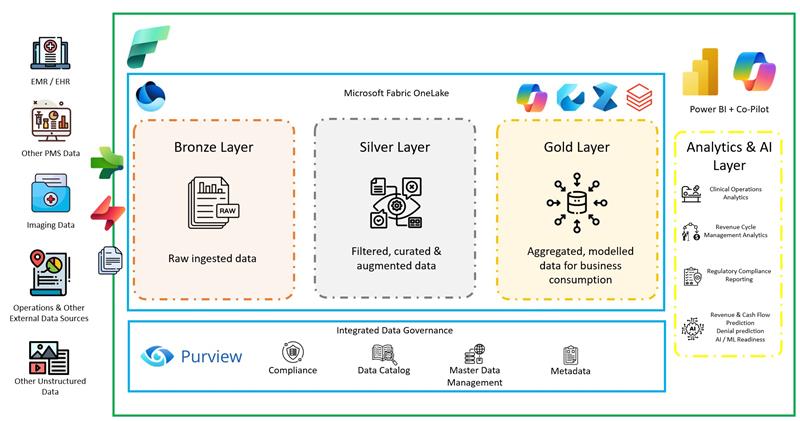
CaliberFocus implemented a medallion architecture using Microsoft Fabric as the core data platform. Native connectors such as Fabric Data Factory and Azure Health Data Services were used to ingest data from disparate sources, including EMR/EHR systems, clinical records, FHIR feeds, claims, and compliance data, into Fabric OneLake storage.
Synapse Data Engineering notebooks, Fabric Data Factory, and Real-Time Intelligence (RTI) capabilities were leveraged to build transformation pipelines. The transformed, analytics-ready data was consumed through Power BI (with Copilot) for interactive visualization. RAG-based and agentic AI solutions using Azure OpenAI Services and Cosmos DB were implemented to support prediction and advanced analytics.
Phase 2: Role-Based Dashboard Design
Rather than deploying generic dashboards, CaliberFocus designed role-specific operational views, ensuring each stakeholder received relevant, actionable insight.
Executive Dashboards
- Hospital-wide occupancy and capacity trends
- Patient throughput and length-of-stay indicators
- Cost per patient day and operational efficiency metrics
- Cross-facility performance comparisons
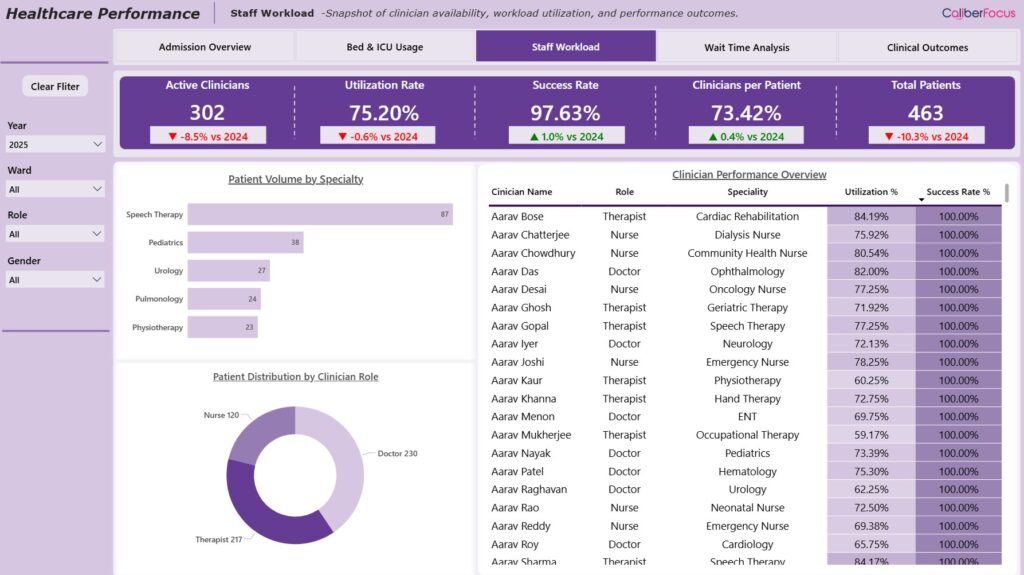
Operations Dashboards
- Live bed availability by unit and acuity
- Emergency department inflow and wait times
- Discharge pipeline status and bottlenecks
- Staffing coverage versus real-time demand
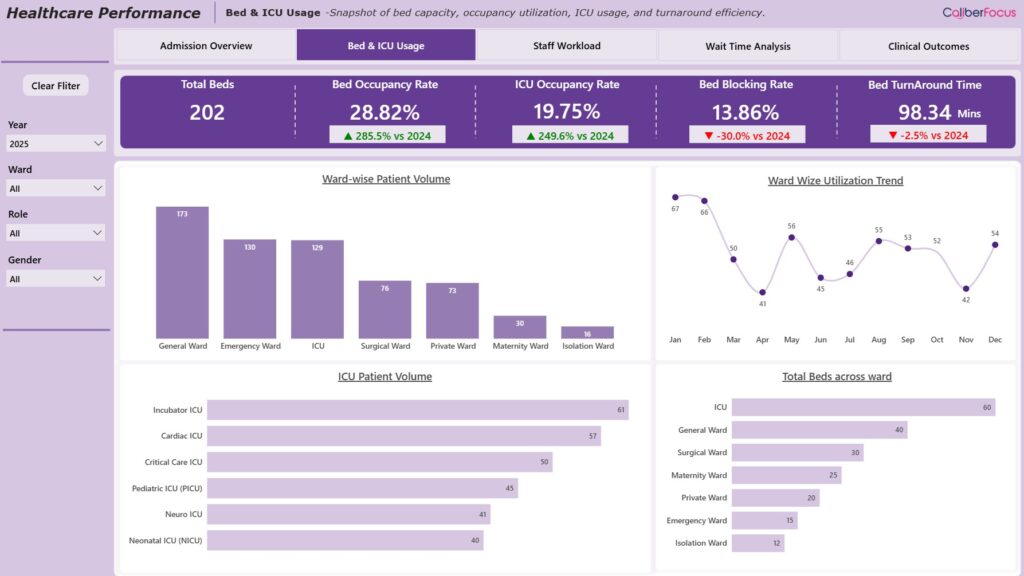
Clinical Dashboards
- Unit-level patient census and acuity mix
- Pending discharges and care progression indicators
- Real-time alerts for capacity or workflow constraints
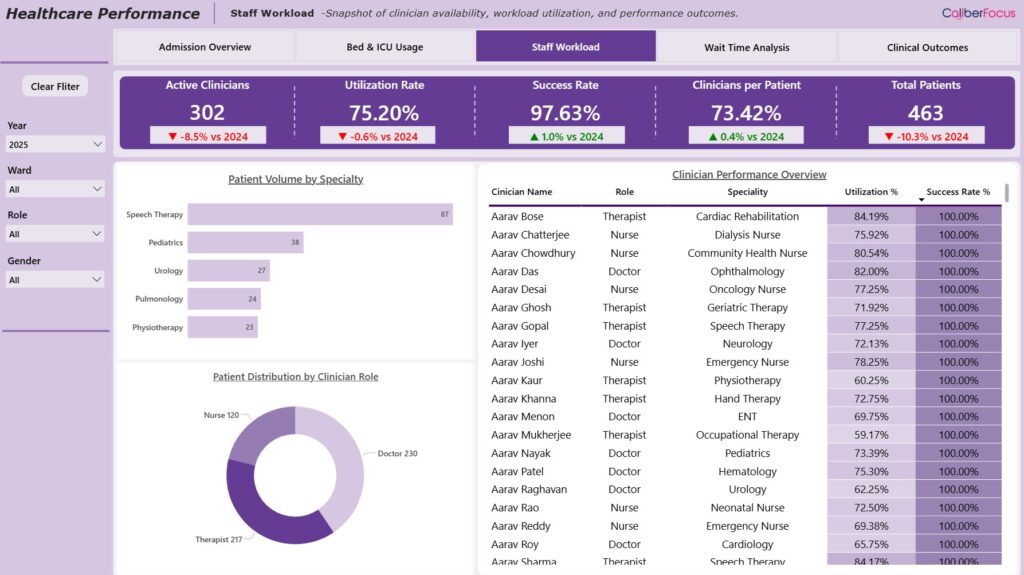
Dashboards were accessible via web and mobile, ensuring visibility across leadership, operations, and care teams.
Phase 3: Real-Time Alerts and Predictive Signals
CaliberFocus embedded predictive and prescriptive intelligence directly into dashboards:
- Early warnings for ED congestion and bed shortages
- Predictive discharge readiness based on historical patterns
- Staffing demand forecasts aligned to patient inflow trends
- Threshold-based alerts to prevent bottlenecks before escalation
This shifted hospital operations from reactive firefighting to proactive orchestration.
Phase 4: Pilot Deployment and Validation
CaliberFocus launched a controlled pilot across high-impact departments:
- Emergency Department
- Medical-Surgical Units
- Discharge Planning Teams
During the pilot, CaliberFocus worked closely with hospital leadership and frontline teams to validate data accuracy, refine dashboard usability, and align insights with real operational workflows.
Phase 5: Pilot Deployment and Validation
Following pilot success, dashboards were rolled out across the hospital network with:
- Role-based training programs
- Operational playbooks tied to dashboard insights
- Discharge Planning Teams
- Ongoing support and optimization
This ensured high adoption and sustained operational impact.
Results & Measurable Business Impact
The real-time operational intelligence initiative delivered significant improvements across clinical, operational, and financial performance.
Key Performance Improvements
Operational Intelligence, Not Just Visualization
Dashboards were designed to drive action, not display metrics. Every KPI was mapped to an operational decision or intervention.
Healthcare-Specific Data Modeling
CaliberFocus applied deep healthcare domain expertise to normalize and contextualize data, ensuring metrics reflected real clinical and operational realities.
Real-Time Architecture by Design
Unlike traditional batch reporting, the platform was built for near- real-time data ingestion and alerting, enabling minute-level decision-making.
Role-Aligned Experience
Executives, operators, and clinicians each received tailored views aligned to how they work—maximizing adoption and trust.
Scalable Foundation for AI
The architecture supports future expansion into predictive capacity planning, AI-driven staffing optimization, and clinical operations automation.
Technology Stack & Compliance
- Data Integration: Fabric Data Factory, Fabric RTI, Azure Health Data Services
- Data Platform: Microsoft Fabric (secure, HIPAA-compliant cloud environment)
- Visualization: Power BI with Copilot
- Security: Role-based access control, encryption, audit logging
- Compliance: HIPAA-aligned data governance and access policies
Strategic Value for Healthcare Leadership
This initiative transformed operational intelligence into a strategic capability, enabling the hospital network to:
- Respond dynamically to patient demand
- Optimize resources without compromising care quality
- Improve staff experience through better workload alignment
- Strengthen financial sustainability in a value-based care environment
Real-time dashboards became a command center for hospital operations, not just a reporting tool.
Conclusion
This case study demonstrates how real-time dashboards, when designed with operational intent and healthcare expertise, can fundamentally transform hospital performance. By partnering with CaliberFocus, the hospital network moved beyond fragmented reporting to a unified, predictive, and actionable operational intelligence platform.
As healthcare organizations face rising demand, staffing pressures, and cost constraints, real-time operational intelligence is no longer optional—it is foundational. CaliberFocus’s approach proves that with the right data architecture, domain expertise, and execution model, hospitals can achieve measurable improvements in efficiency, patient experience, and financial outcomes.
Ready to Build Real-Time Hospital Operational Intelligence?
Assess your hospital’s operational intelligence readiness with CaliberFocus. Unlock real-time visibility, predictive insight, and data-driven control across your healthcare operations.