

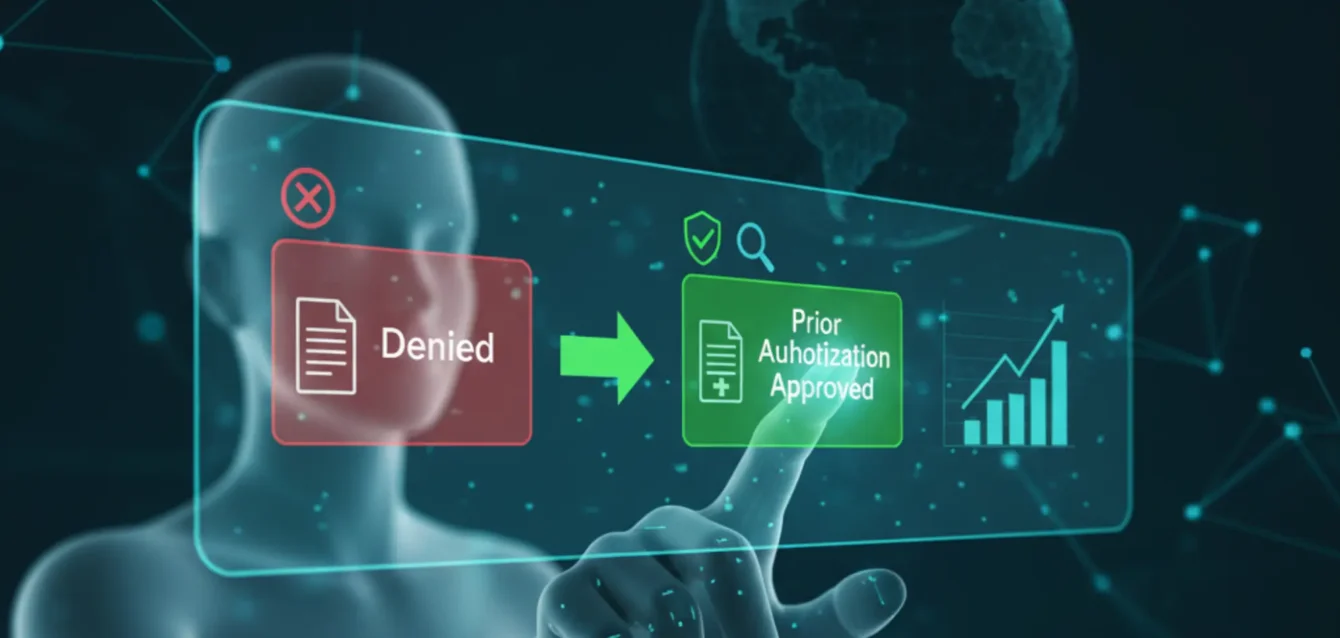
Prior authorization is no longer just an administrative step. It is an upstream control point that directly affects claim accuracy, denial rates, and revenue cycle performance.
Most delays and denials tied to prior authorization are caused by fragmented systems, manual rule interpretation, and slow adaptation to payer changes. These same issues have already pushed healthcare organizations to adopt autonomous AI agents across the revenue cycle, including medical coding, claims processing, and accounts receivable workflows.
Applying AI agents to prior authorization moves that intelligence earlier in the workflow. By enforcing payer rules, coordinating data across systems, and adapting to change in real time, AI agents reduce downstream denials and administrative rework before they occur.
The Real Problem With Prior Authorization And Why Automation Alone Isn’t Enough
Prior authorization has become one of the most persistent operational bottlenecks in healthcare revenue cycle management.
Most leaders already know the visible pain points: paperwork, slow approvals, frustrated clinicians, and burned-out staff. What’s often missed is the hidden operational drag that compounds over time:
- Clinical and administrative teams constantly switching between EHRs, payer portals, and internal systems
- High-value clinical time diverted to rule checking and documentation instead of patient care
- Approval delays quietly eroding patient trust, access to care, and downstream revenue
These issues aren’t caused by effort gaps. They’re caused by process complexity, payer variability, and under-automation, exactly where modern AI agents outperform traditional tools.
What Is a Prior Authorization AI Agent?
A Prior Authorization AI Agent is an autonomous system that manages authorization workflows across EHRs, payer portals, and internal revenue cycle systems. It plans, executes, and adapts tasks in real time, enforcing payer-specific rules while reducing the need for manual intervention.
Key Capabilities:
- Rule interpretation: Understands payer criteria and applies them consistently.
- Data validation: Checks clinical documentation before submission.
- Exception handling: Escalates only complex cases to human staff.
- Adaptive learning: Improves accuracy from approvals, denials, and resubmissions over time.
Unlike traditional automation, prior authorization AI doesn’t just move data faster. It reduces delays, prevents errors, and minimizes administrative rework.
Why It Matters:
- Financial impact: Fewer denials and faster approvals improve cash flow.
- Operational impact: Staff spend less time on repetitive tasks.
- Patient impact: Faster authorization accelerates care access.
In short, AI for prior authorization brings intelligence upstream in the revenue cycle. It makes better decisions at scale, ensuring that approvals are accurate, timely, and aligned with payer requirements.
Why AI Agents Matter Now
AI agents have moved beyond experimentation and are now critical in real-world RCM operations, addressing the most error-prone and time-intensive stages of prior authorization where human workflows frequently fail:
- Document collection and validation
- Payer-specific rule enforcement
- Submission sequencing and follow-ups
- Exception handling when cases fall outside standard criteria
What changed is not interest, it’s capability. Today’s AI agents:
- Operate continuously, not in batches
- Adapt when payer rules change
- Learn from denial feedback and resubmissions
This shift is why AI for prior authorization has moved from hype to infrastructure.
Why AI Agents Are Essential for Modern Prior Authorization
Prior authorization has become one of the most error-prone and time-intensive parts of revenue cycle management. AI agents are no longer experimental, they are actively transforming the workflow by handling tasks where human teams consistently face delays, errors, and inefficiencies.
In practice, AI agents address the highest-risk stages of prior authorization:
- Collecting and validating documents automatically
Gathers clinical and demographic data from EHRs and other systems, reducing missing or incomplete submissions. - Applying payer-specific rules consistently
Ensures each request meets payer criteria, lowering the risk of denials caused by manual mistakes. - Sequencing submissions and managing follow-ups
Coordinates multiple steps in authorization workflows so requests progress smoothly without human delays. - Handling exceptions intelligently
Flags only unusual or complex cases for human review, letting staff focus on high-value decisions.
Modern AI agents also learn from outcomes, adjusting to new payer rules and denial patterns. This combination of automation, intelligence, and adaptability is why AI for prior authorization has become a critical part of efficient, reliable revenue cycle operations.
Where Prior Authorization AI Agents Fit in the Workflow
A Prior Authorization AI Agent is most effective when integrated across the authorization workflow, not added as a last-minute tool. These agents tackle the steps where delays, errors, and manual inefficiencies most often occur, bringing intelligence and consistency upstream in the revenue cycle.
In practice, AI agents:
- Extract and validate clinical and demographic data from the EHR
Automatically gathers structured and unstructured information, ensuring complete submissions and reducing the risk of denials. This process leverages NLP in clinical documentation to interpret complex clinical notes.
- Apply payer-specific authorization rules before submission
Enforces rules consistently across all requests, minimizing errors and rework. Modern systems often combine retrieval-augmented techniques for dynamic policy interpretation.
- Assemble and submit complete authorization packages
Coordinates multi-step submissions automatically, preventing lost requests and ensuring compliance with payer protocols. This aligns closely with best practices in AI agents for claims processing.
- Monitor status and manage follow-ups autonomously
Keeps authorization requests on track by detecting delays, triggering reminders, and automatically escalating exceptions when needed.
- Route true exceptions to humans with context and recommendations
Only complex cases reach staff, who can focus on nuanced decision-making. This mirrors the approach in Agentic AI for Medical Coding, where AI handles scale and humans handle judgment.
By embedding Prior Authorization AI Agents across these workflow points, organizations reduce administrative burden, accelerate approvals, and improve downstream revenue cycle performance. AI handles repetitive and rule-heavy tasks, while humans focus on clinical and operational judgment.
Why RCM Leaders Are Investing in Prior Authorization AI Agents
Revenue cycle management teams are moving away from patchwork fixes and manual interventions toward end-to-end operational control using Prior Authorization AI Agents. These agents address the most error-prone parts of the workflow, providing structural improvements that go beyond incremental gains.
RCM decision-makers consistently report the following benefits and measurable outcomes:
- Faster Approvals and Reduced Bottlenecks
Automates data gathering, payer rule checks, and submission sequencing, cutting turnaround times by 30–50%, even in complex cases. - Lower Administrative Cost and Reduced Burnout
Offloads repetitive work, freeing teams to focus on problem-solving, patient communication, and high-value decisions, resulting in up to 40% reduction in manual workload. - Continuous Compliance With Changing Payer Rules
Monitors policy updates in real time, applies them consistently, and reduces preventable denials. This ensures workflows stay audit-ready and aligned with current payer requirements. - Actionable Visibility Across the Authorization Lifecycle
Built-in analytics highlight workflow bottlenecks, identify high-friction payers, and provide data-driven insights for proactive optimization. - Improved Patient and Clinician Experience
Faster, more accurate authorizations lead to quicker care access, higher patient satisfaction, and reduced clinician frustration. - Higher First-Pass Resolution Rates
Complete, accurate submissions decrease resubmissions and downstream claim denials, improving both revenue cycle efficiency and cash flow.
In short, Prior Authorization AI Agents are not just automating tasks, they are structurally transforming revenue cycle performance, delivering measurable financial, operational, and patient care impact.
Choosing the Right AI Agent Development Partner for Prior Authorization
Technology alone doesn’t determine success. Execution does.
When evaluating an AI agent development partner, RCM leaders should prioritize:
Proven Healthcare and RCM Experience
The AI agent development partner must understand clinical workflows, payer behavior, and revenue cycle realities, not just AI theory.
Deep Compliance and Integration Capability
Experience with HIPAA, CMS requirements, and major EHR and payer integrations is non-negotiable for any AI agent development partner operating in prior authorization.
Ability to Handle Non-Standard Cases
Real prior authorization workflows are messy. An effective AI agent development partner builds agents that adapt rather than fail when edge cases appear.
Ongoing Optimization and Support
AI agents improve through feedback. Continuous tuning from the AI agent development partner is essential for sustained ROI.
Demonstrated, Measurable ROI
A credible AI agent development partner provides evidence, case studies, metrics, and references, not promises.
Turn Prior Authorization Intelligence Into Measurable RCM Outcomes
Move prior authorization out of reactive mode and into a system that actually learns from outcomes.
How CaliberFocus Develops Custom AI Agents for Prior Authorization
CaliberFocus develops custom AI agents for prior authorization, designed around real-world healthcare revenue cycle workflows, payer variability, exception handling, and clinical-to-financial handoffs included.
Key differentiators include:
- Custom-built, modular AI agents tailored to each organization’s prior authorization workflows
- Deep, native integration across EHRs, RCM platforms, and payer portals
- Outcome-driven learning that improves accuracy based on real approval and denial results
- End-to-end performance analytics connecting agent activity to operational and financial impact
- Dedicated healthcare AI specialists focused on continuous optimization and payer adaptation
The objective isn’t automation volume. It’s building AI agents that reduce friction so care delivery and revenue move forward together.
How CaliberFocus Stands Out in AI Agents for Prior Authorization
CaliberFocus combines advanced autonomous AI platforms, cognitive automation, and deep healthcare expertise to transform prior authorization into a seamless, intelligent process. Leveraging its expertise in ai agent development services for RCM, CaliberFocus delivers tailored solutions that integrate smoothly with existing systems, enhancing accuracy, speed, and compliance. Their AI agents continuously learn and adapt to evolving payer requirements, providing end-to-end automation that reduces manual effort and accelerates approvals. With comprehensive analytics and dedicated support, CaliberFocus empowers healthcare organizations to optimize revenue cycles while improving patient outcomes and staff satisfaction.
Here’s how:
Flexible, Modular AI Architecture
Our AI agents are built on scalable, AI-first platforms that adapt to your unique workflows and expand across your entire organization, ensuring consistent performance at every level.
Seamless Integration Across Systems
We connect deeply with your EHR, revenue cycle management systems, and payer portals, reducing manual handoffs and streamlining data flow for faster, error-free approvals.
Adaptive Learning and Continuous Improvement
Rather than just automate fixed tasks, our agents learn from each interaction, handling exceptions and evolving based on outcomes to continually refine authorization accuracy and speed.
Comprehensive Analytics for Operational Insight
End-to-end data tracking powers real-time analytics that inform ongoing improvements in workflow efficiency, regulatory compliance, and payer negotiation strategies.
Dedicated Support from Healthcare AI Experts
Our teams provide real-time assistance and tailored optimization, ensuring every solution fits your clinical and operational needs without one-size-fits-all compromises.
With CaliberFocus, prior authorization is no longer a bottleneck but an intelligent, agile backbone that frees your teams to focus on delivering exceptional care and driving impactful business results.
Final Takeaway for RCM Leaders
Prior authorization doesn’t break down because teams lack effort. It breaks down because fragmented systems force manual decisions, inconsistent submissions, and reactive follow-up at scale.
AI agents address that structural problem. By coordinating data, applying payer-specific logic, and learning from real authorization outcomes, AI in prior authorization brings reliability to a process historically defined by variability.
For RCM leaders under pressure to reduce denials, protect revenue, and accelerate patient access, AI agents are no longer an efficiency upgrade. They are becoming core infrastructure, essential to operating a modern, resilient revenue cycle.
FAQs
A well-designed prior authorization AI agent does both. By learning from payer responses and historical outcomes, AI in prior authorization improves first-pass accuracy, which directly reduces denials, while also accelerating approval timelines.
Not when done correctly. AI for prior authorization is typically implemented in phases, integrating with existing EHR and RCM systems to support current workflows rather than replace them overnight.
Compliance is built into the agent. A prior authorization AI agent operates within HIPAA, CMS, and payer-specific rules, with ongoing updates and audit visibility to ensure regulatory alignment as requirements change.
ROI is measured through faster approval turnaround times, lower denial and rework rates, reduced administrative effort, and improved patient access, linking AI in prior authorization directly to financial and operational performance.