


If you lead a coding team or manage RCM operations, you’ve probably stared at a performance dashboard and felt something was off, but couldn’t point to exactly what.
The reports run. The numbers look stable. Yet denials keep coming, accuracy keeps shifting, and nobody can explain why.
That’s not a data problem. That’s a visibility problem. And it’s exactly where data analytics in healthcare is changing how RCM teams operate.
Mitigate Coding Risk Before It Reaches Your Payer
We help you to identifies denial risk, documentation gaps, and payer rule conflicts in real time before claims leave your system.
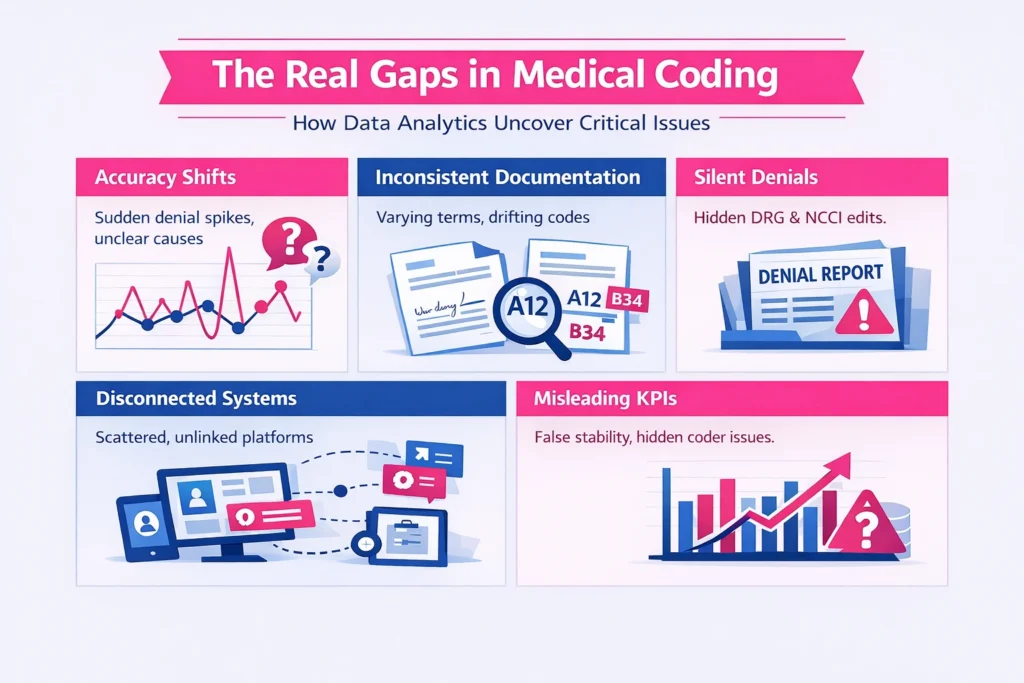
The Real Gaps Most Coding Teams Are Living With
Most leaders sense the problem before they can name it. Here’s what it looks like in practice:
- Accuracy shifts without explanation: a denial spike hits and no one can tell if it came from documentation variance, coder interpretation, or a payer rule change that went unnoticed.
- Inconsistent documentation: physician phrasing varies by encounter, coders interpret it differently, and codes drift without a clear audit trail.
- Silent denial patterns: DRG shifts, NCCI edits, and medical necessity flags accumulate quietly until they show up in a report nobody was watching.
- Disconnected systems: audit findings, query trends, and edit triggers scattered across platforms that don’t talk to each other.
- Misleading KPIs: performance indicators look stable while coder-level variation and query lag stay buried underneath.
By the time the monthly summary surfaces any of this, the financial damage has already compounded. That’s the core problem data analytics in medical coding is built to solve.
Why 71% of U.S. Hospitals Are Moving Toward Analytics
According to recent federal data briefs, 71% of U.S. hospitals reported using predictive AI in 2024. That’s not a trend. That’s a signal that manual oversight can no longer keep pace with the complexity of modern coding operations.
Medical coding sits at the intersection of clinical documentation, physician inputs, ICD-10-CM/PCS and CPT/HCPCS coding rules, payer-specific policies, NCCI edits, and constantly shifting coverage requirements. Understanding the four types of data analytics, descriptive, diagnostic, predictive, and prescriptive is the foundation for turning all of that complexity into decisions that actually move outcomes.
What Is Data Analytics in Medical Coding?
Data analytics in medical coding is the use of real-time, predictive, and prescriptive intelligence, applied to coding decisions, documentation patterns, payer rules, and workflow behavior, to improve accuracy, reduce denial risk, and protect revenue before claims leave the system.
It is not a dashboard. It is not a monthly audit. It is a continuous intelligence layer embedded inside coding workflows, surfacing the right information at the exact moment it can still change an outcome.
How Data Analytics Improves Medical Coding: 7 Operational Areas
1. Real-Time Coding Validation
Traditional coding review happens after submission. Real-time validation happens while the chart is still open, while the coder can still act.
Every diagnosis or procedure selected gets cross-checked against clinical context, encounter details, and historical coding patterns instantly. NCCI edits and bundling logic are applied automatically. Payer-specific rules, commercial, Medicare, Medicaid, surface at the point of selection, not in a denial letter three weeks later. Missing specificity around laterality, severity, stage, or operative technique gets flagged before it becomes a claim problem.
The result is stronger first-pass clean-claim rates and fewer corrections that nobody saw coming.
2. Dynamic Payer Rule Mapping
Payer rules change with little warning and almost never in one organized location. LCDs update. NCDs revise. Quarterly edit files arrive. Coverage PDFs conflict with portal notifications. Keeping up manually is nearly impossible, and the gaps that result turn directly into denials.
Analytics solves this by maintaining a continuously updated library of Local and National Coverage Determinations, government and commercial payer policies, code-specific frequency rules, medical-necessity requirements, and bundling logic. Instead of a coder hunting through outdated manuals, the current applicable rule surfaces inside the workflow at the exact moment the coding decision is being made.
3. Documentation Gap Detection
Incomplete documentation is the most persistent root cause of coding errors and medical-necessity denials. That’s not a new observation. What analytics changes is when you catch it.
Instead of relying entirely on coder judgment, analytics reviews each chart and surfaces specific concerns before submission, missing severity or specificity that affects code assignment, inconsistent language across notes, clinical indicators that don’t fully support the billed service, ambiguous terminology payers routinely challenge, and procedure details that affect modifier selection.
Think of it as a built-in second reviewer that says: “Here’s what needs clarification and here’s exactly why this payer will flag it.”
For coders, fewer back-and-forth queries. For CDI teams, more predictable documentation quality. For RCM leaders, documentation-related denials that shrink measurably over time.
4. Predictive Denial Prevention
Most denial management is built to respond after a denial arrives. Medical coding analytics for denial prevention breaks that cycle by identifying risk before submission.
Predictive models evaluate historical denial behavior across payers, specialties, diagnoses, and procedures, including patterns that repeat across quarters without ever appearing in standard reports. They flag code combinations known to trigger NCCI conflicts, surface documentation gaps that routinely cause medical-record requests, and apply payer-specific medical-necessity logic at the pre-bill stage.
The difference is simple. Predictive catches a problem that costs nothing to fix. Reactive catches it after appeal, rework, and 30 additional days in AR.
5. Coder Workflow and Productivity Intelligence
Analytics gives leaders a factual view of how operations actually run, not how they appear in monthly summaries.
It reveals turnaround delays broken down by code type, specialty, or payer. It surfaces bottlenecks tied to specific procedure types or documentation complexity. It identifies recurring error patterns that drive rework across coders or service lines. It shows where workload volume sits versus where complexity actually sits, two things that rarely align without data.
With that visibility, managers can assign charts based on demonstrated coder strength, target training at specific code categories, and build throughput models that reflect reality instead of estimates.
6. Built-In Compliance and Audit-Readiness
Compliance is where analytics delivers some of its most measurable and immediate value.
Every coding decision becomes traceable, which documentation was reviewed, what clinical indicators supported the code, which payer policies or NCCI/LCD-NCD rules applied, why a specific alert fired, and how coder actions aligned with regulatory guidelines. When auditors arrive, the information is already organized. No reconstruction needed. No scramble for rationale. Just defensible, documented decisions ready for review.
7. Rework Reduction at the Source
Rework is never random. It’s a pattern and patterns are solvable once you can see them.
Analytics typically surfaces the same drivers repeatedly: missing laterality in orthopedics, incomplete staging in oncology, insufficient device-type specificity in cardiology, documentation that doesn’t support the E/M level billed, and modifier application that doesn’t account for payer-specific rules.
Once visible, the fix is targeted, not a sweeping policy change that disrupts everyone. The volume of preventable corrections drops. The team’s time shifts toward decisions that actually require clinical judgment.
What Improves Downstream When Coding Gets Better
Coding accuracy doesn’t stay contained to the coding department. Patient access and registration analytics strengthens documentation at the front end. Coding analytics catches what slips through. Together they remove the compounding errors that create claim-level problems downstream.
Claims bypass avoidable edits and reach adjudication faster. AR teams spend less time chasing preventable follow-ups. Denial management shifts from volume firefighting to targeted intervention. Payment timelines stabilize. Operational teams redirect capacity from rework to improvement. Cash flow becomes more predictable and the revenue cycle starts functioning like a system instead of a series of individual recoveries.
Reactive vs. Predictive: The Only Comparison That Matters
Most RCM teams are still operating in reactive mode. Here’s what that actually costs versus what predictive analytics makes possible:
| Reactive Denial Management | Predictive Denial Prevention | |
| When it acts | After denial received | During coding, pre-submission |
| Cost to fix | Appeal time + AR delay + rework | Minimal caught before submission |
| What it addresses | The symptom | The root cause |
| Long-term outcome | Denial rate stays elevated | Clean-claim rate improves over time |
| Team impact | Constant rework cycle | More time on high-value decisions |
This is the shift data analytics in medical coding makes possible and why organizations that adopt it stop chasing denials and start preventing them.
How to Choose the Right Medical Coding Analytics Partner
This is a strategic decision, not a software procurement. The wrong partner creates misleading outputs and misleading analytics is often worse than no analytics at all.
The right partner demonstrates deep fluency in ICD-10-CM/PCS, CPT/HCPCS, NCCI edits, and LCD/NCD frameworks, not general data expertise applied to healthcare. They deliver real-time alerts inside coding workflows, not post-submission reports. They integrate cleanly with your EHR, encoder, billing engine, and audit systems without requiring manual exports or separate logins. Their predictive models explain why a claim was flagged in coding language a coder can act on, not a black-box risk score nobody understands. And they scale with you as coding volumes grow, service lines expand, and payer rules evolve.
One rule: if a vendor can’t explain why their system flagged a specific claim in plain coding language, walk away.
Scale Faster with Intelligent Data Analytics
Unified data from 2.4M+ annual patient encounters into a single decision-making layer for regional multi-hospital
How CaliberFocus Delivers Data Analytics in Medical Coding
Manual reviews and retrospective audits aren’t enough anymore. Modern RCM requires intelligence that operates continuously, inside workflows, not outside them.
CaliberFocus is built specifically for coding and revenue cycle operations. Not a general analytics platform adapted for healthcare. A purpose-built capability designed around how coding teams actually operate, the payer complexity they navigate, the documentation variance they encounter, the financial accountability they carry.
Our medical coding analytics platform embeds real-time quality indicators and documentation alerts directly into coding workflows, no separate tool to check, no report to wait for. Predictive denial signals surface high-risk claims before submission with specific guidance on what to correct and why. Compliance validation runs continuously against NCCI edits, ICD-10-CM/PCS guidelines, CMS coverage policies, and payer-specific LCD/NCD requirements. Coder-level productivity intelligence helps leaders distribute work intelligently and target training where it actually matters. And every coding decision is logged with documentation reviewed, rules applied, and actions taken, creating a defensible audit trail without retrospective reconstruction.
Where CaliberFocus differs from general vendors is domain depth. Data analytics in healthcare only delivers value when it’s embedded into workflows, not delivered as a report someone has to interpret after the fact. Our team understands how coding decisions translate into financial risk, how payer behavior shifts affect denial rates, and what it takes to build a coding operation that improves compoundingly over time.
The result: fewer denials, stronger revenue integrity, and a coding operation that gets measurably better with every claim processed.
Frequently Asked Questions
It’s the real-time, predictive, and prescriptive use of clinical, coding, and payer data to improve code accuracy and reduce denial risk, applied at the point of coding, before claims reach the payer.
By identifying historical denial patterns by payer, specialty, and code type, and surfacing those risk signals during coding, not after submission. Teams correct high-risk elements before a claim goes out.
Yes. Insights come into the workflow, coders don’t go looking for them. Charts are prioritized by complexity and risk. Throughput improves without adding steps or tools.
Every coding decision is logged with documentation reviewed, rules applied, and logic explained. Internal reviews and external audits become faster and less disruptive, everything is already organized and traceable.
General analytics tracks outcomes, denial rates, AR aging, revenue trends. Medical coding analytics operates at the CPT, ICD-10, modifier, and payer-rule level, where financial risk is actually created, not just reported.