


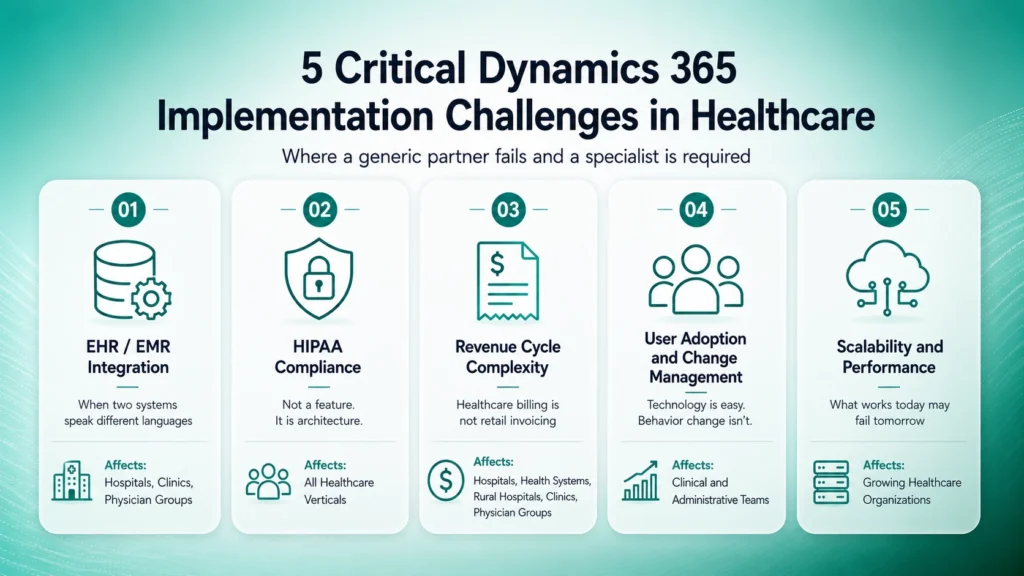
Healthcare is one of the most operationally complex environments in the world. Multiple payers, strict regulatory mandates, legacy clinical systems, and a workforce under constant pressure, the benefits of Microsoft Dynamics 365 can only be realized in this environment with a specialized partner. Without one, it isn’t transformation. It’s risk. It’s risk.
Below are the five most critical implementation challenges healthcare organizations face, across hospitals, RCM companies, billing firms, physician groups, and clinics, and how a Dynamics 365 partner with deep healthcare expertise navigates each one.
Implement Dynamics 365. The Right Way.
If you’re implementing Dynamics 365 and want a partner with both the Microsoft technical depth and healthcare operational fluency to do it right.
Top Challenges in Healthcare While Implementing Dynamics 365
| # | Challenge | Who It Hits Most |
| 01 | EHR/EMR Integration: When Two Systems Speak Different Languages | Hospitals, Clinics, Physicians |
| 02 | HIPAA Compliance: It’s Not a Feature. It’s Architecture. | All Healthcare Verticals |
| 03 | Revenue Cycle Complexity: Healthcare Billing Is Not Retail Invoicing | RCM, Billing Companies, Hospitals |
| 04 | Staff Adoption in High-Pressure Clinical Environments | Physician Practices, Clinics, Ambulatory Care |
| 05 | Multi-Entity Financial Management in Complex Healthcare Structures | Hospital Networks, MSOs, Multi-Specialty Groups |
Let’s break down each challenge, and more importantly, what it takes to get it right.
#1: EHR/EMR Integration: When Two Systems Speak Different Languages
Affects: Hospitals Clinics Physician Groups
Dynamics 365 isn’t an EHR, it’s the operational and financial brain.
But making it communicate cleanly with Epic, Cerner, or Athenahealth is where most implementations hit their first wall.
Clinical data lives in HL7/FHIR structures. Dynamics 365 is not natively wired for those standards. A generic partner treats this like a routine API project. In healthcare, it isn’t. A misstep creates data duplication, billing mismatches, and gaps in care coordination, simultaneously.
What breaks without the right approach:
- Patient scheduling data in the EHR doesn’t sync with Dynamics 365 billing workflows → charges get missed or posted late
- Duplicate patient records split between the EHR and Dynamics 365 erode staff confidence in both systems
- Care coordination breaks down when Dynamics 365 shows a patient as scheduled or discharged while the EHR reflects a different status, leading to billing errors, follow-up gaps, and miscommunication between clinical and administrative teams
#2: HIPAA Compliance: It’s Not a Feature. It’s Architecture.
Affects: Hospitals RCM Billing Companies Physicians Clinics
Dynamics 365 is built on Azure, secure at the infrastructure level. But HIPAA compliance doesn’t come switched on.
Every workflow automation, every Power Automate flow, every custom field, every third-party connector is a potential exposure point if not scoped with PHI handling in mind.
Billing companies carry the steepest risk. They process PHI across multiple client organizations, each governed by separate Business Associate Agreements. One misconfigured access setting can expose data across client environments, and one billing company’s compliance failure is a cascading event that hits every client they serve.
The gaps standard D365 configurations miss:
- Field-level and record-level security not aligned to the minimum-necessary standard
- Audit trails that exist but aren’t configured to surface the right events
- Role-based access that doesn’t account for multi-client PHI segmentation
- Third-party connectors added post-go-live with no BAA review
This is why Microsoft Dynamics 365 for healthcare RCM and patient outcomes goes far beyond finance configuration, it’s a full revenue cycle transformation.
#3: Revenue Cycle Complexity: Healthcare Billing Is Not Retail Invoicing
Affects: RCM Companies Billing Firms Hospitals
Claim submissions follow payer-specific rule sets. Denials arrive weeks later with codes requiring human interpretation. Prior authorization requirements differ by payer, CPT code, and patient plan. ICD-10 documentation errors don’t surface until a remittance comes back short.
Organizations that force-fit a standard Dynamics 365 Finance deployment onto an RCM workflow end up in one of two places: over-customizing until the system becomes a maintenance nightmare, or accepting that Dynamics 365 only handles the back-end of a process that already broke upstream.
The downstream damage:
- Billing staff compensating in spreadsheets outside the system
- AR aging reports that don’t reconcile with payer portals
- Denial rates that don’t improve because the root cause isn’t being captured
#4: Staff Adoption in High-Pressure Clinical Environments
Affects: Physician Practices Clinics Ambulatory Care
Physicians don’t want a new platform. Billing coordinators already have a workflow. Front desk staff learned one system and they’re comfortable in it. A Dynamics 365 go-live, regardless of how well it’s configured, lands as disruption first and benefit later.
In healthcare, that window between go-live and productivity recovery is where patient care and revenue both suffer. The deeper issue: most Dynamics 365 implementations are scoped by IT, not by the clinical and administrative staff who will actually live in the system daily.
Signs a rollout is headed for adoption failure:
- Training scheduled in long blocks that pull clinicians off the floor
- Dashboards built for the system administrator, not the billing coordinator
- Automation that works in testing but breaks during a busy clinic afternoon
- Resistance from a senior physician that hardens into department-wide rejection
#5: Multi-Entity Financial Management in Complex Healthcare Structures
Affects: Hospital Networks MSOs Multi-Specialty Groups Large Billing Companies
Healthcare organizations rarely operate as single legal entities. A hospital network might include the hospital, a physician practice management company, an MSO, a real estate holding entity, and several employed physician groups, each with its own tax ID, cost center, and compliance obligation.
Consolidating financials in Dynamics 365 requires more than enabling a multi-company module. Healthcare’s intercompany complexity is layered with Stark Law, Anti-Kickback Statute exposure, and Medicare cost reporting requirements, all of which need entity-level audit trails baked into the configuration from day one. For hospital networks and MSOs evaluating platforms, the competitive edge of Microsoft Dynamics 365 in ERP lies in its ability to handle multi-entity complexity without replatforming.
Where multi-entity implementations go wrong:
- Consolidation models that satisfy the accountant but fail during regulatory review
- Physician compensation structures that create Stark exposure because contract terms aren’t enforced by the system
- Intercompany transactions recorded inconsistently across entities
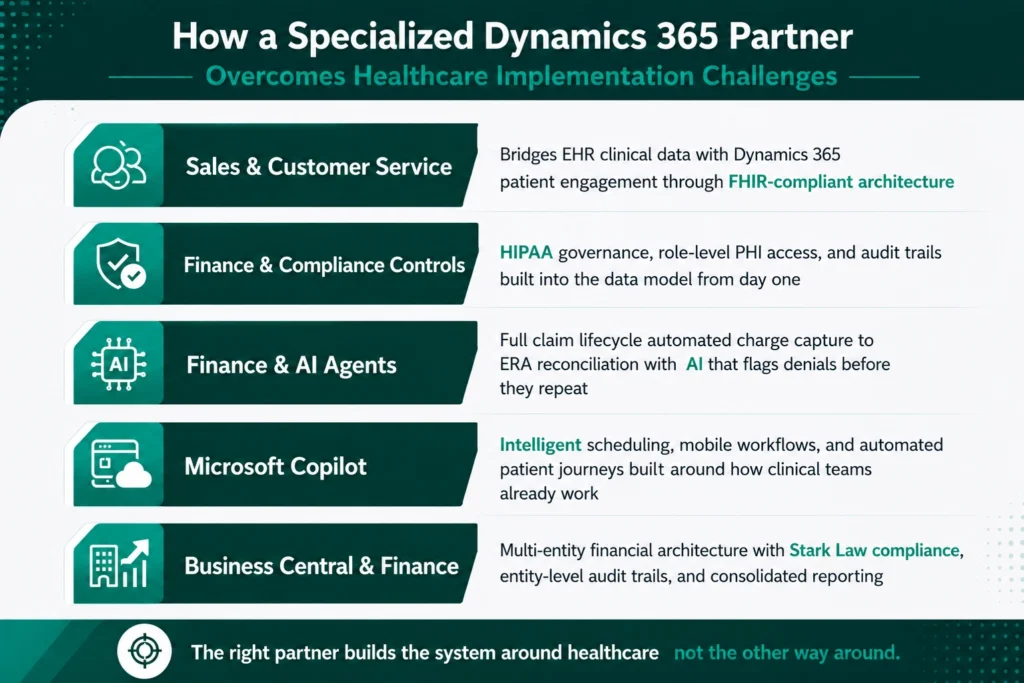
How a Specialized Dynamics 365 Partner Overcomes These Challenges
The technology isn’t the variable. The partner is. A generic system integrator sees five configuration projects. A healthcare-specialized Dynamics 365 partner sees five clinical, financial, and regulatory realities that each demand a different approach.
Sales & Customer Service: Building the Patient Engagement Layer EHRs Were Never Designed For
The EHR owns the clinical record. Dynamics 365 owns everything around it, referral pipelines, patient outreach, case management, scheduling coordination. The right partner doesn’t try to merge these two worlds. They build a clean operational layer on top of D365 Sales and Customer Service, Copilot-first, FHIR-compliant, connected to the EHR through structured integration architecture, so clinical data informs operational decisions without either system overwriting the other.
The outcome isn’t just a working integration. It’s a unified patient engagement model that the EHR was never designed to deliver.
Finance & Compliance Controls: Configuring HIPAA Governance Into the Data Model, Not Onto It
Three things a specialized partner does that a generic one doesn’t:
- Builds compliance into the data model from day one, field-level security, record-level access, and audit trail architecture configured before the first user logs in, not patched in after go-live
- Applies minimum-necessary standards at the role level, so a billing coordinator at a multi-client firm sees exactly what their BAA permits, nothing more
- Treats PHI governance with the same rigor as financial compliance, the same AI-driven anomaly detection and smart controls used for SOX and GAAP, applied to protected health information
Finance & AI Agents: Automating the Full Revenue Cycle From Charge Capture to ERA Reconciliation
Most D365 Finance implementations are built for accounts receivable. RCM is not accounts receivable.
A partner who understands this maps the full claim lifecycle into Dynamics 365, from charge capture through ERA reconciliation, using agentic finance automation that doesn’t just process transactions but learns from them. Denial patterns get flagged before they repeat. Resubmissions get automated. Payer performance surfaces in real-time dashboards that billing directors can actually act on.
And for the billing coordinator who just needs to know where a claim stands? Natural language AI agents answer that in seconds, no report, no filter, no waiting.
Microsoft Copilot in Dynamics 365: Reducing Clinical Staff Friction Without Changing How Teams Work
This one isn’t solved by better training decks. It’s solved by better design decisions made before go-live.
A partner who has deployed Copilot-first field service and mobility solutions understands one thing about clinical environments: the system has to work around how people already operate, not the other way around. That means intelligent scheduling that reduces clicks, not adds them. Mobile-accessible workflows that travel with the care team. Automated patient journey touchpoints that happen in the background, so the front desk coordinator isn’t the one chasing follow-ups manually.
When the system fits the workflow, adoption isn’t a change management problem. It stops being a conversation.
Business Central & Finance: Multi-Entity Financial Architecture Built for Healthcare’s Regulatory Reality
| What’s needed | What a specialized partner configures |
| Stark Law-aware compensation tracking | Physician contract terms enforced at the transaction level in D365 |
| Entity-level audit trails | Cost center structure mapped to each legal entity, not the consolidated org |
| Intercompany transaction accuracy | Business Central intercompany flows configured and reconciled across MSO, hospital, and physician group entities |
| Regulatory-ready reporting | Consolidated dashboards that separate legal entities for compliance while presenting a unified view to leadership |
Manual consolidation doesn’t just waste time. Under audit pressure, it breaks. The right partner builds a financial architecture that holds, at the entity level and the enterprise level simultaneously.
How to Choose the Right Dynamics 365 Partner for Healthcare
Not every Dynamics 365 partner is built for healthcare. Before you sign an implementation contract, here’s what to validate:
| What to Look For | Why It Matters in Healthcare |
| Proven experience with Sales & Customer Service for patient engagement | Healthcare CRM isn’t standard sales pipeline management, your partner should understand referral workflows, omnichannel patient outreach, and AI-driven case management |
| Finance & RCM automation expertise | If they can’t map a claim lifecycle from charge capture to ERA reconciliation, they’re not an RCM partner, they’re a finance configurator |
| Field Service & mobility deployment track record | Clinical and care teams work on the move, a partner without Copilot-powered mobility and intelligent scheduling experience will slow your teams down, not speed them up |
| Business Central for multi-entity healthcare structures | SMBs, MSOs, and multi-location groups need unified financials with natural language AI, not a generic ERP setup that ignores your entity complexity |
| Marketing Automation & patient journey configuration | Patient retention and care coordination depend on targeted, automated outreach, your partner should know how to build those journeys, not just turn the module on |
| Project Operations discipline for phased go-lives | Healthcare implementations are never single-phase. A partner who manages delivery through D365 Project Operations brings accountability and real-time visibility to your go-live timeline |
Healthcare doesn’t need a Dynamics 365 vendor. It needs a partner who knows the difference between a claim and an invoice, between a patient and a customer, and between going live and actually transforming.
Why CaliberFocus Is a Unique Microsoft Dynamics 365 Partner for Healthcare
Healthcare implementations don’t fail because of the technology, they fail because the partner didn’t understand the environment. CaliberFocus sits at the intersection of deep Microsoft Dynamics 365 services expertise and real healthcare operational knowledge, making it one of the few partners that can deliver both without compromise.
Across the full Microsoft Dynamics 365 services stack, Sales, Customer Service, Finance, Supply Chain, Business Central, Field Service, Marketing, and Project Operations, CaliberFocus brings implementations that are architected around healthcare’s specific realities: HIPAA-compliant data models, EHR integration frameworks, RCM automation, multi-entity financial structures, and Copilot-first experiences designed for clinical environments.
What makes CaliberFocus different isn’t the certifications. It’s the ability to walk into a hospital network, an RCM firm, a physician group, or a multi-location clinic, and know exactly where Dynamics 365 needs to be configured differently than every other industry.
That’s not a capability. That’s a specialization.
Don’t take our word for it
We helped a U.S. healthcare network unify billing, scheduling, and finance with Dynamics 365
Frequently Asked Questions
Yes, through FHIR-compliant APIs and Azure integration architecture, Dynamics 365 can connect with Epic, Cerner, and Athenahealth for operational and financial data exchange without disrupting the clinical system of record.
Not by default. HIPAA compliance requires deliberate configuration, field-level security, audit trails, role-based access, and PHI governance built into the data model. Microsoft provides the compliant infrastructure; the partner is responsible for the implementation layer.
It depends on scope and verticals involved. A single-module deployment for a physician group can take 8–12 weeks. A multi-entity hospital network rollout with EHR integration and RCM automation typically runs 6–12 months in phased go-lives.