

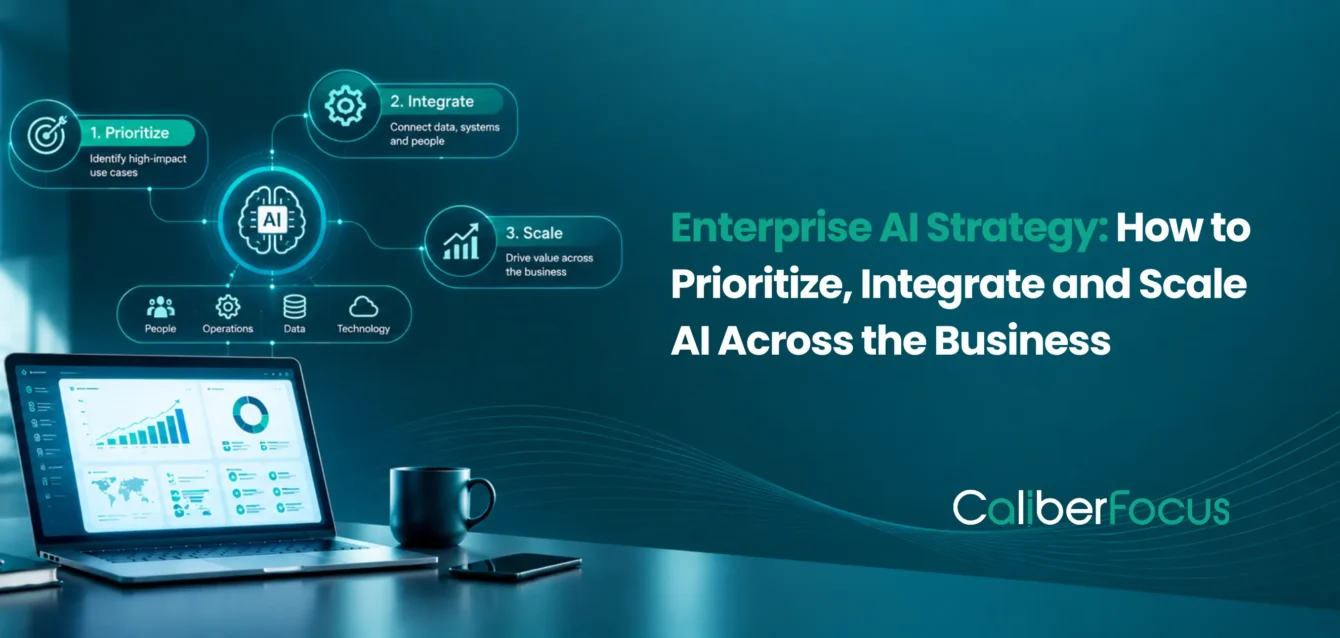
An enterprise AI strategy gives leadership a way to decide where AI deserves investment, how individual initiatives fit broader business priorities, and what the organization needs to implement and scale AI with control. It is not a catalog of AI use cases or a technology plan. It is the decision framework connecting business value, investment priorities, enterprise capabilities, governance, execution, and measurable outcomes.
For enterprises already investing in AI, the strategy should answer five questions early:
- Where should we invest? Identify AI opportunities tied to meaningful business priorities.
- What should we prioritize? Compare use cases by expected value, feasibility, risk, readiness, and strategic importance.
- What are we missing? Determine whether data, architecture, infrastructure, skills, governance, or ownership could limit execution.
- How should we execute? Establish the AI operating model, implementation priorities, accountability, and roadmap.
- What should we scale? Measure whether initiatives create the expected business value before expanding investment.
For organizations that need to connect these decisions into a practical enterprise plan, AI Strategy and Consulting Services can help structure use-case prioritization, readiness, governance, roadmap development, and implementation planning around business objectives. Pasted markdown
Enterprise AI Strategy in One View
The purpose is not simply to increase AI adoption. A strong AI strategy framework helps the enterprise make better decisions about what AI should support, what capabilities need to be established, how investment should progress, and where AI can contribute enough business value to justify further implementation.
Too Many AI Priorities and No Clear Investment Order?
Bring the initiatives already on the table. We’ll help you determine what deserves attention first and where the biggest strategy gaps sit.
Enterprise AI Strategy at a Glance
What Is an Enterprise AI Strategy?
An enterprise AI strategy defines how a business will use the right forms of AI to improve how work gets done, from simplifying repetitive tasks to supporting complex decisions and coordinating work across functions and systems. The strategy starts with the nature of the business and its operational priorities, then determines where AI can create enough value to justify investment.
That does not mean applying the same AI approach everywhere. Different business needs call for different capabilities:
| Business requirement | AI approach | What it is used for in the business |
| Forecast future outcomes from historical and operational data | Machine learning and predictive AI | Forecast demand, predict equipment failure, estimate risk, detect anomalies, prioritize cases, or anticipate customer behavior. |
| Turn large volumes of text and documents into usable information | Generative AI | Summarize reports, interpret documents, draft responses, compare information, and generate content from business context. |
| Answer questions using internal enterprise information | Generative AI with RAG | Retrieve relevant policies, procedures, product information, technical documentation, or other approved knowledge and use it to support contextual responses. |
| Process repetitive work with defined rules and AI-assisted decisions | AI with workflow automation | Classify incoming requests, extract required information, apply workflow rules, route work, update systems, and escalate exceptions. |
| Carry out multi-step work across applications and decision points | AI agents and agentic AI | Gather information, determine next actions, interact with approved systems, execute permitted tasks, and route exceptions for human review. |
| Interpret images or video as part of operations | Computer vision | Detect defects, inspect products, identify objects, monitor equipment or environments, and extract information from visual inputs. |
The strategic decision is therefore not “Which AI technology should we adopt?” It is “What does the business need AI to do, where in the operation should it happen, and which AI approach can perform that role with the required reliability and control?”
Why Enterprises Need an AI Strategy Even If They Already Use AI
Many enterprises already have AI in production, in pilots, or embedded within the software their teams use. The challenge is that individual AI initiatives can move forward without a common direction for investment, architecture, governance, ownership, and value measurement.
An enterprise AI strategy brings those decisions together so AI adoption can progress as an enterprise capability rather than a collection of independent projects.
AI Use Cases Can Grow Independently
Business functions often adopt AI based on their immediate priorities. Customer service may introduce conversational AI, finance may evaluate forecasting models, operations may automate document-heavy activities, and IT may experiment with AI agents.
Each initiative can make sense on its own. The problem appears when several teams independently require the same enterprise data, knowledge sources, integrations, model access, security controls, and governance.
Use Case:
Customer service builds a generative AI assistant using product documentation and customer information. Months later, sales develops another assistant that needs much of the same knowledge. Both teams create separate retrieval mechanisms, integrations, access controls, evaluation processes, and governance requirements.
The business now has two useful AI initiatives, but it is solving many of the same enterprise problems twice.
Strategic implication:
An enterprise AI strategy provides a portfolio view of AI adoption. Leadership can determine which capabilities should remain use-case specific and which should become shared enterprise foundations that support multiple AI initiatives.
Successful Pilots May Still Be Difficult to Scale
A successful pilot answers an important question: can AI perform the intended task? Scaling introduces another question: can the enterprise support that capability consistently across the environments where it needs to operate?
Production AI may depend on data availability, integrations, security controls, infrastructure, monitoring, user adoption, ownership, and operating standards that were not fully tested during a limited pilot.
Use Case:
A manufacturer pilots predictive maintenance on one production line and successfully identifies equipment conditions associated with potential failures. Leadership then wants to extend the capability across several plants.
The expansion exposes differences in machinery, sensor coverage, data formats, maintenance systems, historical data quality, and operating practices. The predictive model may have demonstrated value on the original line, but scaling it now requires broader data, integration, architecture, and operational decisions.
These AI implementation challenges become more visible as enterprises move from controlled experiments into production.
Strategic implication:
Enterprise AI strategy needs to evaluate scalability before a successful pilot automatically becomes the next major investment. The question is not only whether the AI works, but whether the organization can support it repeatedly and economically at the required scale.
AI Can Be Added Without Fixing the Underlying Process
AI can improve an individual task while leaving the larger process almost unchanged. This is particularly important when organizations introduce generative AI or automation into processes that already contain unnecessary handoffs, duplicate activities, disconnected applications, or manual exception handling.
Use Case:
A finance team introduces generative AI to extract and summarize information from invoices and supporting documents. Employees spend less time reviewing each document.
But the next stages remain unchanged. Information is manually entered into another system, approvals move through email, employees check payment status separately, and exceptions require manual follow-up across teams.
AI made document review faster, but the surrounding process continues to create delays.
Strategic implication:
The enterprise needs to determine the appropriate role for AI. Some activities need an AI assistant. Others may benefit from predictive models, automation, or AI agents capable of coordinating actions across multiple systems. In some cases, the process itself needs redesign before additional AI creates meaningful value.
AI Investment Can Grow Faster Than Business Value
As AI adoption expands, the number of pilots, tools, models, assistants, and automation initiatives can become a poor indicator of progress.
Leadership eventually needs to know which investments are changing business performance and which are primarily demonstrating technical capability.
Use Case:
An enterprise has AI initiatives across finance, customer service, operations, HR, and IT. Usage dashboards show that employees are actively using several of them.
Yet leadership cannot clearly determine whether those initiatives have shortened cycle times, reduced operating effort, improved service levels, lowered risk, increased capacity, or contributed to revenue. Adoption can be measured, but the connection to business value remains unclear.
This makes the next funding decision difficult. A heavily used AI application is not necessarily the initiative that deserves the greatest investment.
Strategic implication:
An enterprise AI strategy establishes expected outcomes and measurement criteria before implementation. Leadership can then compare investment against business impact and make evidence-based decisions about what to scale, redesign, consolidate, or stop.
Where Should Enterprises Look for AI Opportunities?
Once the enterprise has established why it needs a coordinated AI strategy, the next decision is where AI can create enough business impact to deserve investment.
Rather than reviewing every process and asking whether AI can be added, leadership can look for recurring business conditions where AI has a distinct role.
| Look for | What is happening in the business | Where AI may contribute | Typical opportunities |
| High manual effort at scale | Teams repeatedly process, classify, review, route, or reconcile large volumes of transactions or documents. | AI can interpret unstructured inputs, identify exceptions, classify work, or support decisions while conventional automation handles deterministic steps. | Invoice processing, claims review, order operations, service request triage, document processing |
| Knowledge is available but difficult to use | Employees search across policies, documents, systems, prior cases, or technical information before they can respond or act. | Generative AI and retrieval-based approaches can bring relevant enterprise knowledge into the context of the task. | Policy interpretation, technical support, internal knowledge access, case research, document comparison |
| Decisions depend on patterns in data | Teams rely on historical and operational information to forecast, prioritize, identify risk, or determine the next action. | Predictive AI and machine learning can identify patterns that support earlier or more consistent decisions. | Demand forecasting, risk scoring, anomaly detection, predictive maintenance, resource planning |
| Work crosses multiple systems and actions | Completing an outcome requires gathering information, making decisions, updating applications, triggering actions, and managing exceptions. | AI agents can potentially coordinate approved actions across systems while human controls remain at defined decision points. | Customer service resolution, operational exception management, procurement activities, IT service workflows |
Not Every Opportunity Requires More AI
Identifying an operational problem does not automatically make it an AI use case.
A repetitive task governed by fixed rules may be better suited to conventional automation. A knowledge-heavy activity may call for enterprise generative AI, while a multi-step activity involving decisions and system actions may require a combination of AI, automation, integrations, and human oversight.
The distinction between AI and automation becomes important here because the objective is not to maximize the number of AI use cases. It is to determine where AI performs a role that existing process logic, software, or automation cannot address effectively on its own.
From Opportunity to Strategy
Finding a potential use case is only the first filter. Before it enters the enterprise AI roadmap, leadership still needs to determine:
Business significance → AI fit → Expected outcome → Data and system readiness → Risk and control requirements → Investment priority
This moves the strategy from “Where could we use AI?” to the more consequential question: “Which AI opportunities are important enough and ready enough to pursue?”
Where Enterprise AI Priorities Change by Industry
An enterprise AI strategy cannot assign the same priorities to every industry. The underlying AI capabilities may be similar, but the business problem, available data, systems involved, acceptable level of autonomy, risk exposure, and expected return can be very different.
| Industry | Strategic AI priorities | Where AI can contribute | What shapes the strategy |
| Manufacturing | Production reliability, quality, planning, engineering knowledge, supply chain performance | Predictive maintenance, visual inspection, production forecasting, engineering knowledge access, procurement intelligence | Equipment and plant differences, OT and IT integration, sensor availability, operational continuity |
| Healthcare and life sciences | Administrative efficiency, revenue performance, knowledge access, documentation, research support | Revenue cycle intelligence, document processing, enterprise knowledge retrieval, workforce support, research workflows | Sensitive data, privacy and security requirements, human oversight, regulatory and clinical context |
| Banking and financial services | Risk, fraud, compliance, operational efficiency, customer service | Fraud detection, risk analysis, document intelligence, forecasting, service automation | Explainability, data controls, auditability, regulatory requirements, model risk |
| Retail and ecommerce | Demand, inventory, merchandising, customer experience, product operations | Demand forecasting, inventory optimization, product information, personalization, customer support | Transaction volumes, changing demand, customer data, real-time decision requirements |
| Logistics and supply chain | Capacity, routing, visibility, exception management, warehouse productivity | Demand and capacity forecasting, shipment exception management, document intelligence, routing support | Distributed systems, real-time operational data, external dependencies, physical constraints |
The Same AI Capability Can Serve Different Business Priorities
Consider predictive AI. A manufacturer may use it to anticipate equipment failure, a retailer to forecast demand, and a financial institution to identify transaction risk.
Manufacturing
Equipment and sensor data → failure prediction → maintenance decision → reduced unplanned disruption
Retail
Sales and inventory data → demand prediction → replenishment decision → better inventory positioning
Financial services
Transaction data → anomaly or risk prediction → investigation prioritization → earlier risk intervention
The AI capability may be similar, but the data foundation, decision being supported, integration requirements, risk controls, and measure of value change with the business context. This is also why an enterprise data strategy roadmap can become an important dependency when AI priorities expose gaps in data availability, quality, ownership, or accessibility. Pasted markdown
Industry context should therefore influence enterprise AI strategy before use cases are prioritized. The strategy provides the common decision framework, while the nature of the business determines where AI creates value, what information it requires, how much autonomy is appropriate, and what outcomes justify investment.
Identify What Is Preventing Existing AI Initiatives From Scaling
Before funding more use cases, enterprises should understand why current initiatives remain isolated.
Your Next AI Investment Should Address What Is Blocking Scale
Assess where data, architecture, governance, ownership, and implementation readiness are limiting progress, then turn those findings into a practical enterprise AI strategy
Why an Enterprise AI Roadmap Matters
An enterprise AI roadmap gives leadership a coordinated view of how AI investments should progress across the organization. It is more than a delivery schedule. The roadmap helps determine which initiatives should move first, what must be in place before implementation, where investments can support multiple use cases, and when results justify further scale.
This becomes increasingly important as AI adoption expands across business functions. A customer-service assistant, predictive model, enterprise knowledge solution, and AI agent may appear to be separate initiatives, yet they can depend on the same enterprise data, integrations, infrastructure, identity controls, governance, or knowledge sources.
What Leadership Should Be Able to See in the Roadmap
| Roadmap view | Decision it supports |
| Business priorities | Which AI initiatives have sufficient strategic and financial relevance to move forward |
| Initiative sequencing | What should proceed now, what should follow, and what should wait |
| Enterprise readiness | Whether data, architecture, integrations, infrastructure, governance, and business ownership can support implementation |
| Shared investments | Which capabilities can support multiple AI initiatives rather than being developed separately for each project |
| Ownership | Who is accountable for business outcomes, technology, risk, adoption, and ongoing performance |
| Investment checkpoints | Where business results should be reviewed before additional funding or wider deployment |
Readiness is particularly important to enterprise AI implementation because an initiative can have a strong business case while still being difficult to operationalize. An AI readiness assessment can help expose gaps that need to be addressed before an initiative progresses further.
For example, three planned AI initiatives may all require access to the same customer and operational data. Treating them as independent projects could lead each team to solve data access and integration separately. Identifying the common dependency through the roadmap allows the organization to consider it as an enterprise capability rather than three project-level requirements.
The roadmap should also evolve as implementation produces evidence. AI ROI, adoption, operating performance, cost, risk, and scalability can inform whether an initiative receives additional investment, remains limited to its current scope, requires redesign, or should be discontinued.
Used this way, the AI roadmap becomes an ongoing investment and execution mechanism for AI transformation, connecting near-term implementation decisions with the capabilities required to scale AI across the enterprise.
A Roadmap Is Useful Only When Priority Initiatives Can Reach Production
Translate selected AI priorities into production-ready solutions with the architecture, integrations, engineering, controls, and operational requirements addressed from the start.
Frequently Asked Questions
An enterprise AI strategy should give leadership a clear basis for deciding where AI deserves investment and what the organization needs to turn those investments into business results. It should cover business priorities, AI opportunity identification, use-case prioritization, enterprise readiness, data and technology requirements, governance, ownership, the AI operating model, implementation planning, adoption, and value measurement.
The strategy should also establish how these decisions connect. Prioritizing an AI use case without understanding its data, integration, governance, operating, and adoption requirements can create an attractive initiative that remains difficult to implement or scale.
An enterprise AI strategy establishes what the organization wants AI to change, where investment should go, what capabilities are required, and how AI will be governed and measured.
The AI roadmap turns those strategic decisions into an executable sequence. It shows which initiatives move first, what dependencies must be addressed, where shared capabilities are required, who owns delivery and outcomes, and when leadership should review results before further investment.
A roadmap without the strategy can become a list of AI projects. A strategy without a roadmap can remain disconnected from implementation.
Yes. Existing AI adoption creates a different strategic challenge: determining whether separate AI initiatives are collectively moving the enterprise in the right direction.
As adoption expands, organizations may encounter duplicated capabilities, inconsistent data access, disconnected integrations, overlapping technology investments, different governance practices, and difficulty comparing business value across initiatives. These are among the AI implementation challenges that become more significant as organizations move beyond isolated pilots.
An enterprise strategy provides a portfolio-level view for deciding which initiatives should receive further investment, which capabilities should be shared, and what needs to change before AI can scale.
AI use cases should be evaluated against more than technical feasibility. Leadership should consider:
Business significance: Is the problem important enough to justify investment?
Expected value: What measurable improvement should the initiative produce?
AI fit: Does the requirement genuinely benefit from AI rather than conventional software or automation?
Readiness: Are the required data, systems, integrations, people, and processes available?
Risk and control: What level of oversight, security, validation, and governance will be required?
Economics: Is the expected value reasonable relative to implementation and operating costs?
Scalability: Can the capability extend beyond the initial use case without disproportionate complexity or cost?
This prevents use-case prioritization from becoming a competition for the most visible AI technology and keeps investment tied to business relevance.
Enterprises should start by identifying which business priorities AI could materially influence, then examine the decisions, information, operational constraints, and processes behind those priorities.
From there, organizations can determine where predictive AI, machine learning, generative AI, AI agents, or conventional automation has an appropriate role. Before significant implementation investment, an AI readiness assessment can help determine whether the required data, architecture, integrations, governance, and organizational capabilities are prepared to support the intended use cases.
The starting point is therefore not the availability of an AI model or platform. It is a business opportunity substantial enough to justify the organizational and technology investment required to pursue it.
AI ROI should connect the investment to the business outcome it was intended to influence. The appropriate measure depends on the use case and may include operating cost, cycle time, throughput, accuracy, employee capacity, service performance, risk reduction, revenue contribution, or another business-specific outcome.
The baseline matters as much as the result. Enterprises need to understand performance before implementation, define the expected improvement, and account for the cost of data, integration, infrastructure, models, governance, change management, and ongoing operation.
ROI should also inform what happens next. An AI initiative that demonstrates measurable value and remains economically viable at greater scale may justify expansion. One that produces limited improvement, low adoption, excessive operating cost, or unacceptable risk may require redesign rather than additional investment.