

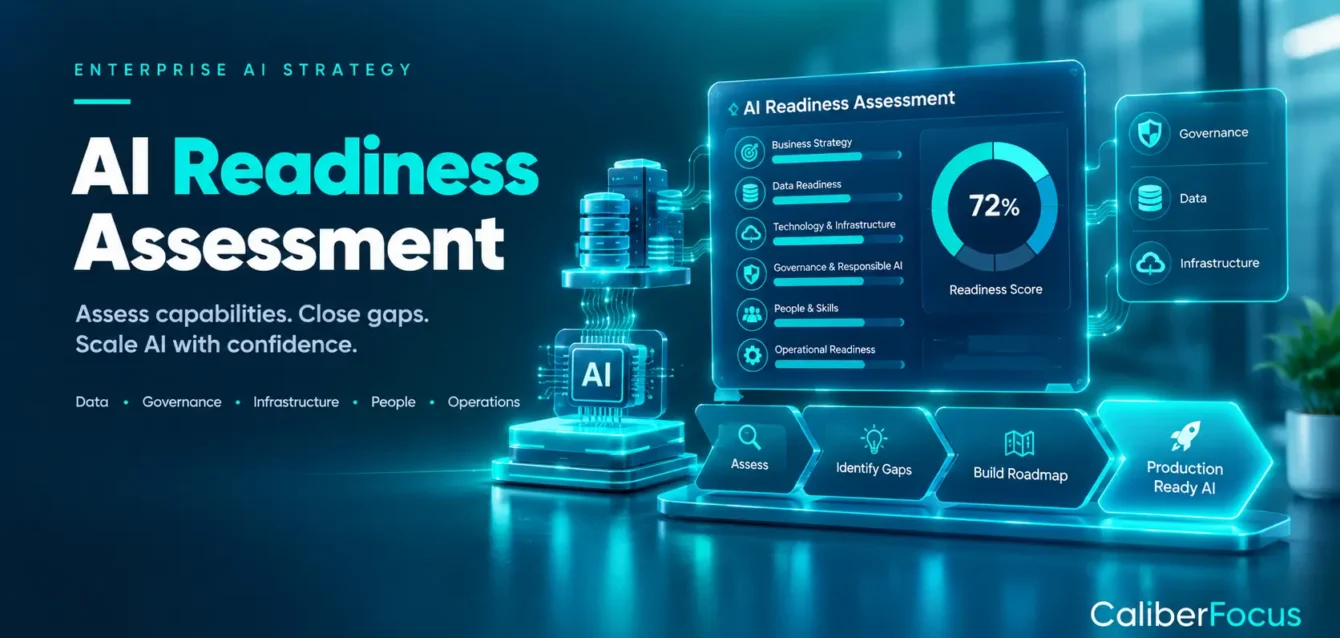
An AI readiness assessment evaluates whether an organization has the business alignment, data, technology, governance, workforce capabilities, and operational processes required to implement AI successfully. It identifies capability gaps, deployment risks, and investment priorities before an enterprise commits to building or scaling AI solutions.
For business and technology leaders, the assessment should answer three questions:
- What can we implement now? Identify AI opportunities supported by existing capabilities.
- What needs improvement? Determine which data, infrastructure, governance, or workforce gaps could affect implementation.
- What should happen next? Prioritize investments, assign ownership, and establish an AI implementation roadmap.
An enterprise may have a promising generative AI use case but lack secure access to the required information. Another may have mature data infrastructure but no process for approving AI-generated decisions. Both need different preparation before deployment.
This guide explains how to assess enterprise AI readiness, interpret assessment scores, and translate findings into an actionable roadmap. It also covers how AI Strategy and Consulting Services can connect assessment findings with implementation decisions.
How Ready Is Your Enterprise for AI Implementation?
Evaluate your current capabilities, identify readiness gaps, and determine the right next steps with CaliberFocus.
When Should an Enterprise Conduct an AI Readiness Assessment?
An enterprise should conduct an AI readiness assessment when an AI investment or deployment decision depends on capabilities that have not yet been validated. This includes evaluating new AI opportunities, selecting platforms, moving pilots into production, or expanding AI across business functions.
The assessment should clarify what the organization can support today, what could prevent implementation, and which improvements are necessary before proceeding.
| Business Situation | What Needs to Be Validated | Decision the Assessment Supports |
| Investing in AI for the first time | Business value, data availability, executive ownership, and technical feasibility | Which use cases justify initial investment |
| Selecting an AI platform or technology partner | Integration requirements, infrastructure compatibility, security, and scalability | Which solution fits the existing enterprise environment |
| Moving successful pilots into production | Production data, system performance, monitoring, governance, and operational ownership | Whether the solution is ready to deploy or needs further preparation |
| Introducing generative AI or AI agents | Enterprise knowledge access, output reliability, decision authority, and human oversight | Which workflows can safely support AI-generated outputs or autonomous actions |
| Scaling AI across business functions | Reusable infrastructure, shared governance, workforce capabilities, and support capacity | Where AI can expand and which capabilities require investment |
The outcome is not simply a readiness score. It is an evidence-based decision to proceed, address specific gaps, or defer an initiative until critical requirements are met.
What Does an AI Readiness Assessment Evaluate?
A comprehensive enterprise AI readiness assessment examines six interconnected dimensions.
| Assessment Dimension | What Is Evaluated | Evidence to Review |
| Business Strategy | Objectives, executive sponsorship, investment priorities, accountability | Business cases, KPIs, budgets, ownership records |
| Data Readiness | Quality, accessibility, integration, ownership, security | Data inventories, quality reports, access policies |
| Technology & Infrastructure | Architecture, APIs, compute, scalability, monitoring | Architecture diagrams, infrastructure and integration assessments |
| Governance & Responsible AI | Risk management, privacy, approvals, human oversight | Policies, risk registers, approval procedures |
| People & Skills | AI literacy, technical expertise, adoption readiness | Skills inventories, training plans, role definitions |
| Operational Readiness | Monitoring, maintenance, workflow integration, incident response | Operating procedures, support models, performance measures |
1. Business Strategy: Are AI Investments Connected to Measurable Outcomes?
AI readiness begins with the business problem, not the technology.
The assessment examines whether proposed use cases support defined priorities, such as reducing processing delays, improving forecasting, strengthening quality control, or increasing operational capacity.
Leadership should establish who sponsors each initiative, who owns the outcome, how value will be measured, and what investment is justified.
Expected output: Prioritized AI opportunities with measurable objectives and accountable business owners.
2. Data Readiness: Can Enterprise Data Support the Intended AI Use Cases?
Data readiness involves more than having information available. Enterprises must establish whether the required data is reliable, accessible, appropriately governed, and suitable for the intended AI application.
An assessment should examine data quality, ownership, integration, access permissions, and information sensitivity.
For generative AI applications using enterprise knowledge, additional questions include whether source information is current, whether access permissions can be enforced, and how generated responses will be evaluated.
Where critical information remains fragmented, targeted improvements in Data Engineering and Pipelines may be necessary before implementation.
Expected output: A use-case-specific data readiness assessment identifying quality, access, and integration gaps.
3. Technology Readiness: Can Existing Systems Support Production AI?
A successful pilot does not establish that the underlying infrastructure can support production workloads.
Technology assessment examines cloud and on-premises infrastructure, compute resources, APIs, application compatibility, security architecture, and monitoring capabilities.
The objective is to determine what existing investments can support and which changes are essential.
These dependencies are among the challenges discussed in Common AI Implementation Challenges in Enterprise Projects.
Expected output: Deployment constraints, architecture requirements, and prioritized infrastructure improvements.
4. Governance and Responsible AI: Are Risks and Decision Responsibilities Defined?
Governance readiness examines whether the organization has appropriate controls for developing, approving, deploying, and monitoring AI systems.
The assessment should establish who approves AI use cases, how risks are evaluated, which decisions require human oversight, and how incidents are handled.
Organizations introducing autonomous or agent-based workflows should pay particular attention to decision authority and escalation procedures.
These requirements connect with broader AI Governance and Responsible AI Services.
Expected output: A governance gap assessment identifying required controls, responsible owners, and critical risks.
5. People and Skills: Can Teams Adopt and Manage AI?
AI implementation changes how employees perform tasks, review information, and make decisions.
Readiness assessment should evaluate technical capabilities, AI literacy, workforce concerns, training requirements, and management support.
It should also determine whether business users understand when AI outputs require verification and who is responsible for acting on them.
Expected output: Role-specific skills, training, and change-management priorities.
6. Operational Readiness: Who Owns AI After Deployment?
Production AI requires ongoing monitoring, maintenance, performance evaluation, and incident management.
The assessment examines whether responsibilities are defined for model updates, performance changes, system failures, and business-process exceptions.
For machine learning and generative AI systems, these responsibilities may require established MLOps and LLMOps practices.
Expected output: An operating model covering monitoring, support, accountability, and continuous improvement.
An enterprise AI readiness assessment should establish whether proposed AI initiatives are feasible within the organization’s current business, data, technology, and operating environment. The process moves from defining what the business wants to achieve to validating capabilities, identifying deployment risks, and determining the next investment decisions.
Define the AI Use Cases and Assessment Scope
Start with the business outcomes the organization expects AI to support. Identify the proposed use cases, affected processes, stakeholders, and systems involved.
The assessment should establish:
- Which business problems justify AI investment?
- What data, applications, and teams will each use case depend on?
- Who owns the business outcome and implementation decisions?
- What measures will determine whether the initiative succeeds?
Examine Existing Capabilities and Collect Evidence
Evaluate the six readiness dimensions: business strategy, data, technology, governance, people, and operations.
Rather than relying entirely on stakeholder opinions, review available evidence such as data quality reports, architecture diagrams, access policies, governance procedures, skills inventories, and operational support arrangements.
The objective is to distinguish capabilities that are already established from those that are assumed to exist.
- Business strategy
- Data
- Technology
- Governance
- People
- Operations
Score Readiness and Identify Deployment Risks
Evaluate each dimension using defined scoring criteria and supporting evidence. Consider how gaps affect the specific AI use cases being assessed.
For example, incomplete historical data may limit a forecasting model, while unrestricted access to sensitive documents may prevent a generative AI application from proceeding safely.
Assess two factors separately:
Capability Maturity
How well the organization currently supports the required function.
Deployment Risk
Whether a gap could prevent implementation, create unacceptable exposure, or undermine the intended business outcome.
Prioritize Gaps Based on Business Impact and Dependencies
Not every readiness gap requires immediate remediation. Prioritize improvements according to their effect on the proposed AI initiatives, business value, implementation dependencies, and risk severity.
For each gap, determine whether it must be resolved before deployment, can be addressed during a controlled pilot, or belongs in a longer-term capability improvement plan.
- Critical blockers
- Near-term requirements
- Future improvements
Translate Findings Into an AI Implementation Roadmap
Convert the assessment results into sequenced actions with responsible owners, expected deliverables, dependencies, and decision points.
The roadmap should establish which initiatives can proceed, which require further preparation, and what conditions must be met before moving into production.
It should also identify how progress will be measured and when readiness must be reassessed.
- Priorities and owners
- Capability improvements
- Dependencies and milestones
- Readiness checkpoints
A structured AI readiness assessment turns current-state findings into clear investment decisions, prioritized improvements, and an actionable path toward implementation.
What Should the Assessment Deliver to Leadership?
| Deliverable | Decision It Enables |
| AI use-case and business-priority assessment | Where AI investment should begin |
| Evidence-based readiness scorecard | Which capabilities are established or incomplete |
| Critical risk and capability-gap register | What could prevent successful deployment |
| Prioritized remediation plan | Which improvements require immediate investment |
| AI implementation roadmap | What can proceed, who owns delivery, and what happens next |
A completed assessment should give leadership enough evidence to proceed, proceed with conditions, or defer a proposed AI initiative, rather than treating organizational readiness as a single pass-or-fail score.
How to Evaluate and Score Enterprise AI Readiness
An AI readiness assessment should measure capabilities against the requirements of a proposed AI initiative, using documented evidence rather than assumptions or stakeholder confidence alone.
Each dimension receives a score from 1 to 5 based on three factors:
- Capability: Does the required process, technology, or organizational capability exist?
- Evidence: Can the organization demonstrate that the capability is implemented and functioning?
- Implementation fit: Is the capability sufficient for the AI use case being assessed?
Example: Assessing Readiness for an Enterprise AI Initiative
Consider a hypothetical organization planning to deploy a generative AI assistant that retrieves information from internal business documents and supports employees in answering operational questions.
Before implementation, the organization evaluates its readiness across six dimensions.
| Assessment Dimension | Example Evaluation Question | Evidence and Findings | Readiness Score |
| Business Strategy | Is the AI use case tied to measurable business objectives and clear ownership? | Defined business case, executive sponsor, and success KPIs | 4/5 |
| Data Readiness | Can the AI application securely access accurate and relevant enterprise information? | Required documents identified, but some information is outdated and access permissions need improvement | 3/5 |
| Technology & Infrastructure | Can existing systems support AI integration and production workloads? | Available APIs, sufficient infrastructure, and documented integration architecture | 4/5 |
| Governance & Responsible AI | Are security, privacy, output validation, and human oversight controls established? | General AI policies exist, but application-specific access controls and approval procedures are incomplete | 3/5 |
| People & Skills | Are employees and support teams prepared to use and manage the application? | Limited training, no established adoption plan, and unclear support responsibilities | 2/5 |
| Operational Readiness | Are monitoring, incident handling, and ongoing support processes established? | Existing IT monitoring processes available, but AI-specific procedures still require validation | 3/5 |
Illustrative example, not an actual CaliberFocus client assessment.
What Does Each Readiness Score Mean?
| Score | Readiness Level | How to Assign the Score |
| 1 | Not Established | Required capabilities or responsible owners are absent |
| 2 | Initial | Some capabilities exist, but processes are informal or inconsistently applied |
| 3 | Developing | Capabilities are documented or partially implemented, but important gaps remain |
| 4 | Established | Required capabilities are implemented and supported by relevant evidence |
| 5 | Validated | Capabilities have been tested under representative conditions and are continuously monitored |
How Should Leadership Interpret This Assessment?
The organization has established business objectives and a technical environment that could support the proposed AI assistant. However, the assessment identifies three important areas requiring attention.
Data readiness (3/5): Information quality and document access permissions need improvement before the assistant can reliably retrieve approved enterprise knowledge.
Governance readiness (3/5): Application-specific access controls, output validation, and approval procedures must be established before production use.
People and skills readiness (2/5): Employees require training, while operational teams need defined responsibilities for managing the application.
Although the technology environment scores 4/5, this does not mean the application is ready for deployment.
Assessment decision: Proceed with conditions.
The organization can continue with controlled development and testing, but production deployment should depend on resolving critical information-access and governance requirements.
The resulting AI implementation roadmap should identify the required improvements, accountable owners, and evidence needed to approve deployment..
AI Readiness Assessment: Self-Assessment or Consulting Partner?
Enterprises can evaluate AI readiness through an internal self-assessment or engage an external AI consulting provider for a more detailed evaluation. Both approaches examine business strategy, data, technology, governance, workforce capabilities, and operational readiness. The difference lies in the depth of evaluation, available expertise, and validation of findings.
Which AI Readiness Assessment Approach Fits Your Organization?
| Evaluation Criteria | Internal Self-Assessment | AI Consulting Partner Assessment |
| Best suited for | Organizations exploring AI opportunities or reviewing existing capabilities | Enterprises preparing for significant AI investments, complex integrations, or production deployment |
| Who conducts it | Internal business, IT, data, security, and operations teams | External AI specialists working with internal stakeholders |
| Assessment depth | Initial capability review using internal knowledge and available evidence | Detailed evaluation of technical feasibility, dependencies, governance, and implementation risks |
| Key advantage | Direct access to business context, existing systems, and internal priorities | Specialized expertise and an external perspective on technical and operational gaps |
| Potential limitation | Findings may be constrained by internal expertise or untested assumptions | Requires stakeholder involvement, access to relevant information, and an agreed assessment scope |
| Expected outcome | Initial readiness baseline and identified improvement areas | Validated findings and recommendations for implementation planning |
When Is an Internal AI Readiness Assessment Sufficient?
An internal assessment may be sufficient when the organization has the expertise to evaluate its business requirements, data environment, infrastructure, governance, and operational capabilities.
It can establish an initial readiness baseline, identify gaps, and determine which AI opportunities warrant further investigation.
When Should Enterprises Consider an AI Consulting Partner?
External assessment support becomes valuable when organizations need specialized technical evaluation, independent validation, or assistance assessing complex enterprise environments.
An AI consulting provider can evaluate integration feasibility, identify deployment dependencies, review governance requirements, and help prioritize improvements before significant investments are made.
Some enterprises may also choose a combined approach: complete an internal assessment first, then engage external specialists to validate findings or evaluate specific capability gaps.
Regardless of who conducts the assessment, the expected outcome should be the same: a clear understanding of organizational readiness, documented risks, prioritized improvements, and an actionable AI implementation roadmap.
Build an AI Strategy Around Your Enterprise Readiness
By evaluating six readiness dimensions and translating findings into prioritized actions, enterprises can make more informed decisions about AI platforms, pilots, production deployment, and long-term adoption.
Frequently Asked Questions
Evaluate the intended use case against business objectives, data availability, infrastructure, governance, workforce capabilities, and operational support. Review supporting evidence and identify critical risks before making deployment decisions.
Examine enterprise information access, data sensitivity, model selection, output evaluation, security, integration, and human oversight. Applications using internal knowledge also require reliable information sources and appropriate access controls.
It should define assessment scope, evaluation dimensions, evidence requirements, scoring criteria, critical risk checks, and deliverables. The output should include a readiness baseline, capability gaps, and prioritized actions.
Start with business and operational requirements. Evaluate data, integration, security, governance, and production support before selecting technology. Existing pilots should also be reviewed against representative production conditions.
A roadmap should identify prioritized use cases, capability gaps, corrective actions, owners, dependencies, investments, milestones, and success measures.
External support may be valuable when internal teams lack a consistent assessment methodology, require independent cross-functional evaluation, or need assistance turning findings into an actionable AI strategy.

Continue Reading
More on Enterprise AI Readiness and Implementation
AI Risk Management Framework
Explore how organizations can identify, assess, prioritize, and manage AI-related risks throughout the AI lifecycle.
Read MoreCommon AI Implementation Challenges in Enterprise Projects
Understand the data, integration, governance, and organizational barriers that can delay enterprise AI deployment.
Read MoreEnterprise Generative AI for Business Operations
Discover how generative AI can support business workflows, enterprise knowledge access, and operational processes.
Read More