

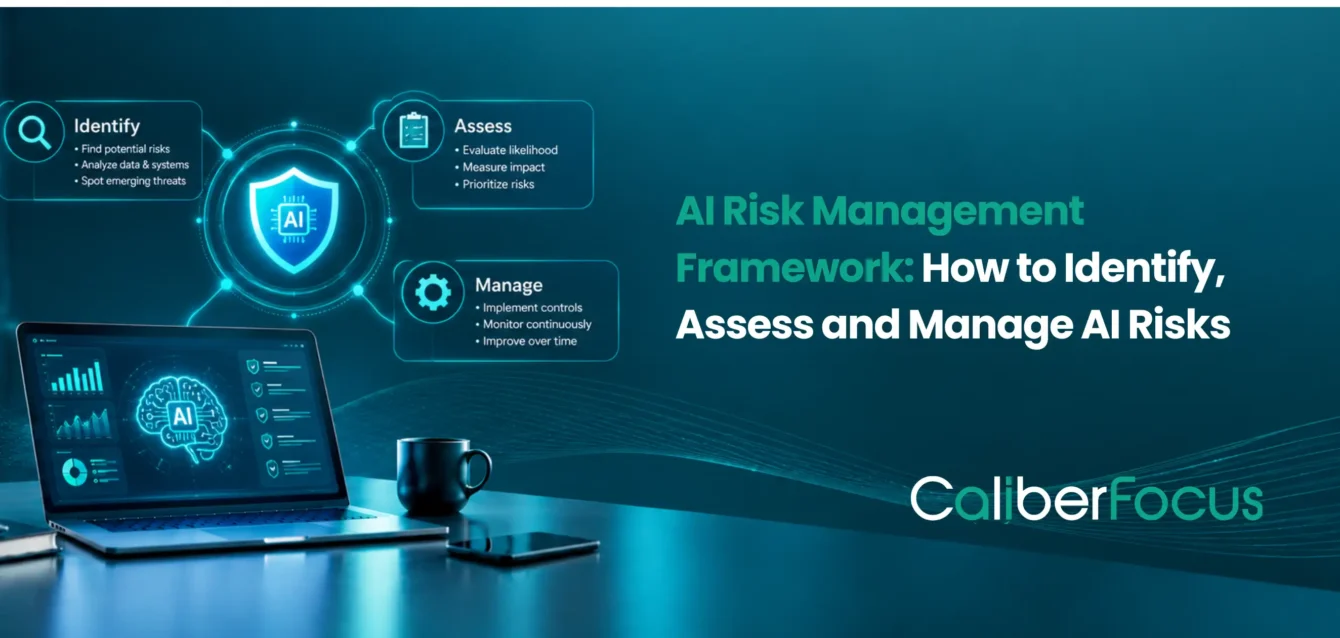
As AI moves from isolated pilots into business processes, enterprise applications, decision support, and increasingly autonomous workflows, the risk conversation changes. Organizations need to understand not only whether an AI system works, but what it can access, which decisions or actions it influences, what happens when it fails, and who is accountable for the outcome.
An AI risk management framework provides a structured approach for identifying AI systems, assessing their risks, prioritizing those risks, applying appropriate controls, and monitoring them throughout the AI lifecycle. It does not necessarily replace existing enterprise risk, security, data governance, privacy, or compliance processes. Instead, it connects and extends them where AI introduces new risks or changes existing ones.
For organizations expanding AI adoption, AI strategy and consulting services can help align use-case priorities, implementation decisions, governance requirements, and business objectives before AI moves into production.
Know Where AI Risk Exists Before It Scales
Assess AI risks across your use cases, data, systems, governance, and operating environment before expanding enterprise adoption.
AI Risk Management Framework at a Glance
A practical artificial intelligence risk management framework connects:
AI Scope → AI Inventory → Risk Classification → Risk Assessment → Risk Prioritization → Governance → Controls → Lifecycle Management → Monitoring and Reassessment
The objective is straightforward:
- Know where and how AI is being used
- Understand the business and technical risks
- Apply oversight according to the level of risk
- Establish clear accountability
- Control unacceptable exposure
- Monitor how risk changes after deployment
What Is an AI Risk Management Framework?
An AI risk management framework is the organizational structure used to identify, assess, prioritize, mitigate, monitor, and respond to risks arising from the development, acquisition, deployment, and use of AI.
It brings together several related disciplines.
| Area | Primary role |
| AI risk management | Identify, assess, prioritize, mitigate, and monitor AI risks |
| AI governance | Define policies, accountability, decision rights, and oversight |
| AI compliance | Address applicable legal, regulatory, contractual, and internal requirements |
| Responsible AI | Establish principles and practices for appropriate AI development and use |
| AI security | Protect AI systems, data, access, integrations, and supporting infrastructure |
These areas should work together. An organization may have an AI policy, for example, but still lack a consistent process for assessing individual use cases, deciding which risks require escalation, determining appropriate controls, or monitoring AI after deployment.
An effective AI governance and responsible AI approach therefore needs to connect organizational policies with the operational decisions made around individual AI systems.
Existing enterprise controls should also be considered before introducing new ones. Cybersecurity, privacy, data governance, model risk, third-party risk, compliance, and enterprise risk management may already address part of the exposure. The AI risk framework should identify where those processes remain sufficient and where AI-specific assessment, ownership, controls, or monitoring are required.
Core Components of an AI Risk Management Framework
Define Which AI Systems Are in Scope
The first requirement is visibility.
AI risk management should account for more than models developed by internal data science teams. Depending on the organization, the scope may include:
- Machine learning models
- Generative AI applications
- AI agents
- Third-party AI platforms and APIs
- AI embedded in SaaS and enterprise applications
- Employee-facing AI tools
- AI used to recommend or automate business decisions
This distinction matters because organizations increasingly consume AI through vendors and existing software rather than developing every model internally.
Before expanding an AI risk management program, an AI readiness assessment can help identify gaps across data, technology, governance, processes, and the operating environment supporting AI adoption.
Create an AI System and Use Case Inventory
Once scope is established, organizations need an inventory showing where AI exists and how it affects the business.
An AI inventory can capture:
| Information | What it establishes |
| AI system and use case | What the AI is intended to do |
| Business owner | Who is accountable for the use case |
| Technical owner | Who is responsible for the system |
| Model or provider | Internal and external dependencies |
| Data accessed | Data, privacy, and security exposure |
| Users affected | Who interacts with or is affected by the AI |
| Decision or process supported | Business consequence of the AI output |
| Level of autonomy | Whether AI informs, recommends, or acts |
| Deployment status | Current lifecycle stage |
| Existing safeguards | Controls already addressing identified risks |
The inventory should be maintained as systems, providers, use cases, integrations, and levels of autonomy change.
Classify AI Systems by Risk
Not every AI system warrants the same level of assessment or control.
An internal assistant summarizing low-sensitivity documents presents a different exposure from an AI system influencing a high-consequence business decision or an AI agent authorized to execute transactions.
Risk classification can consider:
- Business impact: What happens if the AI fails?
- Data sensitivity: What information can it access or expose?
- Decision impact: Does AI inform, recommend, decide, or execute?
- Scale: How many users, customers, transactions, or processes could be affected?
- Autonomy: What can the system do without approval?
- Reversibility: Can an incorrect outcome be corrected?
- Security exposure: Which systems, APIs, tools, or data can it access?
- Regulatory exposure: Which applicable obligations affect the use case?
The classification can then determine how much testing, review, documentation, human oversight, approval, and monitoring the system requires.
Conduct an AI Risk Assessment
An AI risk assessment moves from classification into the specific ways a system could create business, technical, or compliance exposure.
The assessment should be grounded in the use case.
| AI risk area | Questions to assess |
| Data and privacy | Is sensitive or inappropriate data accessible to the system? |
| AI security | Could the system, model, data, credentials, or integrations be compromised? |
| Reliability | Could incorrect or inconsistent outputs materially affect the process? |
| Bias and fairness | Could the system produce inappropriate or unequal outcomes? |
| Transparency | Can relevant users understand where and how AI affects the process? |
| Operational risk | What happens when the AI or a dependency fails? |
| Third-party risk | What dependencies exist on external models, APIs, platforms, or providers? |
| Compliance | What legal, regulatory, contractual, or internal requirements apply? |
| Autonomy | Which actions can AI perform, and where is human authority required? |
A useful assessment flow is:
Risk → Likelihood → Potential Impact → Existing Controls → Residual Risk
This prevents an AI risk assessment from becoming a generic list of concerns disconnected from the business process.
Prioritize AI Risks and Determine the Required Response
Identifying a risk does not automatically determine what the organization should do about it.
The next decision is whether the exposure is acceptable and what level of AI risk mitigation is proportionate.
Prioritization can consider:
Impact + Likelihood + Business Criticality + Existing Controls + Residual Risk
From there, the organization can determine whether to:
- Apply additional controls
- Increase testing or validation
- Require human review
- Restrict data or system access
- Limit AI autonomy
- Increase monitoring
- Escalate the risk for approval
- Accept the residual risk through an authorized owner
- Modify or discontinue the use case
NIST AI RMF similarly describes prioritizing risk treatment based on factors including impact and likelihood, rather than treating every identified risk equally.
The decision path becomes:
Identify → Assess → Prioritize → Mitigate → Approve or Escalate → Monitor
Define AI Governance Roles and Accountability
A risk framework becomes difficult to operate when responsibility is distributed but accountability is unclear.
For each AI system, organizations should establish:
- Who owns the business use case?
- Who owns the technical system?
- Who performs or reviews the risk assessment?
- Who owns security and data controls?
- Who approves production deployment?
- Who can accept residual risk?
- Who monitors the system?
- Who responds when an incident occurs?
- Who can restrict or stop the AI system?
The level of governance should reflect the risk. Requiring the same approval process for every AI use case can create unnecessary friction without improving control over the systems that matter most.
Establish AI Risk Management Controls
AI risk management controls translate identified risks into practical safeguards.
| AI risk | Possible control | Evidence or monitoring |
| Sensitive data exposure | Access and data restrictions | Access records and configuration |
| Unreliable outputs | Testing and human review | Evaluation results |
| Performance degradation | Production monitoring | Performance records |
| Unauthorized actions | Permissions and action boundaries | Activity logs |
| Third-party dependency | Provider assessment | Assessment documentation |
| High-impact decisions | Human approval and escalation | Approval records |
Depending on the system, security controls and other safeguards can include identity and access management, data protection, model testing, output validation, human oversight, logging, monitoring, third-party review, incident management, and documented escalation.
When AI needs to connect with enterprise applications, APIs, data, and operational workflows, AI engineering services can address the production architecture, integration, security, and control requirements surrounding those systems.
The objective is not to accumulate controls. It is to connect each material risk with an appropriate control and determine whether that control is actually operating effectively.
Manage Risk Across the AI Lifecycle
An AI risk assessment performed before deployment captures risk at a particular point in time. The system and its operating environment can subsequently change.
AI risk management should therefore follow the AI lifecycle:
Use Case → Assessment → Development → Testing → Approval → Deployment → Monitoring → Reassessment → Retirement
Risk decisions can occur throughout this lifecycle. New data can alter model behavior. An integration can expand system access. A business team may begin using AI for a different purpose. A provider may change its model or service. An agent may receive additional permissions.
Addressing these AI implementation challenges before production can reduce the gap between an AI system that works technically and one that can operate reliably within enterprise processes and controls.
Establish AI Risk Monitoring and Reassessment
AI risk monitoring determines whether the assumptions made during assessment remain valid once the system is operating.
Monitoring can cover:
- Model and output performance
- Data or operating-context changes
- Security events
- Unexpected behavior
- Control effectiveness
- Incidents and exceptions
- User feedback
- Provider or model changes
- New integrations or permissions
- Changes in business use
For production AI portfolios, MLOps and LLMOps services can support repeatable deployment, evaluation, monitoring, and lifecycle management practices around models and AI applications.
When Should an AI Risk Assessment Be Repeated?
Reassessment should be triggered when a material change could alter the original risk profile.
New Data → Model Change → Provider Change → New Use Case → Increased Autonomy → New Integration → Performance Issue → Security Incident
NIST also describes AI risk management as continuous and performed throughout the AI system lifecycle rather than as a one-time exercise.
How the NIST AI Risk Management Framework Fits In
The NIST AI Risk Management Framework, commonly referred to as NIST AI RMF, provides organizations with a voluntary, non-sector-specific reference for managing AI risks. NIST AI RMF 1.0 organizes its Core around four functions: Govern, Map, Measure, and Manage.
| NIST AI RMF function | What it means for AI risk management |
| Govern | Establish policies, accountability, processes, and oversight |
| Map | Understand the AI system, context, stakeholders, and potential impacts |
| Measure | Assess, test, track, and evaluate AI risks |
| Manage | Prioritize risks and determine appropriate responses |
These functions are not intended as a mandatory sequence or checklist. NIST states that the framework can be adapted according to an organization’s context, resources, risk tolerance, and AI use cases.
This makes the NIST AI framework useful as a reference point rather than a replacement for an organization’s own risk management processes.
NIST also supports comparing current and target AI risk management outcomes to identify gaps and prioritize improvements, which aligns well with organizations that already have established security, governance, or enterprise risk processes.
As of September 2026, NIST states that AI RMF 1.0 is being revised, so organizations aligning with the framework should monitor the current NIST guidance rather than treating the 2023 publication as static.
AI Risk Management Framework Implementation Checklist
Use this checklist to determine whether the core elements of the AI risk management program are operating across the organization.
- AI systems and use cases in scope are defined
- An AI system inventory is maintained
- Business and technical owners are assigned
- AI risk classification criteria are established
- AI risk assessments are conducted based on use-case context
- Risks are prioritized according to impact and likelihood
- Risk tolerance and escalation requirements are defined
- AI risk management controls are mapped to material risks
- Testing and validation requirements are established
- Deployment approval responsibilities are defined
- Third-party AI risks are assessed
- Production AI monitoring is established
- AI incidents have defined response and escalation paths
- Material changes trigger reassessment
- AI retirement and decommissioning are addressed
- Risk decisions, controls, approvals, and changes are documented
The checklist should not be treated as proof that AI risk has been eliminated. Its purpose is to verify that the organization has a repeatable process for identifying exposure, making risk decisions, applying controls, and responding as conditions change.
Key Takeaways
Frequently Asked Questions
An AI risk management framework should cover AI scope and inventory, risk classification, AI risk assessment, prioritization, governance responsibilities, risk controls, lifecycle management, production monitoring, incident response, reassessment, and documentation.
AI governance establishes policies, accountability, decision rights, and oversight. AI risk management focuses on identifying specific AI risks, assessing their significance, deciding how they should be treated, applying controls, and monitoring remaining exposure. The two should operate together.
Start with the AI system’s intended use, data, users, decisions, integrations, and level of autonomy. Identify potential risks, assess their likelihood and business impact, review existing controls, determine residual risk, and decide whether additional mitigation, approval, restriction, or monitoring is required.
Depending on the use case, controls may include data and access restrictions, security controls, model testing, output validation, human oversight, action boundaries, logging, monitoring, third-party assessment, documentation, incident response, and escalation.
The NIST AI RMF provides a voluntary framework organized around Govern, Map, Measure, and Manage. Organizations can use these functions to evaluate and strengthen how they govern AI, understand risk context, assess risk, and prioritize risk responses.
There is no single reassessment interval appropriate for every AI system. The frequency should reflect the system’s risk and operating context, with additional assessments triggered by material changes such as new data, model updates, provider changes, increased autonomy, new integrations, performance issues, or security incidents.