

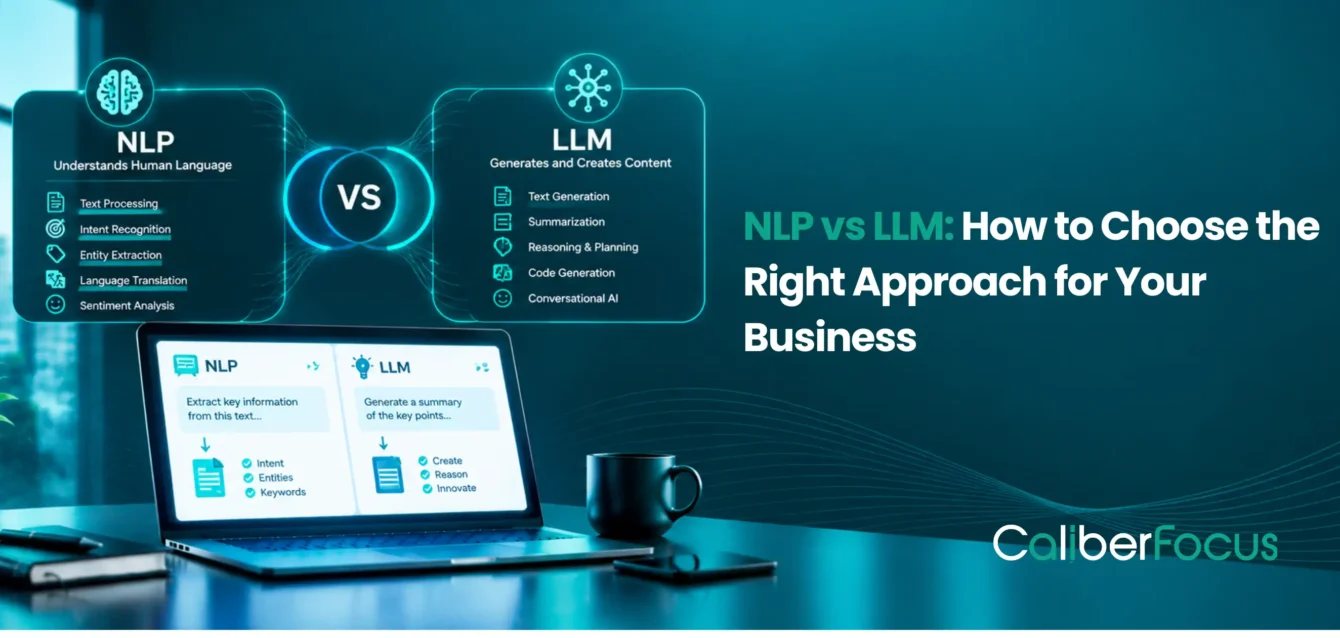
NLP is the broader field for enabling machines to process and understand human language, while LLMs are language models designed to understand and generate language across a wider range of tasks. For businesses, NLP is often enough for defined tasks such as classification, extraction and sentiment analysis. LLMs become more relevant when the requirement involves generation, summarization, conversational interaction or less predictable language inputs.
The Business Decision at a Glance
Classify text → extract information → identify entities → analyze sentiment → produce structured outputs
Understand varied inputs → summarize information → generate responses → support conversations → handle multiple language tasks
Extract or classify information → retrieve relevant context → interpret it → generate a natural-language response
The important distinction is that NLP and LLMs are not necessarily competing choices. An enterprise application may use focused NLP models for predictable language-processing tasks, an LLM for flexible language interaction, or both within the same workflow.
What does the business need the system to understand, extract, classify or generate, and how much flexibility does that workflow require?
For organizations building language-driven applications, NLP and Voice AI solutions can support the broader language-processing layer across enterprise workflows.
Not Sure Whether Your Workflow Needs NLP, an LLM, or Both?
Map the language task, required output, enterprise context, and downstream workflow before choosing the architecture.
NLP vs LLM: The Business Difference
The clearest distinction appears when NLP and LLM models are placed inside an actual business process.This distinction matters because NLP applications often produce structured signals for another system, while LLM applications can continue working with the meaning and context of the language before the workflow proceeds.
The decision is therefore not only about what the technology can understand. It is about what needs to happen next in the process.
| Operational Requirement | Where NLP Fits | Where an LLM Fits |
| Route incoming work | Classifies emails, requests, tickets or documents by intent, topic or category so workflow rules can route them | Interprets less standardized requests where intent depends on broader conversational or document context |
| Extract data for downstream systems | Identifies entities, dates, identifiers, products or other required fields and converts unstructured text into structured data | Interprets information spread across longer or varied documents when straightforward extraction is insufficient |
| Prioritize operational queues | Detects sentiment, intent or predefined language signals that contribute to prioritization rules | Summarizes the issue and surrounding context so users or downstream applications understand what requires attention |
| Process business documents | Classifies documents and extracts defined information for validation or downstream processing | Summarizes, compares or interprets information when the workflow requires broader context |
| Automate customer or employee interactions | Detects intent and extracts information needed to trigger the appropriate workflow | Generates responses and handles follow-up questions where interactions cannot follow a fixed path |
| Work with enterprise knowledge | Identifies, structures or categorizes information to support search and retrieval | Uses retrieved context to answer questions, summarize information or support conversational knowledge access |
| Support multi-step processes | Performs defined language-processing tasks within an automated workflow | Handles steps requiring contextual interpretation or generation before another system or person takes action |
How NLP and LLMs Fit Into Business Workflows
The difference becomes clearer when you look at what each approach is expected to do inside a real operating process.
Structure Language for the Workflow
Best suited when the business already knows what information must be identified and what action should follow.
Interpret Context Before the Next Action
Fits workflows where the next step depends on understanding broader context, summarizing information, or generating a response.
Combine Structured Processing With Contextual Reasoning
Useful when a process needs both structured language processing and contextual interpretation before a business action can happen.
Language intelligence is only one part of process automation
NLP and LLMs can handle the language-intensive steps, but routing, approvals, system updates, exception handling, and downstream actions still require workflow logic.
AI and automation solve different parts of the workflow ↗Start With the Operational Bottleneck
Focused NLP may be enough.
An LLM may be the better fit.
NLP and LLM capabilities may need to work together.
When NLP Is the Better Fit
NLP solutions are particularly useful when the organization already knows what information must be identified and what should happen once it is found.
Typical NLP use cases include:
- Text classification: determine the intent, category, or topic of an incoming request.
- Named entity recognition: identify people, organizations, products, account references, dates, or other entities.
- Information extraction: convert information embedded in documents or messages into structured fields.
- Sentiment analysis: detect predefined language signals that contribute to prioritization or analysis.
- Document classification: identify document types before validation or downstream processing.
The critical question is:
Once the required information has been identified, can established business logic determine the next action?
If yes, introducing an LLM may add capability the workflow does not require.
NLP implementation still depends on factors such as language variability, domain terminology, model accuracy, training data, and integration. These considerations are examined further in Challenges and Considerations in NLP. Pasted text
When an LLM Becomes Necessary
The case for an LLM becomes stronger when understanding the language is only the beginning of the work.
Consider a request containing several issues, references to earlier interactions, supporting information, and a question whose meaning depends on the surrounding context. Identifying its category may not tell the system what to do.
The workflow instead becomes:
Request → understand situation → identify relevant context → synthesize what matters → generate or recommend next output
LLM applications are therefore more relevant when the business process requires:
- contextual interpretation across varied language;
- summarization of longer information;
- synthesis across multiple pieces of content;
- text generation or explanation;
- conversational AI or AI chatbots that must handle changing context.
This is an important distinction from traditional NLP models. The requirement has moved from finding predefined signals in language to working with the meaning of the information before the process can continue.
When NLP and LLMs Need to Work Together in the Same Workflow
For many enterprise applications, the decision is not to replace NLP with an LLM. The workflow may need NLP to turn unstructured language into defined information, an LLM to interpret or generate around that information, and business logic to control what happens next.
This becomes useful when a single process moves through several different language tasks before reaching a business outcome.
One Workflow Can Require Different Types of Language Processing
NLP can handle the defined processing steps
Classify document
Extract entities and fields
Structure information
An LLM can handle the contextual step
Supporting context
Interpret
Summarize or generate
The result returns to the operational workflow
Validation
Approval
System update or routing
Rather than asking one model to perform every step, the architecture can assign different responsibilities according to what the process requires.
Where Combined NLP and LLM Workflows Make Operational Sense
| Business workflow | NLP role | LLM role | What the process gains |
| Document processing | Classify documents and extract defined fields or entities | Interpret relationships across the document and summarize relevant information | Structured data and contextual output can move through the same process |
| Customer or service operations | Detect intent, entities, topics, or routing signals | Understand the wider request and prepare a contextual response | Requests can be routed while still supporting more complex interactions |
| Knowledge-intensive workflows | Structure, tag, or classify incoming information | Interpret retrieved information and produce an answer or summary | Employees can work with both structured signals and contextual knowledge |
| Feedback and experience analysis | Detect sentiment, topics, entities, or categories across large text volumes | Synthesize patterns and summarize recurring themes | Teams can move from individual language signals to broader interpretation |
| Case or request processing | Extract required details and classify the incoming case | Summarize the situation or generate context for the next review step | Manual reading can be reduced without removing workflow controls |
The Integration Point Matters More Than the Model Boundary
The value of combining NLP and LLMs depends on how their outputs connect with the systems that actually run the process.
A typical enterprise flow may look like:
Language input
↓
NLP classification and extraction
↓
Business data and relevant context
↓
LLM interpretation or generation
↓
Validation and business rules
↓
CRM, ERP, workflow platform, service system, or human review
The AI components handle specific language-intensive steps. The surrounding application and workflow architecture determines when information is retrieved, which system receives the output, what requires validation, and when a person should remain in the process.
This is where AI engineering becomes relevant. The challenge moves beyond selecting an NLP model or LLM and into integrating language capabilities with enterprise data, applications, workflows, and operational controls. Pasted markdown
Do Not Add an LLM Where the Workflow Does Not Need One
A combined architecture should not become the default simply because both technologies are available.
If classification or extraction already produces everything the downstream process needs, adding generation may create unnecessary architectural and operational complexity.
Likewise, if an LLM can handle the required interaction without a separate NLP component, splitting the task across multiple models may not provide meaningful value.
The architecture should therefore follow the process:
Defined extraction or classification requirement
→ NLP may handle the step.
Contextual interpretation or generation requirement
→ LLM may handle the step.
Both requirements occur at different stages of the same process
→ NLP and LLM integration becomes relevant.
Enterprise knowledge is required before the LLM can respond
→ The workflow introduces another question: how should the right business information be retrieved and supplied to the model?
Need NLP and LLMs to Work Inside the Same Business Process?
Connect classification, extraction, contextual interpretation, and generation with the enterprise data, applications, and workflow controls required to move the process forward.
Where RAG Fits Into an LLM Workflow
An LLM does not automatically have access to an organization’s current policies, procedures, product documentation, knowledge bases, or proprietary information.
When the answer depends on enterprise knowledge, retrieval becomes another part of the architecture:
Business question → semantic/vector search → retrieve relevant enterprise content → LLM interprets context → response
Semantic search retrieves information based on meaning rather than only exact keyword matches. Vector search is commonly used to identify semantically related content. Retrieval augmented generation (RAG) supplies retrieved information to the LLM as context before generation.
This makes Retrieval Augmented Generation Services relevant when an LLM application needs access to organization-specific knowledge. Pasted text
RAG does not replace NLP or an LLM:
NLP → processes defined language signals
LLM → interprets context and generates outputs
RAG → supplies relevant enterprise knowledge to the LLM
Choosing the Right NLP and LLM Architecture for the Business Process
Once the language requirement is clear, the next decision is not simply NLP or LLM. The architecture needs to match the way work actually moves, the information AI needs, and the controls required before its output can influence a business process.
Match the Architecture to What the Workflow Must Accomplish
| Business requirement | Architecture to evaluate | Why it fits |
| Identify intent, classify text, detect sentiment, or extract defined information | NLP | The process needs a structured language signal that can feed an established workflow |
| Interpret variable requests, summarize information, or generate contextual outputs | LLM | The process requires interpretation or generation beyond predefined outputs |
| Extract defined information before interpreting or generating around it | NLP + LLM | Different stages of the workflow require structured processing and contextual generation |
| Answer questions using internal documents or organizational knowledge | LLM + RAG | The model needs relevant enterprise context before generating the response |
| Process language and then trigger routing, approvals, updates, or other system actions | NLP/LLM + workflow integration | Language intelligence must connect with the applications and rules that execute the process |
The architecture should therefore follow the operational sequence, not the perceived sophistication of the technology.
Take Your NLP or LLM Use Case From Architecture to Production
Define the right model approach, integrations, validation, security, monitoring, and operational requirements for a production-ready language AI application.
Frequently Asked Questions
Not automatically. If existing NLP models reliably handle defined tasks such as classification, entity recognition, information extraction, or sentiment analysis, replacing them with an LLM may not improve the workflow. The decision should consider whether the business now needs capabilities the existing NLP layer cannot provide, such as contextual interpretation, synthesis, generation, or more flexible conversational interactions.
Not necessarily. A larger or more capable language model does not automatically translate into better production performance for every task. Accuracy should be evaluated against the specific workflow, input variability, domain terminology, expected output, and validation requirements. For a narrowly defined extraction or classification task, a focused NLP approach may still meet the requirement without introducing an LLM.
It depends on where each capability is required. A workflow might use NLP to classify documents and extract fields, then use an LLM to interpret the resulting information or generate a summary. In other applications, NLP alone or an LLM alone may be sufficient. Adding multiple models without a process requirement can create unnecessary architectural and operational complexity.
The model needs a way to access the relevant enterprise information. A RAG architecture can retrieve appropriate content from sources such as internal documentation or knowledge repositories and provide it to the LLM as context before generation. Semantic search and vector search can support that retrieval layer.
Not necessarily. First determine whether the problem is missing knowledge or model behavior. If the application needs current or proprietary information, RAG may address the knowledge requirement by retrieving it at runtime. Fine-tuning becomes a separate consideration when specialized model behavior cannot be achieved adequately through prompting, context design, application logic, or retrieval.
Evaluate the complete operating environment, not only model performance. That includes access to required data and context, integration with enterprise applications, accuracy and validation requirements, security and permissions, exception handling, human review, monitoring, and ownership after deployment. Production AI also needs processes for ongoing evaluation and lifecycle management.