
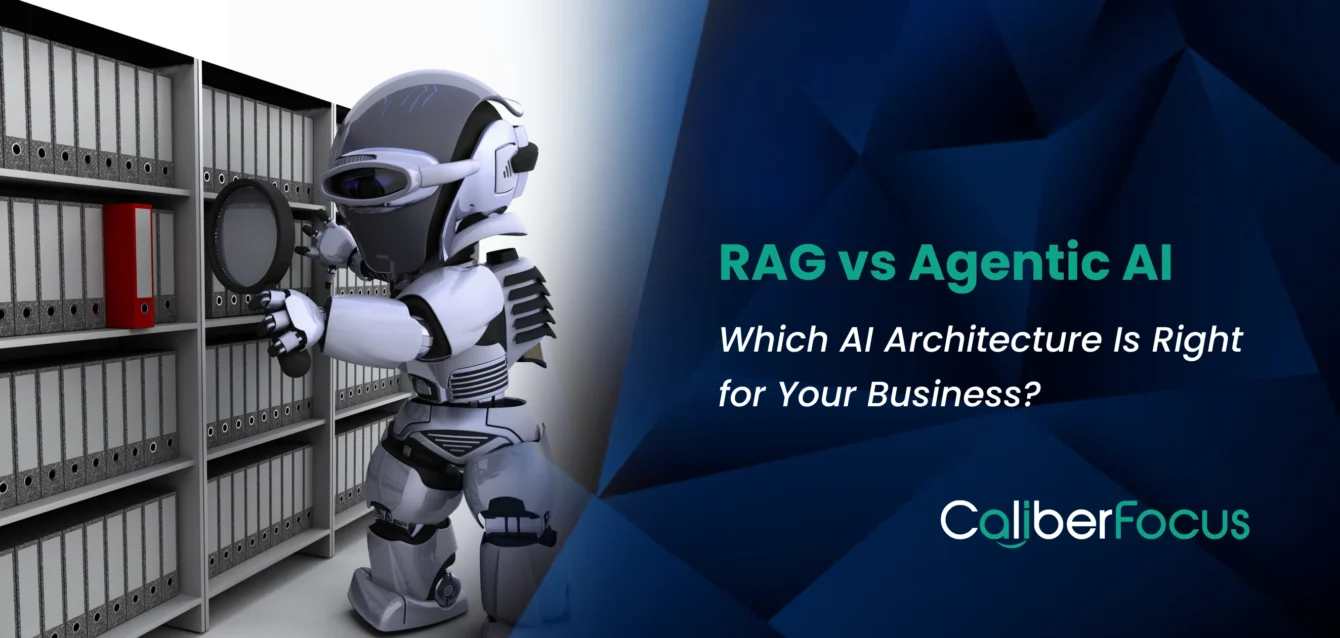
RAG vs Agentic AI: Which AI Architecture Is Right for Your Business?
Choosing between Retrieval-Augmented Generation (RAG) and Agentic AI depends on what you expect AI to accomplish. If your goal is to deliver accurate, up-to-date answers from enterprise knowledge, RAG is often the right starting point. If you want AI to make decisions, execute workflows, and complete multi-step tasks with minimal human intervention, Agentic AI offers greater autonomy.
Many organizations are now combining both approaches instead of treating them as competing technologies. RAG supplies trusted business knowledge, while AI agents use that information to reason, plan, and take action.
According to Grand View Research, the global Retrieval-Augmented Generation market is expected to grow at a compound annual growth rate of over 40% through the next decade, reflecting the rapid adoption of enterprise AI systems that rely on accurate knowledge retrieval.
Businesses exploring enterprise knowledge solutions often begin with Retrieval-Augmented Generation Services, then expand into AI agents as their automation needs mature.
In this guide, you’ll learn the difference between RAG vs Agentic AI, where each approach delivers the most value, when Agentic RAG becomes the better architecture, and how organizations can make the right investment based on their business goals.
RAG vs Agentic AI at a Glance
Teams often compare Agentic AI vs RAG as if one replaces the other. In practice, they solve different problems.
| Capability | RAG | Agentic AI |
| Primary purpose | Retrieve trusted information | Complete tasks autonomously |
| Uses enterprise knowledge | ✔ | ✔ |
| Multi-step planning | Limited | ✔ |
| Executes workflows | ✘ | ✔ |
| Best for | Knowledge assistants, enterprise search, document intelligence | Business process automation, operations, customer support, finance workflows |
| Human oversight | High | Configurable based on task complexity |
| Typical users | Customer support teams, healthcare providers, legal, internal knowledge teams | Operations, finance, healthcare, supply chain, enterprise automation |
The simplest way to understand the difference is this:
RAG helps AI answer questions using reliable information from your organization’s documents and knowledge repositories. Agentic AI goes beyond answering questions by deciding what actions to take next, coordinating multiple steps, and interacting with business systems to accomplish a defined objective.
For most enterprises, the conversation is no longer AI agent vs RAG. The real question is which architecture fits today’s business needs while supporting tomorrow’s automation roadmap.
When RAG Delivers the Most Business Value
Imagine a customer asking about a product warranty, an employee searching for an internal compliance policy, or a healthcare professional reviewing updated treatment guidelines. In each case, success depends on retrieving accurate information instead of generating a confident guess.
That is where RAG consistently performs well.
By connecting large language models with trusted enterprise data, RAG helps organizations produce responses grounded in current documents rather than relying solely on model training. This improves answer quality while reducing hallucinations, making it especially valuable for industries where accuracy matters.
Organizations typically adopt RAG when they need to:
- Build enterprise knowledge assistants
- Search across large document repositories
- Improve customer self-service experiences
- Support healthcare and clinical documentation
- Deliver accurate responses using frequently updated information
Healthcare organizations using RAG in Healthcare can retrieve updated payer policies, clinical guidelines, and operational documents in real time. Hospitals and revenue cycle teams manage thousands of payer policies, coding updates, and clinical guidelines that change regularly. A RAG-powered assistant can retrieve the latest policy before generating a response, helping staff spend less time searching across multiple systems.
For organizations evaluating enterprise knowledge solutions, our Retrieval-Augmented Generation Services explain how custom RAG architectures improve search quality, governance, and response accuracy across business-critical applications.
When Agentic AI Creates Greater Business Impact
Some business challenges require more than finding information.
Consider an insurance claim that needs validation, document review, fraud checks, customer communication, and system updates before it can be approved. Retrieving information is only one step. The real value comes from coordinating the entire workflow.
This is where AI agents excel.
Instead of waiting for individual prompts, Agentic AI can plan tasks, choose the next action, interact with business applications, and adapt its decisions as new information becomes available. That ability makes it well suited for operational processes involving multiple systems and repetitive decision making.
Common enterprise use cases include:
Customer operations
AI agents can classify requests, retrieve customer history, recommend resolutions, and initiate follow-up actions without requiring employees to switch between multiple applications.
Healthcare revenue cycle management
For organizations in healthcare, combining RAG with AI agents across intake, documentation, and claims has helped reduce manual effort, improve decision consistency, and give staff accurate information at every stage of patient and revenue cycle operations.
Financial operations
Finance teams use AI agents to reconcile invoices, validate transactions, identify exceptions, and route approvals based on predefined business policies.
IT and Internal Operations
Enterprise AI agents can monitor service requests, troubleshoot recurring issues, escalate incidents, and coordinate actions across different enterprise platforms.
As automation initiatives expand, many organizations begin with a focused workflow before scaling across enterprise operations. Building AI agent development services around domain-specific workflows helps organizations create secure, scalable agents that integrate seamlessly with existing business systems.
Ready for AI That Takes Action?
From claims validation to workflow orchestration, we build agents that execute.
Why Agentic RAG Is Gaining Enterprise Attention
As organizations mature their AI initiatives, the discussion shifts from RAG vs Agentic AI to how both can work together.
This is where Agentic RAG comes in.
Instead of treating retrieval and autonomous decision making as separate capabilities, Agentic RAG combines them into a single architecture. RAG retrieves the most relevant business knowledge, while AI agents interpret that information, decide the next course of action, and execute tasks across connected systems.
Consider a healthcare revenue cycle workflow. An AI agent receives a denied claim, retrieves the latest payer policy through RAG, validates the denial reason, recommends corrective actions, updates the case in the claims platform, and notifies the billing team. Each step depends on accurate knowledge as well as autonomous execution.
This approach is why enterprises evaluating agentic rag vs agentic ai often find that the comparison is incomplete. Agentic RAG is not a replacement for either technology. It extends their strengths to solve complex, end-to-end business processes.
Several open-source ecosystems are making this architecture more accessible through agentic rag tools and orchestration frameworks. However, selecting a framework is only one part of the implementation. Success depends on designing workflows, defining governance, integrating enterprise systems, and maintaining reliable retrieval pipelines that align with business objectives.
Agentic AI & RAG Capability Framework
Autonomous Outcomes (Agentic RAG)
Combines knowledge retrieval, reasoning, and action to automate complex outcomes.
Intelligent Execution (Agentic AI)
Plans, orchestrates, and executes multi-step workflows across systems.
Trusted Knowledge (RAG)
Retrieves accurate, relevant information from enterprise data to ground AI responses.
Data Foundation
The base layer of clean, secure, governed, and accessible data across your organization.
Improved Accuracy
Better decisions with reliable, trusted data.
Operational Efficiency
Automate workflows and save valuable time.
Risk & Compliance
Stronger governance, security, and auditability.
Continuous Improvement
AI that learns, adapts, and drives growth.
A Practical Decision Framework for Businesses
Instead of asking which technology is better, start by identifying the business problem you want to solve.
If you’re an SMB
Start with RAG if your priority is improving access to information. Customer support, sales enablement, internal knowledge bases, and policy search are common starting points because they deliver measurable value without requiring complex workflow automation.
If you’re a mid-market organization
You may benefit from combining knowledge retrieval with workflow automation. For example, customer service teams can retrieve product documentation while AI agents create support tickets, route requests, and trigger follow-up actions. Organizations investing in agentic AI workflows in healthcare RCM often follow this phased approach to improve operational efficiency.
If you’re an enterprise
Large organizations usually manage multiple business systems, compliance requirements, and department-specific processes. Here, Agentic RAG provides greater flexibility because AI agents can make decisions using trusted enterprise knowledge before taking action. Industries such as healthcare, banking, insurance, and manufacturing increasingly rely on this architecture to automate high-value workflows while maintaining governance and auditability.
The right architecture should reflect your operational goals, data maturity, and business priorities rather than industry trends.
Building AI Around Business Outcomes
Technology decisions become easier when they’re tied to measurable outcomes.
At CaliberFocus, every AI engagement begins with understanding how teams work today, where decisions slow down, and which processes depend on trusted enterprise knowledge. That foundation determines whether the solution requires retrieval augmented generation services, AI agent development services, or a combination of both.
For organizations in healthcare and revenue cycle management, combining RAG with AI agents for denial management has helped reduce manual effort, improve decision consistency, and provide staff with accurate information at every stage of the claims lifecycle. The objective is never to introduce more AI. It is to create systems that help teams work faster while maintaining accuracy and governance.
Final Thoughts
The conversation around RAG vs Agentic AI is evolving beyond choosing one technology over another. Organizations that see the strongest business outcomes are selecting architectures based on the problems they need to solve today while leaving room to scale tomorrow.
Whether your roadmap begins with enterprise knowledge retrieval, intelligent workflow automation, or a unified Agentic RAG architecture, building on a strong technical foundation ensures your AI investments continue delivering value as business needs grow.
Turn Fragmented Data Into Trusted Answers
Ground your AI in verified enterprise knowledge, built for accuracy, governance, and scale.
Explore RAG Services →Frequently Asked Questions
RAG retrieves relevant information from trusted enterprise data before generating a response. Agentic AI goes further by planning, reasoning, and executing multi-step tasks. RAG improves answer quality, while Agentic AI automates business workflows.
Yes. Many enterprise AI applications combine both approaches. RAG provides accurate business context, and AI agents use that information to make decisions, complete tasks, and interact with enterprise systems. This combined architecture is commonly known as Agentic RAG.
It depends on the use case. Traditional RAG is sufficient when the goal is knowledge retrieval or question answering. Agentic RAG becomes valuable when applications need to retrieve information, reason through multiple steps, and perform actions across business systems.
Most SMBs benefit from starting with RAG because it is faster to implement and immediately improves access to organizational knowledge. As processes become more mature, AI agents can automate repetitive tasks and expand operational efficiency.
The decision depends on business objectives. If the priority is accurate knowledge retrieval, RAG is usually the best fit. If the objective is workflow automation, AI agents provide greater value. Enterprises managing complex operations often combine both technologies through Agentic RAG to balance accuracy, governance, and automation.