


Every year, U.S. hospitals generate over 1.2 billion clinical documents. Lab results, discharge summaries, wearable readings, insurance claims, the data never stops. Yet for decades, nearly all of it collected dust in siloed systems, never doing the one thing it was always capable of: saving lives earlier.
That’s the shift predictive analytics in healthcare is making right now. Not someday. Now.
Clinicians are identifying patients likely to develop sepsis 6 hours before standard monitoring catches it. Administrators are preventing staffing shortfalls before they happen. Payers are flagging fraudulent claims before they’re paid. The predictive analytics healthcare industry has moved well past proof-of-concept, it’s become a core operational capability for organizations serious about outcomes.
The global market reflects this urgency. Valued at $18.49 billion in 2024, predictive analytics for healthcare is projected to reach $67.26 billion by 2030 at a 24.1% CAGR (Grand View Research, 2024). Yet fewer than 30% of healthcare organizations have deployed predictive models at scale (McKinsey Global Institute), which means the competitive gap between early adopters and laggards is widening fast.
This guide breaks down exactly how it works, where it delivers the most value, and what it actually takes to implement it well.
What Is Predictive Analytics in Healthcare?
Predictive analytics in healthcare is the use of historical data, machine learning, and statistical modeling to forecast future clinical and operational outcomes, before they happen.
Instead of reacting to a patient in crisis, care teams can now identify who is likely to deteriorate days in advance. Instead of reviewing last quarter’s cost overruns, administrators can anticipate resource shortfalls before they occur.
It sits in the middle of a three-part analytics spectrum, between descriptive analytics in healthcare and prescriptive analytics, each answering a fundamentally different question:
| Type | Key Question | Healthcare Example | Output |
| Descriptive | What happened? | Last quarter’s readmission rate | Historical report |
| Predictive | What will happen? | Which patients will be readmitted in 30 days? | Risk score / forecast |
| Prescriptive | What should we do? | Which intervention reduces this patient’s risk? | Recommended action |
Predictive analytics for healthcare spans the full care continuum, from prevention and early diagnosis through treatment planning and long-term prognosis
Scale Faster with Predictive Healthcare Analytics
Build intelligent coding and RCM workflows using predictive models, automation, and machine learning.
The Role of Big Data in Predictive Analytics in Healthcare
Predictive analytics in healthcare using big data has transformed what’s possible. Traditional models were built on small, structured datasets. Today, healthcare organizations draw from multiple simultaneous data streams:
- Electronic Health Records (EHRs): clinical history, diagnoses, medications
- Medical imaging: X-rays, MRIs, CT scans analyzed by computer vision
- Wearables and remote monitoring: real-time vitals, glucose levels, heart rhythms
- Claims and billing data: utilization patterns, denial trends
- Genomic data: disease predisposition and treatment response
- Social Determinants of Health (SDoH): housing, income, food access
The challenge is integration. Most healthcare organizations operate fragmented systems where EHRs, billing platforms, and monitoring tools don’t communicate. Predictive analytics in healthcare using big data only delivers value once those sources are unified through clean, governed data pipelines, ideally built on a modern lakehouse architecture supported by a solid cloud data modernization foundation, and enabled by a well-executed ETL migration to cloud that makes real-time, multi-source analytics technically feasible at scale.
HIPAA compliance adds another layer: all data environments must include access controls, encryption, Business Associate Agreements (BAAs), and audit trails from day one.
How AI Powers Predictive Analytics in Healthcare
AI predictive analytics in healthcare goes beyond traditional rule-based systems. Instead of manually coded thresholds, machine learning models identify patterns across thousands of variables simultaneously, patterns no human analyst could detect.
Three core modeling approaches drive most healthcare applications:
- Generalized Linear Models (GLMs) are the most interpretable. They work well for structured clinical data and are easier to explain to clinicians and regulators. The trade-off is that they can’t capture complex, non-linear relationships.
- Gradient Boosting and Random Forest models handle structured data with high accuracy and are widely used for readmission prediction, length-of-stay forecasting, and claim denial scoring.
- Deep learning and neural networks excel at unstructured data, clinical notes via NLP, imaging via computer vision, and continuous wearable streams. The trade-off is explainability, which matters enormously in clinical settings.
AI predictive analytics in healthcare inherits the biases in historical data. If past clinical practice underdiagnosed certain populations, the model will encode that disparity. Ongoing validation with diverse training datasets is non-negotiable.
Benefits of Predictive Analytics in Healthcare
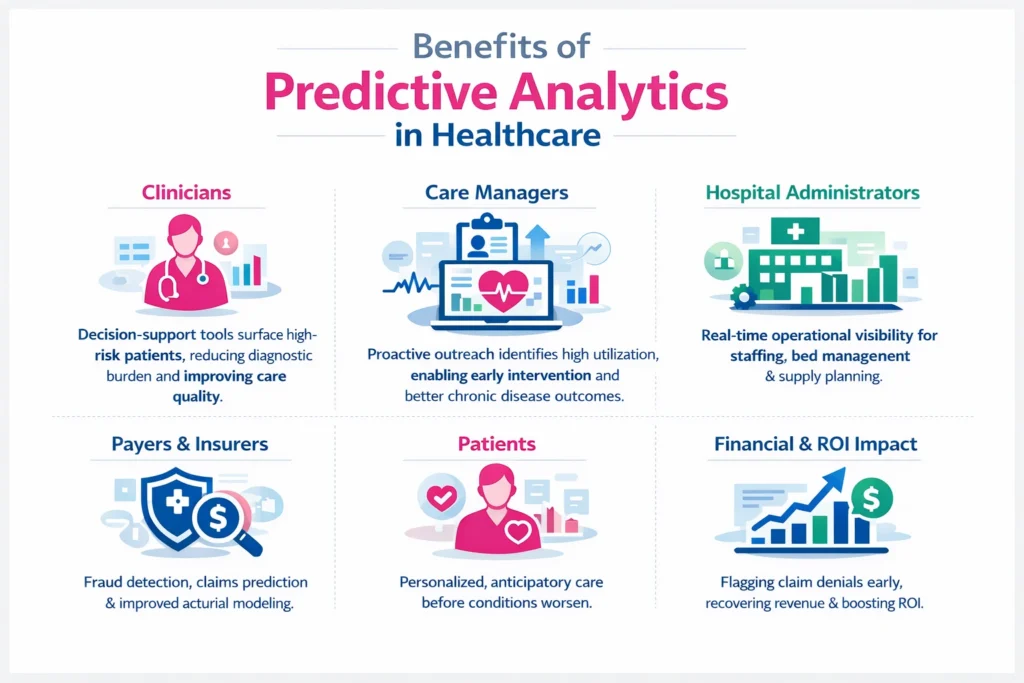
The benefits of predictive analytics in healthcare are measurable across every stakeholder group, and they extend well beyond the clinic into how data analytics is transforming patient care in healthcare at an operational level.
- For Clinicians Early warning systems surface high-risk patients automatically, reducing diagnostic burden and enabling more focused care. Sepsis detection models, for example, have been shown to reduce mortality by flagging deterioration up to 6 hours earlier than standard monitoring (Source: NEJM Catalyst).
- For Care Managers Proactive outreach replaces reactive crisis response. By identifying patients trending toward high utilization, care managers can intervene early, reducing avoidable admissions and improving chronic disease outcomes for conditions like heart failure, COPD, and diabetes.
- For Hospital Administrators Real-time visibility into patient admission volumes, staffing needs, and equipment maintenance replaces purely experiential decision-making. Predictive scheduling has cut nurse staffing waste by up to 15% in large health systems (Source: Health Affairs).
- For Payers and Insurers Fraud detection, claims outcome prediction, and pre-authorization modeling reduce administrative costs and improve actuarial accuracy.
- For Patients The benefit is simple: care teams act before a condition worsens, not just when a patient shows up in crisis.
On the financial side, predictive models that flag likely claim denials before submission can recover 3–8% of gross revenue, making revenue cycle analytics one of the highest-ROI applications in the predictive analytics healthcare industry.
Use Cases Across the Healthcare Industry
Predictive analytics is reshaping the predictive analytics healthcare industry across clinical, operational, and financial domains:
- Risk stratification: scoring patients for sepsis, readmission, or disease progression using EHR + SDoH data
- Population health management: segmenting patient panels by risk tier for proactive outreach
- Surgical and procedure outcome prediction: estimating complication risk before elective procedures
- Staff and bed management: forecasting census volume to optimize scheduling
- Revenue cycle: predictive models are driving measurable improvements in analytics for medical coding and RCM, reducing denial rates before claims are ever submitted
- Patient access and registration: predictive tools are reducing no-shows, streamlining prior authorizations, and improving throughput across patient access and registration analytics in healthcare
- Public health forecasting: modeling flu spread, outbreak risk, and disease burden by region
How a Multi-Hospital Network Unified Its Siloed Data
Implement descriptive analytics that drives smarter leadership choices, operational efficiency, and measurable outcomes, safely and compliantly.
Challenges and HIPAA Considerations
Implementing predictive analytics for healthcare carries real risks worth addressing directly:
- Data security: Aggregating multi-source data creates a larger attack surface. HIPAA-compliant architecture, role-based access, and BAAs with all vendors are required, not optional.
- Bias and accuracy: Models trained on biased historical data can widen health equity gaps. Validation across demographic subgroups before deployment is essential.
- Clinician adoption: The biggest practical barrier. Clinicians who don’t understand how a prediction was generated won’t act on it. Explainability and change management are as important as the technical build.
- Regulatory complexity: Beyond HIPAA, the FDA has expanded oversight of AI-based clinical decision support tools that meet the threshold of a medical device. Legal review should happen before deployment, not after.
How to Get Started
Most failed implementations share one pattern: deploying sophisticated models before the data foundation supports them.
A practical roadmap:
- Audit your data landscape: understand what you have, where it lives, and what gaps exist
- Define one high-impact use case: a focused pilot (readmission prediction, claim denial scoring) builds proof of value faster than a broad rollout
- Build a compliant data infrastructure: organizations running fragmented legacy systems need a cloud data modernization strategy before predictive modeling can scale reliably
- Build or partner: partnering with teams experienced in healthcare analytics significantly shortens the path to production
- Pilot, validate, scale: run in a controlled environment, validate against real outcomes, then expand
- Invest in clinician buy-in: technical success and clinical adoption are two different milestones
The Future of AI Predictive Analytics in Healthcare
The next evolution of AI predictive analytics in healthcare is the shift from prediction to prescription, models that don’t just identify risk but recommend specific interventions personalized to the individual patient. Precision medicine depends on exactly this: using genetic, clinical, and behavioral data together to determine not just what’s likely to happen, but what action is most likely to help.
Real-time predictive analytics at the point of care is also maturing. Wearables and remote monitoring devices generate continuous data streams that, when integrated with clinical records, enable dynamic risk scoring that updates as a patient’s condition changes, not just at the next scheduled appointment.
Lakehouse architecture is emerging as the infrastructure foundation for this future, combining the flexibility of data lakes with the structure and governance of data warehouses, enabling both AI model training and real-time analytics from a single source of truth.
The most important shift, though, isn’t technical. Organizations seeing the greatest impact are the ones investing in tech-clinician collaboration, creating shared ownership between data scientists and care teams so that models are built on real-world clinical logic, not just statistical patterns.
Ready to Move From Reactive Care to Predictive Care?
We help healthcare organizations build the data foundation, models, and workflows that make predictive analytics actually work in practice.
Conclusion
Predictive analytics in healthcare is not a trend, it’s becoming a core operational capability for organizations serious about improving outcomes, reducing costs, and staying competitive. The technology is mature enough to deliver real value. The challenge now is implementation: building the right data foundation, choosing the right use cases, navigating compliance, and bringing clinical stakeholders along.
Organizations that start with strategy, invest in clean data infrastructure, and treat analytics as an ongoing capability rather than a project will be the ones that see real results.
That’s exactly where CaliberFocus comes in. From data engineering and integration that unifies fragmented clinical and operational systems, to analytics and visualization that turns model outputs into decisions clinicians can act on, to data strategy consulting that helps healthcare organizations define a clear roadmap, CaliberFocus brings all three capabilities together under one roof. So your organization isn’t just collecting data. It’s using it.
Frequently Asked Questions
It uses historical and real-time data from EHRs, wearables, and claims to forecast clinical and operational outcomes. Data is collected, cleaned, modeled, and interpreted to support decisions before situations escalate. The model informs, the clinician decides.
AI identifies complex patterns across clinical data that traditional methods miss, detecting early warning signals for sepsis, readmission risk, and disease progression across thousands of simultaneous variables.
Earlier intervention, reduced readmissions, optimized staffing, lower claim denial rates, and more personalized patient care, with measurable ROI across clinical, operational, and financial domains.
EHRs, claims data, medical imaging, wearables, lab results, genomic data, clinical notes, and increasingly, social determinants of health. Data quality directly determines model reliability.
It enables real-time, multi-source modeling at scale, processing thousands of variables simultaneously, updating risk scores as conditions change, and detecting signals that no rule-based system could identify.

Antony Savari
Senior Vice President – Data & AI
Antony brings more than two decades of dedicated expertise in Information Technology and Data Analytics. His spans hands-on engineering to enterprise strategy, with deep experience across SAP Analytics and cloud-native data ecosystems. Known for building robust data cultures and guiding enterprises through AI transformation, he combines technical depth with visionary leadership to help organizations turn data into lasting business impact.