

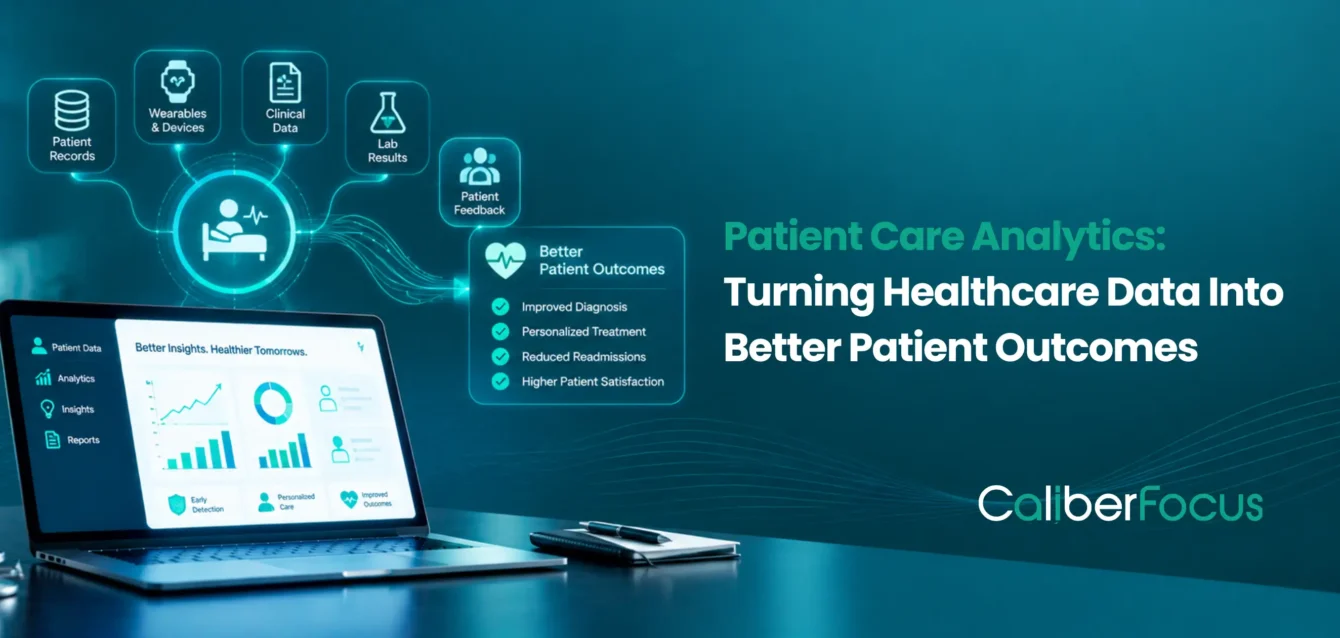
Patient care analytics turns clinical, operational, claims, and patient data into insights that help healthcare organizations identify risk, understand care gaps, support clinical decisions, and measure outcomes. Its value is not in producing more dashboards. It is in getting the right signal into the care workflow early enough for a clinician, care manager, or operational team to act.
That can mean identifying patients with elevated readmission risk, finding gaps in follow-up care, understanding where patients encounter delays, comparing outcomes across populations, or recognizing changes that may require intervention.
The challenge is connecting those decisions to reliable data. Effective patient analytics depends on integrated EHR and EMR data, claims and operational information, appropriate analytical models, and a clear path from insight to action. CaliberFocus Data Analytics Services support organizations in building that broader data-to-decision capability.
Have Patient Data but Struggling to Use It for Care Decisions?
Connect clinical, operational, and patient data to identify risk, care gaps, and outcome patterns that healthcare teams can act on.
At a Glance
How Patient Care Analytics Supports Care Decisions
Patient care analytics becomes useful when it connects a patient signal to a decision that a care team can act on. Within broader data analytics in healthcare, the analytical approach changes depending on the care question, available data, and action the organization needs to support.
| Care decision | Analytics focus | What it can surface |
| Which patients may need earlier attention? | Patient risk analytics | Higher-risk patients or cohorts requiring review |
| Who may require additional support after discharge? | Readmission analytics | Readmission risk indicators for follow-up prioritization |
| Where is the care journey breaking down? | Patient journey analytics | Delays, access barriers, or workflow bottlenecks |
| Are interventions producing the intended results? | Patient outcomes analytics | Outcome patterns across cohorts, pathways, or locations |
| Where are patients disengaging from care? | Patient engagement analytics | Follow-up, adherence, or engagement patterns |
| Which populations require targeted intervention? | Population health analytics | Cohort-level patterns in risk, utilization, and outcomes |
The distinction matters because patient analytics is not one type of analysis. A readmission program may require predictive risk analysis, while evaluating treatment performance may depend on outcomes analytics. Understanding access problems may require patient journey and operational data.
The right starting point is therefore not “Which analytics capability should we deploy?” but “Which patient care decision are we trying to improve, and what data and analysis are required to support it?”
How Patient Care Analytics Connects Patient Data to Risk, Care Gaps and Outcomes
Healthcare organizations generate patient information across EHR and EMR systems, claims, labs, scheduling platforms, patient interactions, and operational systems. Patient care analytics brings these data points together to identify specific signals such as elevated patient risk, potential readmissions, gaps in care, changes in outcomes, and friction across the patient journey.
The process can be viewed as a decision pathway:
The important transition happens between finding a pattern and enabling a care decision. For example, readmission analytics may identify a patient with elevated risk, but the analysis becomes operationally useful only when that information reaches the team responsible for discharge planning or follow-up. Similarly, patient journey analytics may identify recurring access delays, but the organization still needs to determine where those delays occur and which workflow needs attention.
The reliability of these signals also depends on the underlying patient information. EHR data analytics, claims analysis, and operational data may each provide only part of the picture. Connecting relevant sources and maintaining sufficient data quality gives clinical and patient analytics a more complete basis for identifying patterns and measuring outcomes.
Where those sources remain fragmented, Data Engineering and Integration Services can support the data foundation required to connect clinical, claims, and operational information for patient analytics.
Where Patient Care Analytics Is Applied Across the Care Journey
The role of analytics changes as patients move from access and treatment through discharge, follow-up, and ongoing care. This creates several distinct applications for healthcare organizations.
Before and During Care: Identify Patient Risk Earlier
Predictive analytics in healthcare can use relevant historical and current data to identify patterns associated with defined outcomes and help prioritize patients or populations for further review.
Applications can include:
- Patient risk stratification
- Readmission risk analysis
- Identification of patients requiring additional follow-up
- Monitoring patterns associated with complications or deterioration
The prediction itself is only one part of the use case. A patient risk analytics program also needs to determine when the risk is calculated, who receives the information, what supporting context is available, and what action can reasonably follow.
Across the Care Journey: Find Where Patients Encounter Friction
Patient journey analytics examines patterns as patients move through scheduling, registration, treatment, discharge, and follow-up.
Combining journey data with patient experience analytics and patient engagement analytics can help organizations investigate different types of care friction.
| Observed pattern | What analytics can help investigate |
| Longer time to appointment | Location, specialty, provider, or scheduling constraints |
| Missed appointments | Patient groups, appointment types, or recurring access patterns |
| Delayed follow-up | Handoffs between discharge and follow-up workflows |
| Declining engagement | Changes in adherence, communication, or follow-up behavior |
| Repeated access issues | Where friction consistently occurs across the patient journey |
At the front end of the journey, patient access and registration analytics can help identify recurring patterns in scheduling delays, registration processes, and other access barriers.
After Care: Determine Whether Outcomes Are Improving
Patient outcomes analytics examines patterns in what happens after care is delivered. Rather than treating an outcome metric as an isolated number, organizations can compare results across patient cohorts, care pathways, service lines, locations, or periods.
A typical analysis might follow:
Outcome measure → segment by relevant cohort → identify variation → investigate contributing factors → adjust the care process where appropriate → measure subsequent outcomes
This can support analysis of readmissions, complications, utilization, treatment outcomes, and other measures relevant to a specific care program.
For example, CaliberFocus has applied analytics to clinical decision-making and readmission reduction, connecting patient data with a defined healthcare outcome rather than treating analytics as a standalone reporting exercise.
You are right. That replacement still repeats the same logic we already established in the earlier sections.
By this point, the blog has already covered:
- Different patient care decisions and their corresponding analytics approaches.
- The flow from EHR, EMR, claims, labs and operational data into risk, care-gap and outcome signals.
- Predictive analytics for patient risk and readmissions.
- Patient journey, access and engagement analytics.
- Patient outcomes analytics.
- The relationship between analytics signals and care-team action.
So another section explaining descriptive → predictive → data quality → workflow → intervention adds semantic keywords, but not enough new information. It should not remain in that form.
Instead, this part of the blog should address a question we have not answered yet and that matters to healthcare leaders implementing patient care analytics:
What Can Limit the Reliability of Patient Care Analytics?
Patient care analytics can produce sophisticated risk scores, patient segments, and outcome measures, but their usefulness depends on whether the underlying data represents the patient and care process accurately.
Several issues can change what the analytics sees:
| Analytics constraint | Why it matters for patient care |
| Incomplete longitudinal records | Important encounters, diagnoses, treatments, or follow-up events may be absent from the analysis |
| Different definitions across systems | The same clinical or operational measure may not be represented consistently across facilities or applications |
| Delayed data availability | A signal may arrive too late to support a time-sensitive intervention |
| Patient identity mismatches | Records belonging to the same patient may not connect correctly across systems |
| Missing workflow context | The data may show an outcome without capturing the operational circumstances that contributed to it |
| Changes in patient populations or care processes | Historical patterns may become less representative of current conditions |
This is particularly important when organizations move from retrospective healthcare BI toward patient risk analytics, readmission analytics, and real-time healthcare analytics. A dashboard showing last quarter’s outcomes can tolerate different data latency than a model intended to identify a patient who may require attention before discharge.
Healthcare data quality therefore needs to be evaluated against the intended patient care use case rather than treated as a generic data-management metric. Completeness, consistency, timeliness, and appropriate clinical context can have different importance depending on the decision being supported.
Healthcare interoperability creates a related challenge. EHR, EMR, laboratory, claims, scheduling, and other systems may contain different parts of the patient journey. Making those sources available for analysis does not automatically make them analytically consistent. Governance is still needed around definitions, ownership, quality rules, and how information should be interpreted across systems.
Build a Data Foundation Your Patient Analytics Can Rely On
Address fragmented healthcare data, inconsistent definitions, and data quality issues before they limit the reliability of patient risk and outcomes analytics.
Getting Patient Analytics Into Clinical Workflows
This section should stay, but we should make it much shorter because the earlier sections have already established the insight-to-action concept.
A patient risk score, readmission indicator, or care-gap signal only becomes relevant to care delivery when the responsible team can use it at the appropriate decision point.
For example:
Elevated readmission risk identified before discharge
→ Relevant factors available for review
→ Care team evaluates the patient
→ Follow-up or other intervention is determined
→ Subsequent outcome is measured
The important implementation question is therefore not simply whether the analytics can identify risk. Healthcare organizations need to determine where the signal appears, who reviews it, what supporting information is available, and what action can reasonably follow.
That makes clinical workflow integration particularly relevant for patient care analytics intended to influence active care decisions rather than retrospective reporting.
What Healthcare Leaders Should Evaluate Before Investing
A patient care analytics initiative should begin with a defined care or operational decision.
Before implementation, evaluate five areas:
- Decision: What specific decision or intervention should analytics improve?
- Data: Which clinical, claims, operational, or patient data is required?
- Analytics: Is descriptive, diagnostic, predictive, or another analytical approach appropriate?
- Workflow: Who receives the insight, where, and at what point in the care process?
- Measurement: Which outcome determines whether the initiative is producing value?
The fifth question is especially important. Success should be connected to the original use case, whether that involves readmissions, care gaps, intervention timeliness, patient access, workflow efficiency, or another defined measure.
That keeps the investment focused on better decisions and measurable operational or care outcomes, rather than analytics adoption for its own sake.
Planning a Patient Care Analytics Initiative?
Discuss your priority use case, current data environment, workflow requirements, and expected outcomes with a CaliberFocus data analytics expert.
Key Takeaways
Frequently Asked Questions
EHR reports and healthcare BI can provide visibility into what has happened, but that may not be enough when the organization needs to identify patient-level risk, detect care gaps, compare outcomes across cohorts, or prioritize patients for follow-up. The decision should start with what existing reporting cannot currently tell the care team, rather than adding another analytics platform.
Data readiness should be evaluated against the intended use case. A readmission model, for example, may require different clinical, discharge, utilization, and follow-up data than patient access analytics. Healthcare leaders should assess whether the required data is sufficiently complete, consistent, timely, and connected across relevant EHR, EMR, claims, laboratory, and operational systems.
Not necessarily. Attempting to integrate every available source before proving a use case can expand scope without improving the initial decision. Start by identifying the patient care question, determine which data is necessary to answer it reliably, and expand healthcare data integration as additional use cases require broader patient context.
A predictive score should not be treated as a clinical decision by itself. Healthcare organizations need to understand the data used, evaluate model performance for the intended patient population and use case, determine how results will be validated and monitored, and define how clinicians should interpret the signal alongside other patient information. Predictive analytics should support clinical judgment rather than replace it.
It can if implementation focuses on generating signals without designing how they enter the clinical workflow. Before deployment, organizations should determine which findings warrant attention, who receives them, where they appear, what supporting context is provided, and what action can follow. The objective should be decision support, not another queue of analytics notifications.