





What Is EHR Automation and Why Healthcare Cannot Afford to Wait
Most EHR platforms were never built for what healthcare teams are putting them through today.
They were designed to store and retrieve patient records. What they were not designed for is the volume of clinical decisions, administrative handoffs, and billing actions that now run through them every single day.
That mismatch is where the cracks show up:
- Physicians spending two hours documenting for every one hour of patient care
- Claim denials piling up from coding gaps that automation could catch upstream
- Prior auth requests sitting for days because nobody owns the follow-up
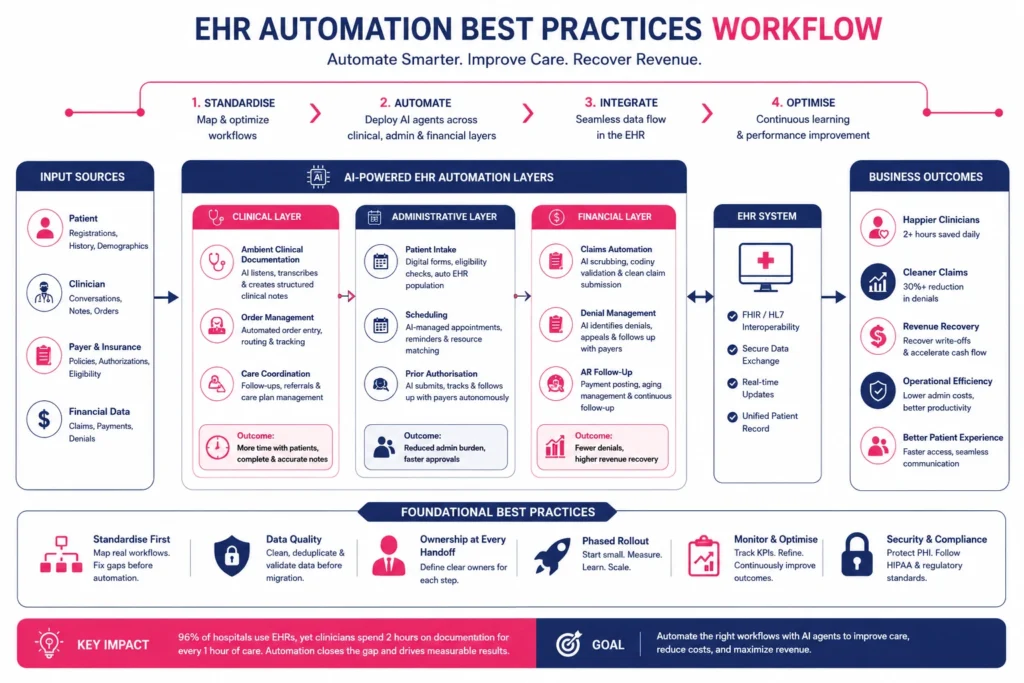
The best practices for automating EHR processes in 2026 are about building the intelligence layer that handles this work so your team does not have to. That layer covers three areas most organisations still run manually:
Clinical: documentation, order management, care coordination
Administrative: intake, scheduling, prior authorisation
Financial: claim scrubbing, denial management, AR follow-up
The financial layer alone is covered in full across AI agents for RCM. Leave any one of these areas unaddressed and the cost compounds across the other two.
96% of acute care hospitals in the US have an EHR, yet clinicians still spend two hours documenting for every one hour of direct patient care. Billing errors cost the system $262 billion a year. And 30% of claim denials are avoidable, meaning they never should have happened in the first place.
Where EHR Automation Stands in 2026 and What Leading Organisations Are Doing Differently
Having an EHR and actually using it well are two very different things.
96% of acute care hospitals are on an EHR platform. Most digitised their records and stopped there. What they are left with is rule-based automation that holds up fine for predictable, repeatable work. The moment a payer updates a policy, a claim carries an unusual diagnosis code, or a workflow hits any variation from the script, the rules break down.
Here is what that breakdown costs right now:
| What Is Breaking | The Cost |
| Clinician admin burden | 90 minutes lost per clinician per day |
| Avoidable claim denials | 86 to 90% of all denials are preventable |
| Fragmented data exchange | Up to $570 billion in annual administrative waste |
| AI readiness gap | Only 18% of organisations are ready to deploy AI in care delivery |
The organisations actually narrowing that gap are not adding more rule sets. They have moved to autonomous agents that read clinical and operational context, make decisions, and act across full workflows without needing a human to trigger each step. Generative AI use cases in healthcare covers where that shift is already producing measurable results.
Best Practice 1: Standardise Your Workflows Before You Automate Them
Automating a broken workflow does not fix it. It just breaks it faster.
Before a single agent is deployed, the workflow it runs on needs to be mapped as it actually exists. Not how it looks in a process document. How it runs on a Tuesday afternoon when two staff members are out, the payer portal is slow, and a physician is still finishing morning notes.
That version is what gets automated. If it is messy going in, it comes out messier.
EHR implementation best practices start here. Here is what that process looks like in practice:
Step 1: Map the real workflow, not the official one Shadow the billing team. Sit with intake staff. Talk to clinical coordinators. Document every workaround and every point where someone picks up the phone because the system cannot handle an exception.
Step 2: Separate structural problems from human ones A structural bottleneck is a system design issue automation can fix. A training or ownership gap is not. Deploying an agent into a handoff where nobody owns the output produces the same delay with less visibility into why.
Step 3: Cleanse before you migrate Legacy records that are incomplete, inconsistently coded, or duplicated will compromise every downstream automation that depends on them. This step is consistently underestimated in both time and cost.
Step 4: Name an owner at every handoff Who reviews the documentation output. Who receives the denial alert. Who approves the prior auth submission. Without clear ownership, automation creates accountability gaps instead of closing them.
Step 5: Roll out one department at a time It lets you catch integration failures, measure real impact, and train staff without the pressure of a full-facility cutover. AI in hospital operations for smarter resource management shows what phased deployment delivers at each stage.
Best Practice 2: Start With Ambient Clinical Documentation, the Highest-ROI Layer in Any EHR Stack
If there is one place to start before anything else, it is ambient clinical documentation.
Here is exactly what happens during a visit when it is running:
The AI listens to the patient-provider conversation in real time. Speech recognition and NLP work in the background, structuring a complete clinical note as the consultation unfolds. By the time the visit ends, the note is ready. The physician reviews it, approves it, and it goes straight into the EHR. No typing during the visit. No catching up on notes at 9pm.
See how AI agents for clinical documentation handle this across both structured and unstructured clinical data.
Cleveland Clinic’s pilot put numbers to it: a 35% reduction in documentation time, with physicians reclaiming more than two hours of direct patient care per day.
But the downstream effect is where it gets more interesting. More complete notes produce more accurate codes. More accurate codes produce cleaner claims. Cleaner claims mean fewer denials, and that happens without any additional RCM effort on your team’s end.
The clinical documentation layer and the revenue cycle are not separate problems. Fixing one moves the needle on the other.
“A physician who is not typing is a physician who is listening.”
Ready to Close the Gap Between Your EHR and Your Revenue Cycle?
Our AI agents handle the clinical, administrative, and financial layer so your team does not have to.
Best Practice 3: Automate the Administrative Layer: Intake, Scheduling, and Prior Authorisation
A significant portion of your team’s day is spent on work that should never reach a human desk.
Here is where that time is going and what automation does about it:
Patient Intake Manual check-in creates a backlog at the very first touchpoint. Digital self-serve forms replace the process entirely, auto-populating directly into the EHR with no rekeying and no transcription errors. AI-powered patient intake for healthcare operations covers how removing that bottleneck changes the pace of everything that follows.
Scheduling Cancellation slots go unfilled. Reminders go out late or not at all. AI-managed scheduling fills gaps automatically, matches appointment types to the right clinical resources, and sends reminders based on patient preferences without staff involvement.
Prior Authorisation This is where administrative drag hits revenue hardest. Manual auth processes add an average of eleven days to approval timelines. Prior authorisation AI agents submit requests, track status, and follow up with payers on their own. When a request stalls or needs additional documentation, the agent handles it. For organisations where eligibility gaps are quietly driving denial patterns, AI agents for eligibility verification show why the fix needs to happen before the auth request even goes out.
Best Practice 4: Close the Revenue Leak: Claims, Denials, and AR Follow-Up
If 68% of denied claims are being written off without a single rework attempt, that is not a payer problem. That is a workflow problem.
And it starts further back than most teams realise. Incomplete documentation produces claim errors. Claim errors produce denials. Denials that go unworked become permanent write-offs. The revenue cycle cannot be fixed without also fixing the documentation layer feeding it.
Here is how automation closes each part of that loop:
Claims Automated scrubbing catches coding errors and missing data before submission, running continuously across ICD-10, CPT, and HCC categories, not as an end-of-day batch job.
Denials When a rejection comes in, the agent identifies the reason, builds the appeal, and routes it to the payer without a manual touchpoint. For follow-up that requires an actual call, it handles that too. See how AI agents for denial management work end to end without pulling anyone from your RCM team.
AR Aging queues are worked continuously. Claim processing and payment posting close the loop so nothing sits waiting on a person to remember to act. AI agents for accounts receivable covers how that looks across a live revenue cycle.
To put the revenue impact plainly: 30% of denials are avoidable with better upstream automation. 68% of denied claims are written off without a single rework attempt. The average manual prior auth delay runs eleven days. None of those figures represent payer decisions. They represent workflow gaps your team is absorbing every single day.
Implementation Challenges
Four Challenges That Slow EHR Automation and How to Navigate Each One
The gap between knowing what to do and actually getting it live is where most EHR automation initiatives stall.
| Challenge | What It Looks Like | How to Navigate It |
| Clinician resistance | Staff find workarounds, adoption quietly stalls | Appoint clinical champions before go-live, not after resistance surfaces |
| Legacy system integration | Interfaces hold up in demos, break under real patient volume | Budget for integration architecture from day one, build in room for unknowns |
| Alert fatigue | Clinicians start ignoring automated alerts entirely | Suppress non-critical alerts before launch, review thresholds every quarter |
| PHI exposure | Patient data passing through unsecured RPA endpoints | Deploy bots on local private networks, never through public cloud endpoints without proper controls |
Compliance is not something to layer on after the fact. AI agents for healthcare compliance oversight covers what needs to be built in from day one and what autonomous agents can govern as automation scales, without adding to your team’s workload.
Choosing the right partner
What an Effective EHR Automation Partner Actually Looks Like
A vendor who has never mapped a clinical workflow will automate the wrong things. You will not find out until you are already live.
Before you commit, here is what to require:
Clinical workflow expertise before technology Ask how they approach workflow discovery. If the conversation jumps straight to platforms and tools, that is worth noting.
Experience across both RCM and clinical documentation Fixing one side without the other leaves the largest recovery opportunity untouched. Ask specifically how they have handled implementations that span both the clinical documentation layer and the revenue cycle, and what outcomes they can show from each.
FHIR and HL7 interoperability built into delivery Not figured out after implementation begins. Ask specifically how they handle legacy system integration and what happens when an interface breaks in a live environment.
A real post-implementation process A deployment handoff is not a delivery. Thirty and ninety day reviews are the baseline. Ask what metrics they track and whether they can show specific before-and-after numbers on denial reduction and clinician hours recovered from previous engagements.
Frequently Asked Questions
Start by standardising your workflows before any automation is layered on. Then prioritise the highest-volume tasks: ambient clinical documentation, prior authorisation, claim scrubbing, and denial management. Build on FHIR and HL7 for interoperability, keep PHI protected through private network deployment, and run optimisation reviews at 30 and 90 days after go-live.
Ambient clinical documentation uses AI, speech recognition, and NLP to generate structured medical notes from live patient-provider conversations. It runs in the background during the visit, produces a complete note without any keyboard input from the physician, and pushes it straight into the EHR, saving two to three hours of documentation time per physician per day.
Clean clinical documentation produces accurate claims. Accurate claims reduce denial rates. Automated denial management recovers revenue that manual workflows write off without a second attempt. The clinical and financial layers feed each other directly, and improving the documentation side has a measurable effect on financial performance without adding RCM headcount.
Look for real experience in clinical workflow design, autonomous agent development, RCM, and FHIR interoperability. They should have a structured post-implementation process and be able to show specific before-and-after numbers on denial reduction and clinician hours recovered, not just a list of clients and deployment timelines.

Sundar Rengarajan
Senior Vice President – Artificial Intelligence
Sundar leads the strategy, development, and operationalization of AI-driven products and solutions. With over 24 years of experience in technology and seven years of focused AI expertise, he excels at transforming complex business challenges into scalable, intelligent solutions. Known for his analytical mindset and visionary thinking, Sundar helps organizations operationalize AI strategically, enhancing decision-making, efficiency, and long-term business performance.