


Over 60% of ERP initiatives miss their original objectives. Budget overruns. Delayed go-lives. Post-launch firefighting that eats the ROI the project was supposed to deliver.
A dynamics 365 finance and operations implementation is one of the most operationally complex projects an enterprise will run. Most teams step into it carrying the same unresolved questions: Should Finance and Supply Chain Management go live together or in phases?
- How much customization is acceptable before every Microsoft update becomes a regression risk?
- How do you migrate years of legacy data without importing its problems into a clean system?
Here is the harder question most organizations avoid asking early enough:
is the delay in your Dynamics 365 F&O implementation protecting you from a bad rollout, or quietly becoming the reason one never delivers?
Confusion about where to start and how much internal readiness is enough keeps more implementations stuck in planning than any technical complexity ever does. Organizations weighing the foundational case first will find the measurable benefits of Dynamics 365 for enterprises worth reviewing before getting into delivery mechanics.
Your F&O Implementation Deserves More Than a Handoff
Let’s build Dynamics 365 Finance and Operations around how your business actually operates.
What Is Dynamics 365 Finance and Operations, and Who Is It For?
Dynamics 365 F&O is a cloud-hosted ERP platform that unifies finance, supply chain, manufacturing, and project operations on a single Azure-backed data model. Microsoft licenses it through two separate applications: Dynamics 365 Finance covering GL, AP, AR, and budgeting, and Dynamics 365 Supply Chain Management covering procurement, inventory, warehouse, and production. Most enterprise deployments require both. Missing this distinction early creates budget surprises later.
F&O is built for:
- Multi-entity organizations consolidating financials across subsidiaries and regions
- Global operations requiring multi-currency, multi-language, and country-specific compliance
- Complex manufacturers and distributors needing advanced warehouse management and master planning
- Enterprises that have outgrown mid-market ERP and need a platform that handles transaction volume without workarounds
Organizations comparing options often look at Dynamics 365 Business Central. Business Central suits simpler mid-size operations. F&O is the right platform when multi-entity consolidation or global regulatory compliance is in scope.
Pre-Implementation Planning: The Phase Most Teams Rush Through
The most common root cause of Dynamics 365 finance implementation failures is not technical. It is organizational.
Start with objectives that have a number attached
“Improve financial reporting” is not a project objective. “Reduce month-end close from 14 days to 5 within 6 months of go-live” is. Vague goals give implementation teams nothing concrete to design toward. Every module decision and customization debate traces back to whether the team has a measurable target or a directional aspiration. One produces a genuine competitive edge in ERP. The other produces a technically complete system that moves nothing.
The fit-gap analysis is where implementation cost is actually set
Not during vendor negotiation. Here. Map every business requirement against standard D365 F&O capabilities before any configuration decision is made. Every customization accepted at this stage extends the timeline, raises cost, and turns every future Microsoft update into a regression exercise.
On budget
A dynamics 365 finance and operations implementation ranges from $250,000 to $3 million or more depending on module scope, integrations, and compliance requirements. Single-entity Finance deployments can complete in 6 to 9 months. Multi-country enterprise rollouts run 18 to 24 months. Compressing either estimate without reducing scope shifts cost from the project budget into the recovery budget.
Implementation Methodology: Phases That Cannot Be Skipped
Microsoft’s Success by Design framework governs implementing Microsoft D365 for Finance and Operations through four phases: Initiate, Implement, Prepare, and Operate.
Step 1: Discovery and Solution Design
Solution architects map every requirement to the D365 data model, define the environment strategy across Development, Test, UAT, and Production, and lock customization decisions. The output is a solution blueprint. No configuration begins before the steering committee approves it.
Step 2: Build and Configure
Configuration runs module by module against the approved design. Where customizations are unavoidable, X++ development follows Microsoft’s extension model rather than overlayering. Data migration design and integration builds run in parallel here, not after.
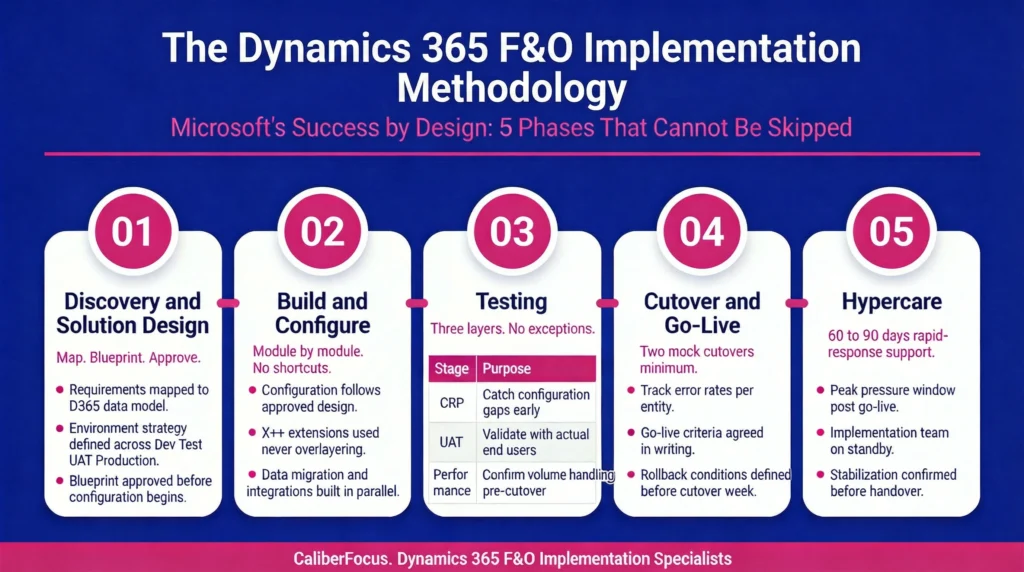
Step 3: Testing
| Testing Stage | What It Catches | When It Runs |
| Conference Room Pilot (CRP) | Configuration gaps and process misalignments | Before UAT begins |
| User Acceptance Testing (UAT) | Business process validation by end users | After CRP sign-off |
| Performance Testing | Transaction volume handling on Tier-2 environment | Before cutover planning |
Skipping any layer moves that risk into production where resolution costs more and disrupts live operations.
Step 4: Cutover and Go-Live
Run a minimum of two full mock cutovers. Track data load duration, error rates per entity, and manual intervention points. Go-live criteria and rollback conditions must be agreed in writing before cutover week, not decided under pressure.
Step 5: Hypercare
The first 60 to 90 days post go-live carry peak operational pressure. A structured hypercare plan keeps the implementation team on rapid-response terms while the organization stabilizes.
Dynamics 365 F&O Consolidating Financial Operations for a Healthcare Provider
Fragmented AP, AR, and billing unified on one platform. Faster period close, cleaner revenue data, zero manual reconciliation.
Integrations: Architecture Decisions That Follow You for Years
A Dynamics 365 F&O implementation rarely exists in isolation. For organizations running Microsoft Dynamics 365 CRM alongside F&O, the Dual-write framework enables real-time bidirectional synchronization of customer, product, and order data across both systems. REST API and OData services suit synchronous real-time exchange. Azure Service Bus handles high-volume asynchronous scenarios where tight system coupling creates risk.
For organizations in regulated industries, Dynamics 365 security and compliance requirements govern how integration endpoints must be configured, audited, and monitored throughout the implementation lifecycle.
Why Implementations Fail: The Patterns That Repeat
Dynamics 365 F&O implementations fail in predictable sequence. Scope creep compounds silently until timeline and budget no longer reflect the project anyone approved. Over-customization converts every platform update into a regression exercise. Poor data quality migrated at cutover becomes a live operations crisis.
Each failure mode is manageable alone. The wrong partner amplifies all three simultaneously. An experienced team of Microsoft Dynamics implementation partners brings formal architecture, change control discipline, and hypercare commitment. In verticals where Dynamics 365 implementation challenges in healthcare carry distinct regulatory constraints, industry-specific experience is a delivery requirement, not a preference.
Copilot and AI in 2025 Implementations
The 2025 dynamics 365 finance and operations implementation carries embedded AI that most current project plans still treat as post go-live additions.
That is the wrong sequence.
Copilot for Finance delivers natural language querying of financial reports, AI-assisted collections prioritization, and journal entry anomaly detection before period close. In Supply Chain, predictive disruption alerts and AI-suggested purchase orders reduce manual planning load. Organizations running Dynamics 365 for Sales can extend Copilot across the full customer-to-cash cycle, connecting pipeline signals to supply planning in real time.
Copilot requires Dataverse connectivity and specific Microsoft 365 licensing. These are architectural decisions that belong in solution design, not the post go-live roadmap.
How CaliberFocus Approaches Dynamics 365 F&O Implementation Differently
Most implementation partners configure D365 F&O and hand it over. CaliberFocus brings in-house capabilities across Dynamics 365, Data Engineering, AI, and Analytics under one delivery team. No handoffs between the ERP consultant and the data team. No gap between what the system delivers and what the business can act on.
AI is not an add-on. It is the starting point. Copilot readiness, Dataverse connectivity, and AI-assisted financial workflows are designed into the solution blueprint from day one, not retrofitted after go-live.
On data migration, there is no external dependency. Azure Data Factory pipelines, SAP and Oracle transformations, and DMF-governed entity migrations are handled within the same team. Data quality and cutover timelines stay under direct control throughout.
Through ImpactBI, D365 financial data extends into Analytics as a Service, giving finance leaders operational insight that standard Power BI configurations do not reach without significant additional build.
| What most partners do | What CaliberFocus delivers |
| F&O and CRM handled by separate teams | Full Dynamics 365 suite under one delivery team |
| Copilot addressed post-stabilization | AI architecture designed at blueprint stage |
| Reporting limited to standard dashboards | Extended analytics through ImpactBI |
For regulated industries including healthcare and RCM, compliance constraints and audit trail requirements are established delivery ground, not new territory.
Frequently Asked Questions
The disruption is real, but staying on a system that limits multi-entity consolidation and forces manual workarounds carries a higher long-term cost. The decision is about the total cost of staying, not just the cost of moving.
Three signals indicate unreadiness: processes are undocumented, the executive sponsor treats it as an IT project, and no one owns data cleansing. Readiness is about honest visibility into gaps before the project baseline is set.
If financial close and procurement are tightly coupled today, separating them creates reconciliation problems during the interim. If they run independently, phasing reduces go-live risk. This decision belongs in solution design.
If fewer than 30% of users need it to perform their role, it belongs in Power Automate, not the core system. Customization without formal change control is where post go-live technical debt consistently starts.
A formally agreed hypercare period, documented rollback conditions, and two completed mock cutovers create a recoverable situation. These need to be in place contractually before cutover week, not negotiated after problems surface.