

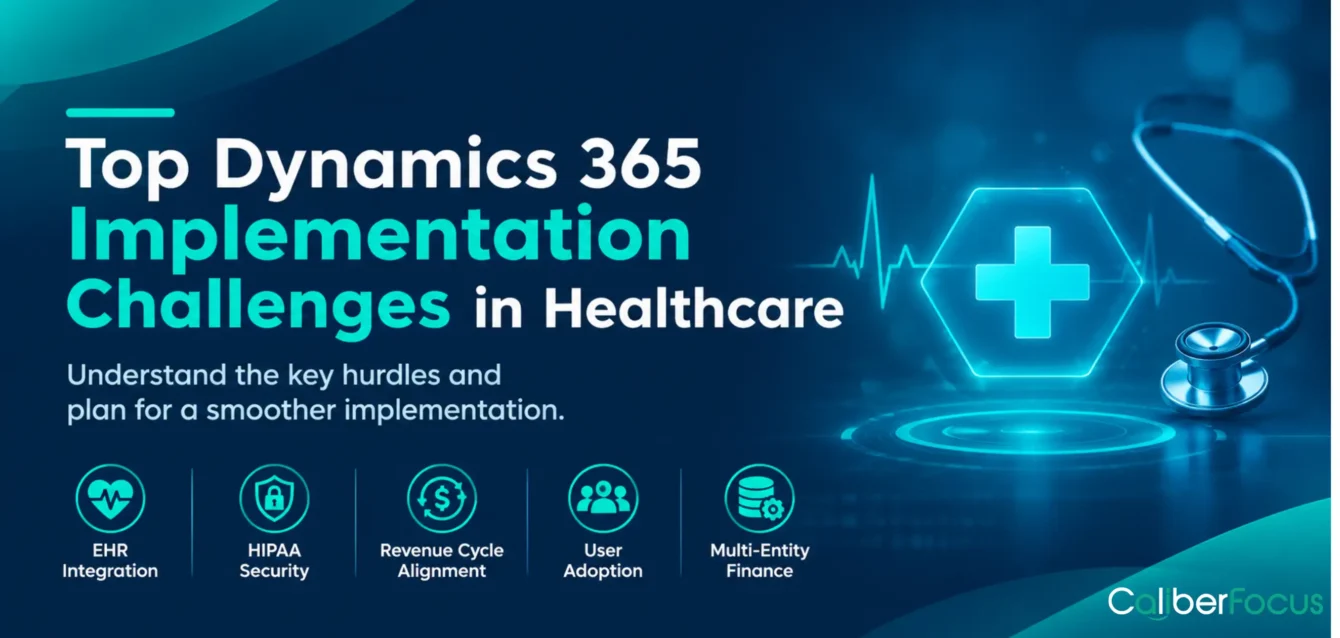
Healthcare organizations adopting Microsoft Dynamics 365 face challenges that extend beyond software configuration. Existing EHR platforms, revenue cycle systems, protected health information, financial structures, and established workflows create dependencies that must be resolved throughout implementation.
The five major Dynamics 365 implementation challenges in healthcare are EHR integration, HIPAA security, revenue cycle alignment, user adoption, and multi-entity financial management.
A successful Dynamics 365 healthcare implementation begins by determining which applications should manage specific business functions and how they will interact with existing systems. Microsoft Dynamics 365 services can encompass this assessment alongside CRM and ERP configuration, integration engineering, migration, testing, and deployment.
This guide examines the challenges, their implications for healthcare leadership, and the decisions required to manage implementation risk.
Can Your AX Environment Follow a Supported Upgrade Path?
Answer these four questions about your existing Dynamics AX environment. Get a preliminary indication of the factors that may influence your move to Dynamics 365.
This is an indicative result based on your answers, not a Microsoft upgrade eligibility assessment. Actual eligibility and migration approach require technical validation of your source environment, including its version, configuration, customizations, and data.
Discuss Your AX Upgrade Readiness →IMPLEMENTATION OVERVIEW
Dynamics 365 Healthcare Implementation at a Glance
Seven implementation areas that healthcare leaders should evaluate when planning a Dynamics 365 implementation.
EHR Integration
Primary challenge Disconnected clinical and administrative data
Leadership priority Establish system ownership and interoperability
HIPAA and Security
Primary challenge Inappropriate PHI access or inadequate controls
Leadership priority Validate access, governance, and audit requirements
Revenue Cycle Operations
Primary challenge Misalignment between ERP and specialist billing systems
Leadership priority Define financial and RCM application boundaries
User Adoption
Primary challenge Disruption to established workflows
Leadership priority Validate usability and operational readiness
Multi-Entity Finance
Primary challenge Complex consolidation and reporting requirements
Leadership priority Establish entity-level financial controls
Implementation Planning
Primary challenge Unclear scope and unresolved dependencies
Leadership priority Approve architecture, testing, and deployment criteria
Partner Selection
Primary challenge Insufficient healthcare and technical understanding
Leadership priority Evaluate deliverables and implementation accountability
Top 5 Dynamics 365 Implementation Challenges in Healthcare
1. Integrating Dynamics 365 with EHR and Legacy Healthcare Systems
Healthcare organizations rarely introduce Dynamics 365 into an environment with a single source of information. Patient records, appointments, claims, financial transactions, and operational data may already reside across EHR, practice management, clearinghouse, and enterprise applications.
The difficulty in Dynamics 365 EHR integration is not simply establishing connectivity. It is ensuring that information moves accurately without creating conflicting records or responsibilities.
For example, a hospital may use an EHR as its clinical system of record while Dynamics 365 Customer Service supports administrative case management. The integration must define which information can be exchanged, who can access it, and how updates are handled.
Microsoft provides healthcare data models, Dataverse healthcare APIs, and integration capabilities supporting FHIR-based scenarios. However, these tools do not automatically resolve source-system limitations, identifier mismatches, or workflow dependencies.
Healthcare leaders should require an integration architecture that identifies authoritative systems, supported interfaces, data mappings, error handling, and testing responsibilities.
Executive consideration: Who owns each critical record, and what happens when connected systems disagree?
Connecting Dynamics 365 to an EHR?
We review your EHR’s available interfaces, identifier matching, data requirements, and workflows, and tell you what is feasible and what to settle first.
- Review available EHR interfaces
- Assess identifier matching and data requirements
- Identify integration dependencies and workflow considerations
2. Managing HIPAA Compliance, Data Security, and Access Controls
A common question during healthcare technology evaluation is: Is Dynamics 365 HIPAA compliant?
Microsoft provides security and compliance capabilities for supported Dynamics 365 services, but deploying the platform does not automatically make an organization’s implementation HIPAA compliant.
The healthcare organization must assess how protected health information is collected, stored, accessed, transmitted, and retained. Responsibilities also depend on the selected services, contractual arrangements, and applicable regulatory requirements.
Implementation decisions should address:
- Role-based and, where supported, field-level access controls.
- Audit logging and monitoring requirements.
- PHI access across integrations and connected applications.
- Business Associate Agreements where applicable.
- Data retention, incident response, and administrative governance.
These controls must be evaluated during architecture and configuration, not introduced only after users begin accessing the system.
A technically functioning application can still present privacy risks if permissions are too broad or integrations expose unnecessary information.
Executive consideration: Can the organization demonstrate that sensitive data access is appropriate, controlled, and auditable?
Unsure Whether Your Design Exposes More PHI Than It Needs To?
We review your planned roles, integrations, and audit approach with your security and compliance teams and flag where access looks too broad. We do not provide legal advice.
3. Connecting Revenue Cycle Operations with Dynamics 365
Healthcare revenue cycle processes involve eligibility, authorization, coding, claims submission, payment posting, denial handling, and collections. These functions are often managed through specialist EHR, practice management, billing, and clearinghouse applications.
Dynamics 365 Finance and Business Central are not direct replacements for the complete medical claims lifecycle.
The implementation challenge is determining where Dynamics 365 contributes to enterprise finance, customer engagement, case management, reporting, or connected administrative processes without duplicating specialist RCM functionality.
For example, healthcare RCM automation may involve transferring approved financial information into an ERP, coordinating administrative cases, or analyzing operational trends. Each scenario requires clear integration boundaries and transaction ownership.
Problems arise when organizations assume that standard ERP accounts receivable functionality can reproduce payer-specific claims workflows.
Before implementation, leadership should establish which platform manages each transaction, how exceptions are escalated, and how financial information is reconciled between systems.
Executive consideration: Will the proposed architecture improve financial visibility without creating another disconnected operational layer?
Not Sure Where Your RCM System Ends and Dynamics 365 Begins?
In a short working session, we map each transaction to an owning platform, define exception escalation, and outline the reconciliation between systems.
4. Managing User Adoption Across Healthcare Operations
Even technically sound implementations can underperform when new applications conflict with established business processes.
Healthcare organizations operate with different user groups, responsibilities, and tolerance for disruption. Finance teams, administrative staff, customer service teams, and relevant clinical-adjacent users may require different interfaces and workflows.
A single training program cannot resolve poorly designed processes.
User adoption should begin during requirements gathering, when stakeholders can identify unnecessary steps, approval bottlenecks, and information requirements.
Testing should then use representative business scenarios rather than isolated software functions. Deployment plans must also account for training availability, operational continuity, and support during stabilization.
The leadership objective is not simply achieving user logins. It is ensuring that the configured application supports the intended process without creating avoidable workarounds.
Executive consideration: Has the organization validated the future operating process with the people accountable for its results?
5. Managing Multi-Entity Finance and Regulatory Requirements
Hospital networks, management services organizations, and multi-location healthcare groups may operate across separate legal entities, cost centers, and financial reporting structures.
Implementing healthcare ERP software in these environments requires decisions about legal-entity configuration, intercompany transactions, financial consolidation, approval responsibilities, and reporting controls.
Microsoft Dynamics 365 Finance and Business Central offer different financial management capabilities. Product selection should reflect organizational complexity rather than assuming both applications are interchangeable.
Regulatory considerations can further influence system design. For example, physician compensation and financial relationships may raise Stark Law compliance questions.
Appropriate financial records, approvals, and audit trails can support compliance oversight, but ERP configuration does not independently establish compliance with the Stark Law. Legal and compliance specialists must assess applicable arrangements and requirements.
The broader Dynamics 365 ERP selection process should therefore consider financial complexity, reporting requirements, application fit, and implementation dependencies before a platform is selected.
Executive consideration: Can leadership obtain consolidated financial visibility without compromising entity-level accountability?
Dynamics 365 Implementation Challenges by Healthcare Organization Type
The relative importance of these challenges depends on the organization’s operating model.
| Healthcare organization | Key implementation priorities |
| Hospitals and health systems | EHR integration, enterprise finance, identity governance, reporting |
| Physician groups and MSOs | Multi-location operations, administrative processes, financial consolidation |
| RCM and medical billing companies | Client data separation, specialist billing-system integration, case management |
| Healthcare service providers | CRM and ERP fit, workflow automation, customer engagement, data governance |
This distinction matters when defining implementation scope. A physician group seeking better administrative coordination may not need the same Dynamics 365 applications or integration architecture as a hospital network consolidating enterprise finance.
Leadership should establish organizational requirements before evaluating implementation effort or vendor proposals.
How to Avoid Common Dynamics 365 Implementation Mistakes in Healthcare
Implementation risk develops across planning, design, configuration, testing, deployment, and ongoing operations. Managing it requires explicit decisions at each stage.
Establish Application Fit Before Finalizing Scope
Determine which Dynamics 365 applications are required and which functions should remain within existing healthcare systems.
Avoid selecting modules based solely on feature availability. Assess process requirements, integration dependencies, data ownership, and the consequences of introducing additional applications.
Resolve Architecture and Governance Dependencies Early
Document authoritative data sources, integration methods, security requirements, financial controls, and responsibilities for exceptions.
Decisions made during architecture influence configuration effort, testing scope, and long-term maintenance.
Validate Complete Business Processes
Testing should cover representative end-to-end workflows, including connected systems, permissions, financial posting, reporting, and exception handling.
A successful interface test does not necessarily mean the complete business process is ready.
Define Deployment and Stabilization Criteria
Establish measurable acceptance criteria, approval responsibilities, user preparation, cutover procedures, and post-go-live support arrangements.
Implementation completion should depend on validated business readiness rather than a software deployment date alone.
For organizations evaluating project scope, Dynamics 365 implementation costs also reflect integration complexity, data preparation, configuration, testing, training, and support. These dependencies should be visible in the business case before budgets are approved.
Assess Your Healthcare Dynamics 365 Requirements.
CaliberFocus supports Dynamics 365 consulting, process assessment, implementation planning, integration, and deployment activities. Review your application fit, integrations, and controls in a free 45-minute session before you approve a scope.
How to Choose a Dynamics 365 Implementation Partner for Healthcare
Selecting a Dynamics 365 implementation partner requires more than checking product certifications or comparing implementation fees.
Healthcare organizations should evaluate whether a prospective partner can translate operational requirements into an appropriate application architecture and explain the responsibilities of existing systems.
| Evaluation area | What the partner should demonstrate |
| Application strategy | Clear rationale for selected Dynamics 365 applications |
| Healthcare integration | Defined system ownership, interfaces, and data exchange controls |
| Security and governance | Documented access, audit, and validation requirements |
| Implementation delivery | Configuration, testing, migration, and cutover responsibilities |
| Financial accountability | Transparent assumptions, exclusions, and acceptance criteria |
| Post-go-live support | Defined stabilization and issue-resolution arrangements |
A proposal should distinguish standard functionality from configuration, customization, extensions, and third-party dependencies.
The most useful partner discussion is not whether the organization can implement Dynamics 365. It is whether the proposed scope addresses the specific business problems that justified the investment.
How CaliberFocus Supports Healthcare Dynamics 365 Implementation
CaliberFocus provides Dynamics 365 consulting and strategy, business process optimization, CRM and ERP implementation, migration, integration engineering, and user adoption services.
For healthcare organizations, these capabilities can support application-fit assessments, integration planning, financial and administrative process design, and controlled deployment.
The engagement scope should reflect the organization’s existing systems, operating model, security requirements, and implementation priorities.
Healthcare leaders evaluating potential partners can also use CaliberFocus’s Dynamics 365 partner evaluation resource to frame questions about delivery capabilities, implementation responsibilities, and long-term support.
Frequently Asked Questions
Find answers to common questions about Dynamics 365 implementation in healthcare.
Is Dynamics 365 HIPAA compliant?
Microsoft offers security and compliance capabilities for supported Dynamics 365 services. However, organizational HIPAA compliance depends on the specific deployment, PHI handling, access controls, contractual arrangements, and operational safeguards. Compliance requires appropriate assessment and governance.
Can Dynamics 365 integrate with EHR systems?
Yes, Dynamics 365 can participate in integrations with EHR platforms through supported APIs, integration services, and healthcare data capabilities. Feasibility depends on the EHR’s available interfaces, data requirements, security controls, and intended workflows.
Can Dynamics 365 support healthcare RCM automation?
Dynamics 365 can support selected financial, administrative, customer service, and reporting workflows connected to revenue cycle operations. Specialist claims-processing functions generally remain within appropriate EHR, practice management, billing, or clearinghouse systems.
How long does Dynamics 365 implementation take?
The timeline depends on application scope, data migration, integrations, customization, testing, organizational readiness, and deployment approach. A limited CRM implementation and a multi-entity healthcare ERP rollout require different levels of effort. A scoped assessment is necessary for a reliable estimate.
Can Dynamics 365 help with Stark Law compliance?
Financial reporting, approval workflows, and audit records may support organizational oversight of physician financial arrangements. However, these capabilities do not establish legal compliance. Healthcare legal and compliance specialists must assess applicable Stark Law requirements.
What should healthcare organizations prioritize when selecting an implementation partner?
Prioritize application fit, integration architecture, security governance, financial controls, implementation deliverables, and post-go-live responsibilities. Request evidence relevant to the proposed scope rather than relying on general claims of industry expertise.
Key Takeaways
What to consider before implementing Dynamics 365 in healthcare.
-
✓
Dynamics 365 implementation challenges in healthcare extend across interoperability, security, revenue cycle alignment, adoption, and financial management.
-
✓
Dynamics 365 applications should complement, not automatically replace, existing EHR and specialist RCM systems.
-
✓
HIPAA and Stark Law considerations require appropriate governance and specialist assessment; software configuration alone does not establish compliance.
-
✓
Implementation risk should be managed from planning through stabilization, with clear ownership and acceptance criteria.
-
✓
The right Dynamics 365 implementation partner should demonstrate how proposed applications, integrations, and controls address the organization’s actual requirements.
Plan Your Healthcare Dynamics 365 Implementation
Healthcare organizations need an implementation approach that accounts for existing applications, financial responsibilities, sensitive information, and operational dependencies.
Have Your Systems List Ready?
Share your organization type, EHR, billing systems, and the one challenge that worries you most. We send back a recommended approach and the first three decisions to make.