
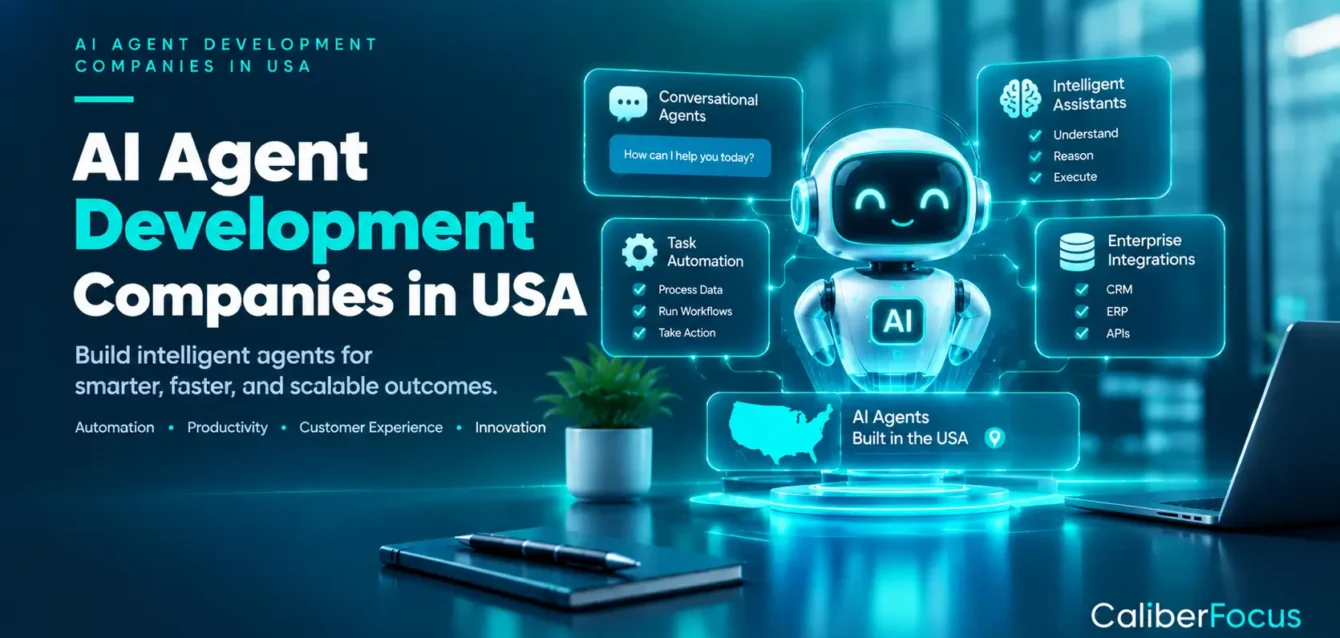
AI agent development companies build intelligent software agents that retrieve enterprise information, interact with business applications, execute authorized tasks and coordinate multi-step workflows. These companies combine AI engineering, data integration, application development and orchestration to make agents operational within existing business environments.
Enterprises typically engage an AI agent development company when the requirement extends beyond answering questions or generating content. An agent may need to interpret incoming documents, retrieve customer or transaction records, validate information against business rules, update connected applications and escalate exceptions to employees.
The following table illustrates where custom AI agents can operate.
| Business Function | AI Agent Applications |
| Finance & Accounting | Invoice validation, purchase-order matching, reconciliation support and exception routing |
| Customer Operations | Service-request classification, account information retrieval, CRM updates and case escalation |
| IT & Application Support | Ticket triage, knowledge retrieval, diagnostic assistance and approved remediation workflows |
| Data & Analytics | Data-quality investigation, pipeline monitoring, metadata retrieval and reporting workflows |
| Supply Chain & Manufacturing | Inventory exception analysis, order-status verification and procurement workflow coordination |
| Enterprise Knowledge | Policy retrieval, document analysis, contract information extraction and internal knowledge assistance |
Implementing these agents requires decisions about LLM selection, retrieval-augmented generation (RAG), enterprise APIs, agent orchestration, access permissions, evaluation and production monitoring.
Organizations comparing AI agent development services should assess how providers connect these technical capabilities with existing applications, data environments and operational processes.
This guide compares ten AI agent development companies serving the US market, their areas of specialization and the capabilities enterprises should evaluate when selecting an implementation partner.
AI Agent Development Companies at a Glance
The following five companies represent different approaches to enterprise AI agent development. The full list of ten providers follows.
| Company | AI Agent Development Focus | Best Fit |
|---|---|---|
|
01 CaliberFocus |
Custom AI agents, enterprise integration, RAG and workflow orchestration | Enterprises connecting agents with existing applications, data and operational processes |
|
02 Deeper Insights |
Applied AI, document intelligence and knowledge-intensive applications | Organizations with complex information-processing requirements |
|
03 Data Reply US |
Enterprise data engineering, cloud AI and AI application architecture | Data-intensive enterprises with complex cloud environments |
|
04 Quantiphi |
Enterprise AI engineering, agentic AI and cloud integration | Enterprises combining agent development with broader cloud and data initiatives |
|
05 C3 AI |
Enterprise AI platforms and agentic applications | Large organizations evaluating platform-based agent deployment |
What Is an AI Agent Development Company?
An AI agent development company specializes in designing, integrating and deploying AI-powered software agents that perform tasks within defined business environments.
Unlike conventional rule-based automation, AI agents can interpret contextual information, select permitted tools and determine the next step within an established workflow. Their autonomy depends on system permissions, business rules and human approval requirements.
For example, an accounts payable agent may extract invoice information, retrieve the corresponding purchase order, compare transaction details, prepare an ERP entry and route discrepancies to a finance employee. The agent performs several connected tasks while sensitive financial actions remain subject to appropriate controls.
The differences between these approaches are explained further in AI vs. Automation: Key Differences.
Core Business Capabilities of AI Agent Development Companies
AI agent development companies support enterprises in automating operational tasks, connecting business systems and managing processes that require information, decisions and coordinated actions.
- Business Process Automation: Automating repetitive and multi-step activities across finance, customer service, IT, procurement and other business functions.
- Cross-Department Workflow Coordination: Connecting tasks, information and approvals across teams to reduce manual handoffs and process delays.
- Enterprise Knowledge Access: Enabling employees and operational teams to retrieve and use information from internal documents, policies, contracts and business records.
- Decision Support and Exception Handling: Analyzing operational information, identifying discrepancies and routing cases that require human judgment.
- Business Application Integration: Enabling AI agents to retrieve, validate and update information across ERP, CRM and other enterprise applications.
- Process Control and Accountability: Defining access permissions, approval checkpoints, escalation rules and audit records for agent-driven activities.
- Ongoing Performance Management: Monitoring task completion, identifying workflow failures and improving agent performance as business requirements change.
Enterprise Knowledge Agents vs. Workflow Agents
Knowledge agents primarily retrieve, interpret and synthesize information from enterprise sources. Workflow agents extend this capability by interacting with applications, invoking tools and carrying out authorized operational steps.
An employee knowledge agent might retrieve policy information and summarize relevant procedures. A workflow agent could additionally verify a request against those policies, prepare an application update and send the request for approval.
The distinction is important because experience building knowledge assistants does not automatically demonstrate expertise in transactional workflows or multi-agent orchestration.
For a closer comparison, RAG vs. Agentic AI explains how information retrieval and agent-driven execution serve different requirements.
Top 10 AI Agent Development Companies in the USA
The companies below represent different delivery models, from custom AI engineering firms to enterprise AI platform providers. Their suitability depends on the type of agent being developed, the applications involved and the level of implementation support required.
The list retains the providers covered in the July version. Company descriptions are based on that draft, supplemented by available current provider information. The ordering is editorial rather than an independently verified performance ranking.
CaliberFocus

Focused on: Custom AI agent development, enterprise integration and operational workflow orchestration.
Best fit for: SMBs, mid-market businesses and enterprises that need AI agents connected to existing applications, proprietary information and business processes.
Core AI Agent Capabilities
- Custom AI agent development and orchestration
- RAG and enterprise knowledge integration
- Multi-agent workflow architecture
- ERP, CRM, data and API integration
- AI strategy and implementation planning
- AI governance, evaluation and production support
Why consider CaliberFocus
CaliberFocus works across AI engineering, data and analytics, application engineering and enterprise applications. This combination is relevant when AI agents must retrieve information from internal systems, interpret operational context and execute defined workflow actions through connected applications.
For example, an enterprise workflow might require an agent to interpret an incoming service request, retrieve account details, verify business rules, prepare an application update and route exceptions for approval. Delivering this requires coordination between AI, data, integration and application engineering.
CaliberFocus is particularly relevant to organizations evaluating agent development as part of broader operational modernization rather than as a standalone AI interface.
Need agents that hold up under compliance review?
Let’s talk through your workflow and what production-grade would look like for your team.
Deeper Insights
Focused on: Applied AI engineering, document intelligence and knowledge-intensive applications.
Best fit for: Organizations handling complex documents, unstructured information and research-oriented workflows.
Core AI Agent Capabilities
- Custom AI and machine learning development
- Natural language processing
- Document intelligence
- Knowledge extraction and analysis
- AI application integration
- Model deployment and evaluation
Why consider Deeper Insights
Deeper Insights is positioned around applied AI and extracting value from complex information. This makes it relevant for enterprises evaluating intelligent document processing, research assistance and knowledge-driven applications.
Buyers should verify its current US delivery arrangements and specific multi-agent orchestration capabilities.
Data Reply US

Focused on: Enterprise data engineering, cloud AI and AI application architecture.
Best fit for: Enterprises with complex data environments and cloud infrastructure requirements.
Core AI Agent Capabilities
- LLM-enabled application development
- Enterprise data integration
- RAG-based knowledge applications
- Cloud-native AI engineering
- Workflow orchestration
- AI deployment and lifecycle management
Why consider Data Reply US
Data Reply’s positioning in the existing article centers on data engineering and enterprise AI architecture. It is a relevant candidate where agent implementation depends on established data platforms, cloud infrastructure and integration with distributed information systems.
The current US business entity and agent-specific service scope should be confirmed before publication.
Wavicle Data Solutions

Focused on: Data engineering, analytics and AI-enabled business processes.
Best fit for: Data-intensive organizations implementing AI within analytics, reporting and operational workflows.
Core AI Agent Capabilities
- AI-enabled workflow automation
- Enterprise data integration
- Analytics-oriented AI applications
- Cloud data engineering
- Data architecture modernization
- AI implementation planning
Why consider Wavicle Data Solutions
Wavicle’s data engineering and analytics focus is relevant where agents depend on business information distributed across data platforms and operational systems.
For instance, a data operations agent may need to retrieve pipeline status, inspect metadata and prepare a data-quality exception report. Buyers should verify the company’s current capabilities for executing and governing such agent workflows.
SpringML
Focused on: Applied AI, cloud data engineering and enterprise modernization.
Best fit for: Organizations implementing AI alongside cloud modernization, application integration and data engineering.
Core AI Agent Capabilities
- AI-assisted workflow applications
- Cloud AI architecture
- Enterprise data integration
- RAG-based knowledge systems
- Applied machine learning
- Deployment and operational engineering
Why consider SpringML / Egen
The existing article identifies SpringML as part of Egen. The potential fit is enterprise AI work that combines cloud infrastructure, data engineering and business application development.
Editorial verification: Confirm the current company identity and agent development portfolio before publishing this entry under the SpringML name.
C3 AI

Focused on: Enterprise AI platforms, agent orchestration and industry-specific AI applications.
Best fit for: Large enterprises evaluating a platform-based approach to agent development and governance.
Core AI Agent Capabilities
- C3 Agentic AI Platform
- Agent development and orchestration
- Enterprise data modeling and integration
- Workflow and tool execution
- Access control and monitoring
- Industry-specific AI applications
Why consider C3 AI
C3 AI provides an enterprise platform for connecting agents with business data, applications and workflows. Its platform documentation describes agent orchestration, external tool integration and multi-step execution.
It is particularly relevant for enterprises comparing a unified AI platform with a custom-engineered solution built across separate infrastructure and application components.
Quantiphi

Focused on: Agentic AI, enterprise AI engineering and cloud integration.
Best fit for: Enterprises connecting AI agent development with data platforms, cloud infrastructure and operational transformation.
Core AI Agent Capabilities
- Enterprise AI agent development
- Multi-agent orchestration
- LLM and RAG integration
- Enterprise system integration
- AI platform engineering
- Governance and deployment
Why consider Quantiphi
Quantiphi describes its agentic AI offering around enterprise agents, reasoning, orchestration and connected business systems. Its portfolio also covers the broader cloud and data engineering requirements involved in operational AI deployment.
This makes it relevant when agent development forms part of a larger enterprise AI implementation.
Beyond Key

Focused on: Business application integration, workflow automation and AI-enabled operations.
Best fit for: Mid-market businesses and enterprises introducing AI into existing application environments.
Core AI Agent Capabilities
- Custom AI agent development
- Knowledge-based AI assistants
- Business workflow automation
- Enterprise application integration
- Document intelligence
- AI implementation support
Why consider Beyond Key
Beyond Key is positioned in the July article around practical AI development and application integration. It is worth evaluating when agents must interact with existing software, retrieve operational information or coordinate internal workflows.
Current agent-specific offerings should be confirmed directly.
Unico Connect

Focused on: Custom AI applications, workflow agents and digital process automation.
Best fit for: SMBs and mid-market organizations requiring targeted AI agents for internal operations, document processing and customer-facing workflows.
Core AI Agent Capabilities
- Custom AI agent development
- Multi-agent workflow design
- Document processing agents
- Conversational AI
- API and application integration
- AI-enabled SaaS applications
Why consider Unico Connect
Unico Connect is positioned around custom software and AI-enabled business workflows. Its relevance is strongest where an organization needs agents incorporated into an existing application or a focused digital process.
Buyers should evaluate its current integration capabilities, monitoring approach and post-deployment support.
Maruti Techlabs

Focused on: Custom AI engineering, intelligent automation and business process development.
Best fit for: Businesses implementing AI agents alongside existing workflow automation and operational applications.
Core AI Agent Capabilities
- Custom AI agents
- LLM-enabled business workflows
- Conversational AI
- AI and RPA integration
- Workflow orchestration
- Data engineering support
Why consider Maruti Techlabs
Maruti Techlabs is positioned in the existing article around AI development and business process automation. It is a potential fit for organizations looking to extend existing automation with language understanding, contextual information retrieval and coordinated workflow actions.
Its current multi-agent engineering and production support capabilities should be validated during vendor evaluation.
When Do Enterprises Need Custom AI Agent Development?
Custom AI agent development becomes relevant when an organization needs AI to perform tasks using its own information, applications and business rules.
The requirement may involve several systems, multiple workflow stages or actions that must be controlled and audited.
| Enterprise Requirement | Role of AI Agent Development |
| Enterprise Knowledge Access | Retrieve and interpret information from approved documents, policies and internal repositories |
| Document-Heavy Operations | Extract information, validate fields, prepare records and route exceptions |
| Connected Business Applications | Retrieve and update information across ERP, CRM and internal systems through authorized APIs |
| Data Engineering Workflows | Examine pipeline metadata, identify validation failures and prepare corrective actions |
| Multi-Agent Processes | Coordinate specialized agents for retrieval, analysis, execution and verification |
| Production Operations | Implement monitoring, access controls, audit trails, evaluation and human approvals |
AI Agents for Data Engineering and Enterprise Information Workflows
Data engineering teams may use AI agents to investigate pipeline failures, inspect metadata, retrieve validation results and prepare incident summaries. With appropriate controls, agents can also initiate approved operational actions.
For example, an agent could identify a failed data-quality check, retrieve the affected pipeline’s execution history, summarize the likely cause and prepare a remediation request for review.
Such workflows depend on reliable data access and integration with enterprise systems. Organizations should assess these dependencies before deciding how much operational autonomy to grant an agent.
How to Choose the Right AI Agent Development Company
Selecting an AI agent development company requires evaluating its ability to deliver the complete operational system, including integration, orchestration, governance and production support.
| Evaluation Area | What to Ask |
|---|---|
| Business Process Fit | Can the provider map tasks, decisions, exceptions and approval requirements? |
| Agent Engineering | Can agents use tools, maintain workflow context and execute defined actions? |
| Enterprise Integration | Can the solution securely connect with existing applications, APIs and data sources? |
| Multi-Agent Orchestration | How are dependencies, handoffs, failures and retries managed? |
| Governance & Security | How are permissions, sensitive data, approvals and audit records controlled? |
| Production Readiness | How are task accuracy, completion rates, latency and failures evaluated? |
| Ongoing Support | Who maintains integrations, monitors performance and manages updates after deployment? |
Evaluate the Path From Prototype to Production
An AI agent demonstration may successfully complete a workflow under controlled conditions. Production environments introduce incomplete data, unavailable systems, conflicting instructions, changing business rules and unexpected exceptions.
Enterprises should ask providers to demonstrate how agents behave when a task cannot be completed safely or reliably.
These requirements connect with the broader AI implementation challenges enterprises encounter when integrating AI into existing technology environments.
Choosing the Right AI Agent Development Partner
The right AI agent development company depends on what the business needs agents to accomplish, which applications and information they must access, and what controls are required for reliable execution.
Organizations should prioritize relevant engineering capabilities, enterprise integration experience, production evaluation and clear ownership of deployment and ongoing operations. A provider’s ability to demonstrate these capabilities against the organization’s actual workflows matters more than a broad list of AI technologies.
AI Agents Connected to Enterprise Operations
CaliberFocus works across AI engineering, enterprise data, application integration and workflow orchestration to support custom AI agent development.
FAQs
AI agents are suitable for document processing, invoice validation, customer service, IT support, data-quality monitoring and workflows involving multiple applications. Processes with accessible digital data, defined steps and clear approval rules are good starting points.
Yes. AI agents can connect with platforms such as Microsoft Dynamics 365, SAP, Salesforce and proprietary applications through supported APIs and integrations. Feasibility depends on system accessibility, data quality and security permissions.
A single agent may handle a focused workflow, while multi-agent systems coordinate specialized tasks across departments or applications. The choice depends on process complexity, integration requirements and operational dependencies.
Ask for relevant implementation examples, end-to-end workflow demonstrations, integration experience and testing methods. Assess how the provider manages errors, access controls, human approvals, monitoring and post-deployment support.
Costs and timelines depend on workflow complexity, data readiness, application integrations, agent architecture, security requirements and deployment scope. Request estimates covering development, integration, testing and ongoing maintenance.

More on AI Agents and Automation
AI vs Automation: Key Differences
Understand how AI and traditional automation differ in decision-making, adaptability, task execution, and business applications.
Read MoreAgentic AI vs Generative AI for Modern Business Operations
Compare how generative AI creates content and how agentic AI can coordinate actions and workflows across business systems.
Read MoreTop Artificial Intelligence Trends
Explore emerging AI developments and their implications for enterprise technology, business processes, and AI adoption.
Read More