

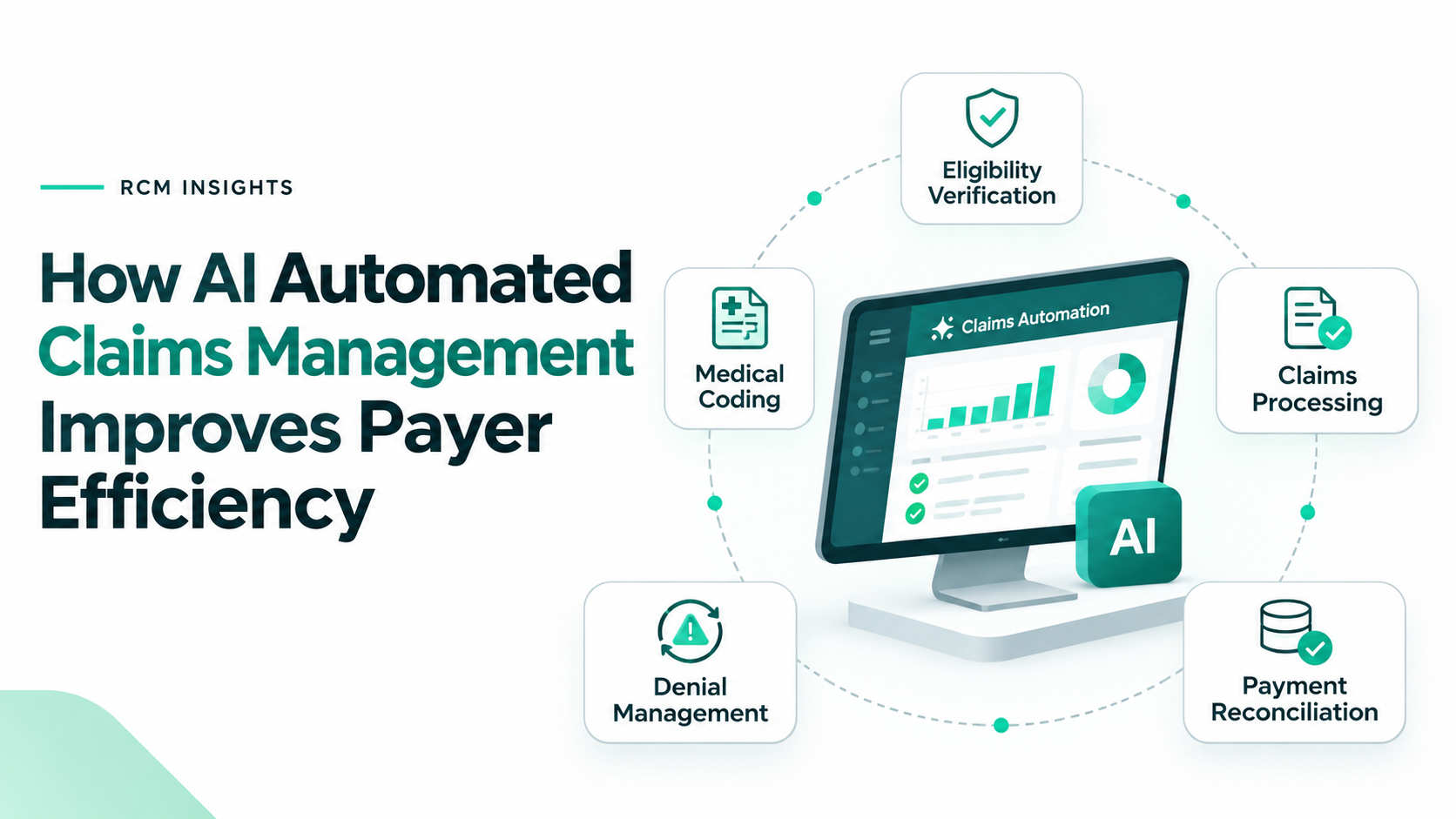
Claims management automation in healthcare uses workflow automation, AI, and intelligent agents to manage claim validation, submission, denial handling, and payment reconciliation with fewer manual interventions. For hospitals, physician groups, and RCM companies, the priority is to identify claim errors earlier, reduce repetitive work, and resolve exceptions before they create reimbursement delays.
However, automating individual tasks does not necessarily improve the entire claims lifecycle. Eligibility mismatches, incomplete documentation, payer-specific requirements, and disconnected billing systems can still cause delays and rework.
A more effective approach connects automation across three critical areas:
BEFORE SUBMISSION
Validate claim information, identify documentation gaps, and flag potential denial risks.
DURING PROCESSING
Use AI agents for claim processing to assist with claim scrubbing, workflow routing, and exception handling.
AFTER PAYER RESPONSE
Classify denials, reconcile payments, and prioritize claims requiring further action.
The challenge is determining which processes can be automated reliably, where AI adds value beyond predefined rules, and when human review remains necessary.
This article examines how healthcare claims automation works, where organizations should prioritize implementation, and what it takes to integrate AI into existing claims workflows.
At a Glance: Claims Management Automation in Healthcare
Six essentials for evaluating connected claims workflows.
Recurring claim errors, disconnected workflows, and manual follow-ups can reveal opportunities for AI-driven improvements across the revenue cycle.
Where Claims Management Workflows Break Down
The biggest challenge in healthcare claims management automation is not always the volume of manual work. It is the inability to identify, resolve, and prevent exceptions across connected claims workflows.
A billing system may flag an eligibility mismatch, a clearinghouse may reject a claim, and a payer may return a denial. Each system identifies a problem at a different stage, but resolving it may still require staff to investigate across multiple applications.
This exposes three critical automation gaps:
Detection without resolution
Systems flag errors, but staff must still investigate, correct, and reprocess claims.
Automation without continuity
A completed task in one system does not automatically trigger the appropriate action in another.
Correction without prevention
Teams resolve individual claims without consistently using recurring error patterns to improve upstream validation.
Addressing these gaps requires more than automating individual tasks. Agentic AI workflows in healthcare RCM offer an approach to coordinating actions, routing exceptions, and maintaining workflow continuity across revenue cycle processes, with human review where necessary.
How Claims Management Automation Works Across the Claims Lifecycle
Claims management automation works by connecting claim data validation, submission, payer response handling, and payment reconciliation through coordinated workflows. Rules-based automation handles predictable checks, while AI can assist with interpreting unstructured information, identifying exceptions, and prioritizing claims that require intervention.
For healthcare providers and RCM companies, the objective is to move claims through each stage with fewer avoidable errors, while maintaining appropriate human oversight.
Five Workflows Where Claims Automation Makes a Difference
| Claims lifecycle stage | How automation works | Where human review remains important |
|---|---|---|
| 1. Eligibility and pre-claim validation | Checks coverage information, identifies demographic mismatches, and flags missing authorization details | Unclear benefits, coverage exceptions, and payer-specific requirements |
| 2. Documentation and coding review | Compares available clinical documentation with claim information and flags potential coding inconsistencies | Clinical interpretation, coding decisions, and medical necessity review |
| 3. Claim preparation and submission | Applies claim edits, checks required fields, and routes validation failures for correction before submission | Complex billing exceptions and unresolved claim discrepancies |
| 4. Denial management and follow-up | Categorizes payer responses, identifies recurring denial patterns, and prioritizes claims for follow-up | Appeals requiring clinical evidence, payer interpretation, or complex judgment |
| 5. Payment posting and reconciliation | Matches remittance information with claim records and identifies payment or adjustment discrepancies | Contractual disputes, unexplained variances, and unresolved payment exceptions |
Connecting Automation to Actual Claims Operations
The value of these workflows depends on how information and actions move between them.
Before submission, AI agents for eligibility verification can assist with coverage checks and identifying discrepancies that require attention before a claim progresses. However, identifying a mismatch is only the first step. The workflow must also route the exception for correction and confirm that the updated information is available to the billing process.
After payer response, AI agents for denial management can assist with denial classification, prioritization, and follow-up preparation. A denial involving missing documentation may require a different resolution path from one involving authorization or coding, so routing every denial through the same workflow can create unnecessary rework.
At payment reconciliation, AI agents for payment posting can assist with matching remittance information, identifying posting discrepancies, and directing unresolved exceptions to the appropriate team.
The Critical Difference: Completing Tasks vs. Resolving Claims
Consider a claim that fails an eligibility check.
A basic automated process may flag the mismatch and stop. A more connected workflow can identify the exception, assign the required correction, and initiate the next permitted step once the issue is resolved.
The same principle applies to denials and payment discrepancies. A workflow is not necessarily complete when an automated task finishes; it is complete when the required action is resolved, appropriately escalated, or handed off with sufficient context.
This distinction matters when evaluating healthcare claims automation because reducing manual touches is useful only when the resulting process maintains claim accuracy, traceability, and appropriate controls.
Rules-Based Automation vs. AI vs. AI Agents in Claims Management
Not every healthcare claims workflow requires AI. Standard claim edits, mandatory field checks, and predefined payer rules can often be handled effectively through traditional automation. AI becomes more relevant when claims involve unstructured information, variable exceptions, or decisions that cannot be addressed through fixed rules alone.
The distinction matters because the right claims automation approach depends on workflow complexity, data reliability, and the consequences of an incorrect action, not simply the sophistication of the technology.
Choosing the Right Automation Approach
| Evaluation factor | Rules-based automation | AI-assisted automation | AI agents |
|---|---|---|---|
| How it works | Executes predefined conditions and actions | Interprets information and generates recommendations | Coordinates multi-step activities using permitted tools and actions |
| Best-fit claims tasks | Required-field checks, standard claim edits, formatting validation | Documentation analysis, denial classification, exception prioritization | Claim-status follow-up, exception routing, coordinated resolution workflows |
| Key limitation | Cannot reliably handle situations outside defined rules | Outputs may require validation and contextual review | Depends on reliable integrations, permissions, and execution controls |
| Human oversight | Reviews flagged exceptions | Validates recommendations and consequential decisions | Approves sensitive actions and handles escalations |
Why More Advanced AI Is Not Always the Better Choice
Consider three different claims processing requirements:
A missing required claim fieldA deterministic validation rule is usually sufficient. Introducing AI adds complexity without a clear operational advantage.
A denial letter containing multiple reasonsAI can assist with extracting relevant information and classifying the denial, while staff validate the findings and determine the appropriate response.
A claim requiring several follow-up actionsA governed AI agent may coordinate permitted status checks, retrieve relevant information, and route unresolved exceptions across connected systems.
The distinction becomes especially important when evaluating agentic AI in healthcare claims processing automation, where the challenge extends beyond interpreting claim information to coordinating actions across multiple workflow steps.
The strongest approach is often a combination of all three technologies: rules for predictable checks, AI for information-intensive tasks, and governed agents for multi-step coordination. Each should be introduced where it offers a clear operational advantage without weakening accuracy, traceability, or human accountability.
How Claims Automation Requirements Differ Across Healthcare Organizations
Claims management automation requirements depend on who owns the claims workflow, how claims are processed, and where operational responsibility sits. A hospital managing complex inpatient claims needs different controls from an RCM company handling multiple clients or a payer evaluating claims for adjudication.
The distinction matters because applying the same AI automation model across these organizations can overlook critical differences in data access, workflow ownership, payer requirements, and human oversight.
Claims Automation Priorities by Healthcare Organization
| Healthcare organization | Where AI automation adds value | Critical implementation requirement |
|---|---|---|
| RCM companies | Multi-client claim validation, denial prioritization, and payer follow-up | Client-specific rules, data segregation, and configurable workflows |
| Hospitals and health systems | Documentation checks, claim edits, and cross-department exception routing | EHR integration, complex billing rules, and departmental coordination |
| Physician groups and practices | Specialty-specific claim validation, rejection handling, and AR follow-up | PMS integration, coding accuracy, and payer-specific requirements |
| PMS/EHR and RCM software vendors | AI-assisted claims functionality embedded within existing platforms | API connectivity, tenant isolation, and configurable product workflows |
| Healthcare payers | Claims intake, policy validation, adjudication assistance, and exception review | Benefit rules, regulatory controls, explainable decisions, and auditability |
| Dental organizations and DSOs | Benefit verification, predetermination tracking, and multi-location claim management | Dental-specific claim formats, payer variations, and location-level controls |
| Ambulatory surgery centers (ASCs) | Procedure-specific validation, authorization checks, and payment exception identification | Surgical documentation, coding requirements, and payer contract alignment |
Why the Operating Model Matters More Than Claim Volume Alone
Two organizations processing similar claim volumes may require entirely different automation architectures.
An RCM company needs to manage client-specific workflows without mixing data or business rules. A hospital may need to coordinate documentation, coding, and billing across departments. A healthcare software vendor may need to integrate AI capabilities directly into its existing application rather than introduce a separate system.
Payer-side automation requires a particularly important distinction: Payers evaluate claims against coverage, benefit, contractual, and applicable policy requirements, while providers and RCM companies prepare, submit, and follow up on claims. These responsibilities should not be treated as interchangeable.
The practical starting point is to map workflow ownership, exception-handling responsibilities, and integration dependencies before selecting automation technologies. This helps determine where AI can act, where human approval is necessary, and which existing systems must remain authoritative.
Integrating AI Claims Automation With Existing Healthcare Systems
An AI claims automation solution may identify errors accurately and still fail operationally if it cannot exchange information with billing systems, manage exceptions, or recover from unsuccessful actions.
Successful AI claims automation integration requires reliable data exchange, controlled workflow execution, human oversight, and continuous monitoring. For healthcare organizations, these requirements determine whether automation can operate consistently within existing revenue cycle processes.
Four Requirements for Production-Ready Claims Automation
Connect Systems Without Creating Conflicting Claim Records
AI workflows may need to exchange information with EHRs, practice management systems, clearinghouses, payer interfaces, and remittance processing applications.
Integration design must establish which system owns each record, how updates are synchronized, and what happens when data is missing or inconsistent. Otherwise, an automated correction in one application may not reach the system responsible for the next claims activity.
Design Exception Handling Beyond the Automated Task
A workflow should not stop silently when a payer response is unavailable, an API fails, or a claim requires manual intervention.
Production workflows need defined exception queues, retry conditions, escalation paths, and safeguards against duplicate submissions or repeated actions. Each unresolved claim should retain sufficient context for staff to continue processing without restarting the investigation.
Establish Security, Auditability, and Human Approval Controls
Healthcare claims automation can involve protected health information, financial records, and consequential billing decisions.
Implementation controls should include:
- Role-based access and appropriate safeguards for protected health information.
- Traceable records of automated decisions, actions, and overrides.
- Human approval for sensitive corrections, appeals, and other consequential actions.
- Defined boundaries for what AI agents can access, recommend, or execute.
Monitor Workflow Outcomes After Deployment
A successful test does not guarantee reliable production performance. Payer requirements, claim formats, system interfaces, and exception patterns can change.
This makes AI agent production readiness particularly important for claims automation. Testing must establish whether agents can recover from integration failures, respect approval boundaries, prevent duplicate actions, and maintain traceable execution records.
Monitoring should cover integration failures, AI output quality, unresolved exceptions, and downstream claim outcomes, not just whether an automated task completed.
The Implementation Test That Matters
Before scaling claims workflow automation, healthcare organizations should be able to answer one practical question:
If an automated action fails halfway through a claim's lifecycle, can the system identify what happened, prevent duplicate activity, and route the claim for safe resolution?
If the answer is unclear, expanding automation may increase operational risk rather than reduce administrative work. Reliable integration and recovery controls should be established before granting AI agents greater execution authority.
Measuring the Value of AI Claims Automation Beyond Traditional RCM KPIs
The value of AI claims management automation extends beyond improving denial rates or reducing processing costs. Its additional value lies in preventing avoidable work, resolving routine exceptions across connected systems, and allowing revenue cycle teams to concentrate on claims requiring human judgment.
Traditional RCM dashboards measure outcomes. AI automation introduces another question: How much manual work can the claims operation avoid altogether?
Five Measures That Reveal AI Automation's Added Value
| AI automation opportunity | What to measure | Value beyond traditional workflows |
|---|---|---|
| Preventing repeat claim errors | Percentage of recurring errors detected and corrected before submission | Moves teams from repeatedly correcting claims to preventing the same issues upstream |
| Resolving exceptions without manual handoffs | Percentage of eligible exceptions resolved through approved automated workflows | Reduces the need for staff to move between systems to complete routine corrections |
| Coordinating multi-step claim activities | Percentage of eligible workflows completed without unnecessary human intervention | Extends automation beyond individual tasks to connected claim resolution |
| Prioritizing claims requiring attention | Percentage of AI-flagged exceptions confirmed as actionable | Helps teams focus on claims where intervention is justified rather than reviewing every exception equally |
| Reducing repeat investigation | Staff investigation time per recurring exception type | Preserves relevant claim context and reduces repeated information gathering |
What Changes When AI Automation Works Across the Claims Lifecycle
Consider an eligibility discrepancy that repeatedly causes claim rejections.
A traditional workflow may flag the error, assign it to staff, and track whether the corrected claim is accepted.
An AI-enabled workflow could go further by identifying recurring discrepancy patterns, retrieving permitted information, routing corrections, and applying approved validation checks before similar claims are submitted.
The distinction is not merely faster claim correction. It is the potential to reduce how often the same correction is needed.
Similarly, AI agents can coordinate permitted follow-up activities across connected systems, while routing complex denials, uncertain findings, and consequential decisions to qualified staff.
Connecting AI Capabilities to Financial ROI
Healthcare organizations can translate these operational improvements into financial value by measuring:
- Staff hours avoided through automated exception resolution and reduced investigation.
- Rework costs avoided by preventing recurring claim errors.
- Operational capacity gained without a proportional increase in staffing.
- Implementation, integration, AI usage, governance, and monitoring costs.
The strongest evidence of AI claims automation ROI is not how many tasks were automated, but how much avoidable work was eliminated while maintaining claims accuracy and control.
These measures should be compared against a pre-implementation baseline and evaluated separately for workflows where automation is authorized and technically appropriate.
Implementing AI Claims Management Automation With CaliberFocus
AI claims automation delivers meaningful operational value when it addresses the underlying causes of manual intervention, recurring exceptions, and disconnected workflows. Implementing AI agents without resolving these dependencies can simply introduce another layer of technology into an already complex revenue cycle.
CaliberFocus combines AI agent development services with workflow automation and application engineering capabilities to help healthcare organizations design, integrate, and implement AI-enabled claims operations within their existing technology environments.
From Automation Opportunities to Production-Ready Workflows
The implementation priorities depend on where claims operations experience the greatest friction.
Identify workflows worth automating
Evaluate recurring claim errors, manual handoffs, denial follow-up activities, and reconciliation exceptions to determine where AI can reduce avoidable work.
Apply the right level of intelligence
Use rules-based automation for predictable checks, AI for information-intensive activities, and governed AI agents for eligible multi-step workflows.
Connect existing healthcare applications
Design integrations around the organization's EHR, practice management, claims processing, and payer-facing systems, considering available interfaces and data requirements.
Maintain control over automated actions
Establish exception routing, human approval boundaries, auditability, and performance monitoring before expanding AI execution authority.
For hospitals, physician groups, RCM companies, and healthcare technology vendors, the objective is not to automate every claims activity. It is to identify where AI can prevent recurring work, coordinate permitted actions, and make existing claims operations more effective.
Move From Claims Automation Potential to Implementation Priorities
Organizations evaluating AI claims automation should begin with a clear understanding of their existing workflows, integration constraints, and the decisions that must remain under human control.
Frequently Asked Questions
What is the difference between claims management automation and traditional RCM automation?
Traditional RCM automation primarily uses predefined rules to perform tasks such as claim edits, data validation, and status updates. AI-enabled claims management automation extends these capabilities by interpreting variable information, identifying recurring exceptions, and coordinating actions across connected workflows. The difference is not simply faster processing, but the ability to reduce repeated manual investigation and improve exception resolution.
Can AI agents manage healthcare claims without human intervention?
AI agents can execute certain claims-related activities without manual intervention when workflows have defined permissions, reliable integrations, and appropriate controls. These may include routine claim-status checks, information retrieval, and approved exception routing. However, complex coding decisions, clinical documentation interpretation, appeals, and consequential financial actions may require qualified human review. The appropriate level of autonomy depends on workflow risk and organizational policies.
Can claims automation integrate with existing EHR and practice management systems?
Yes. Healthcare claims automation can integrate with existing EHRs, practice management systems, clearinghouses, and payer interfaces where compatible APIs, data exchange mechanisms, or other supported integration methods are available. Implementation requires validating data consistency, system permissions, workflow dependencies, and exception handling. Integration feasibility depends on the organization's existing technology environment and the interfaces available.
Which claims management processes should healthcare organizations automate first?
Healthcare organizations should prioritize processes with high manual effort, recurring exceptions, clear decision rules, and measurable outcomes. Eligibility checks, pre-submission validation, denial classification, and routine claim-status follow-up are potential starting points. Before introducing AI agents, teams should assess data availability, integration complexity, exception frequency, and the consequences of incorrect actions. High-volume tasks are not necessarily the best candidates if they require substantial human judgment.
How can healthcare organizations determine whether they are ready for AI claims automation?
Readiness for AI claims management depends on five factors: documented workflows, accessible and reliable claims data, compatible system interfaces, defined human approval controls, and measurable operational baselines. Organizations should also identify which actions AI can execute independently and which require escalation. A focused pilot involving a well-defined claims workflow can help validate technical reliability, operational value, and governance requirements before broader deployment.
Key Takeaways for Healthcare RCM Leaders
Automating tasks is not the same as resolving claims. The greater opportunity lies in connecting validation, correction, follow-up, and reconciliation so exceptions do not repeatedly return to manual queues.
AI should complement existing claims automation, not replace it indiscriminately. Deterministic rules remain appropriate for predictable checks, while AI and governed agents are better suited to information-intensive and multi-step workflows.
Workflow ownership determines implementation design. An RCM company managing multiple clients, a hospital coordinating departments, and a payer handling adjudication require different integrations, permissions, and controls.
Production reliability matters as much as AI capability. Exception recovery, duplicate-action prevention, auditability, and human approval boundaries must be established before expanding automation.
The strongest AI ROI comes from work that no longer needs to happen. Prevented claim errors, fewer repeated investigations, and automated resolution of eligible exceptions provide a clearer picture of AI's additional operational value.
Reduce manual claims work.
Keep control of your workflows.
AI claims automation is most effective when it addresses recurring exceptions, fragmented workflows and integration constraints inside existing RCM operations.