

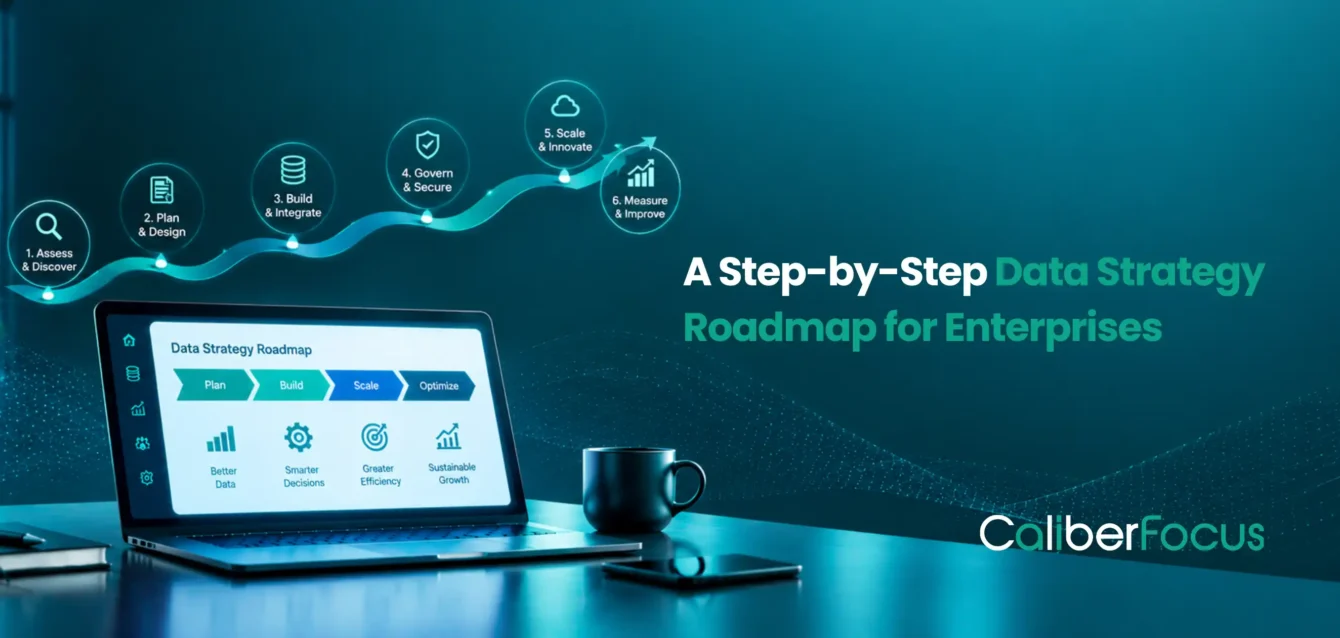
A data strategy roadmap is a prioritized plan that connects business goals with the data capabilities, initiatives and investments required to achieve them. It establishes where the organization is today, what needs to change, which initiatives should come first and how progress will be measured.
Why Enterprises Need a Data Strategy Roadmap Now
For many enterprises, the challenge is no longer starting data initiatives. It is making sure those initiatives move in the same direction.
Cloud modernization may be underway while teams are separately improving data quality, integrating systems, expanding analytics and preparing data for AI. Without a shared roadmap, dependencies can be missed, investments can become disconnected from business priorities, and advanced initiatives may begin before the underlying data is ready.
This is where a broader data strategy and consulting approach becomes important. It connects business priorities with the current data environment, target capabilities and investment decisions. The roadmap then translates that direction into an actionable sequence:
The result should not be a generic list of technology projects. It should provide a decision framework for determining what needs to change, why it matters, what should happen first and what measurable outcome each initiative should support.
The roadmap itself should be specific to the organization. Business priorities, data maturity, architecture, governance requirements and existing capabilities differ across enterprises, so the same sequence of investments will not work for everyone.
Build the Roadmap Around Your Actual Data Priorities
Every enterprise starts from a different point. CaliberFocus helps define the capability gaps, dependencies and priorities that should shape your data strategy roadmap
What Should an Enterprise Data Strategy Roadmap Cover?
A data strategy roadmap should show where data constraints are affecting business execution and what needs to change to remove those constraints. This means looking beyond platforms and datasets to the processes that depend on data every day.
| Roadmap area | Where the problem shows up in the business | What the roadmap should resolve |
| Business and data priorities | Finance, operations, sales and other functions request separate dashboards, integrations and data initiatives with competing priorities | Establish which business outcomes take priority, which data initiatives directly support them, and which requests should be sequenced, consolidated or deferred |
| Data availability and quality | Teams reconcile reports manually, investigate conflicting numbers or wait for usable data before completing forecasts, reviews and operational decisions | Identify the data sources creating discrepancies, establish agreed definitions and quality controls, and reduce the manual reconciliation required before the data can be used |
| Data integration | Customer, financial, operational or supply chain data must be extracted, transferred or reconciled between disconnected applications | Determine which systems and data flows must be connected first so critical processes receive the required data without repeated manual extraction or transfer |
| Data architecture | New reporting, analytics or AI requirements repeatedly require additional point solutions, duplicated pipelines or workarounds | Define how data should be ingested, stored, transformed and consumed so new use cases can reuse shared data foundations instead of creating another pipeline or workaround |
| Governance and ownership | Metric disputes, unclear data ownership, access delays and repeated approval or reconciliation cycles slow execution | Establish who owns critical data and definitions, who can approve access or changes, and which controls apply so issues can be resolved without recurring ownership and approval ambiguity |
| Analytics and decision processes | Management reporting explains what already happened, while operational teams still depend on spreadsheets and manual analysis to decide what to do next | Identify the decisions that require faster or forward-looking insight and deliver the data, metrics and analytics at the point where planning, forecasting or operational action occurs |
| AI readiness | AI pilots reach production planning only to expose missing context, inaccessible sources, inconsistent data or insufficient controls | Identify the data each priority AI use case depends on and close the accessibility, quality, context and governance gaps before committing to production-scale deployment |
| Execution and measurement | Data initiatives run as separate projects, dependencies surface late and technical delivery is measured without knowing whether business performance changed | Map dependencies before sequencing initiatives, assign accountable owners, and measure whether each delivered capability changes the process or business KPI it was intended to improve |
A useful roadmap makes this relationship explicit:
For example, if monthly forecasting requires finance teams to reconcile information manually across ERP, CRM and operational systems, the roadmap should not stop at “improve data integration.” It should identify which source systems create the reconciliation problem, which data must be standardized or connected, what upstream work must happen first, who owns the change, and whether the result reduces reconciliation effort or improves the timeliness of the forecasting cycle.
Ownership and control also need to be designed into that process. A clear data governance framework helps define how ownership, standards, access and accountability operate as data moves across teams and systems, rather than treating governance as a separate activity after implementation.
This is what turns a data roadmap from a portfolio of technology projects into an executable plan tied to business operations.
Before setting priorities, enterprises need to identify where their current data environment is creating friction. Issues such as fragmented systems, delayed data access and repeated data movement often point to broader data integration challenges that need to be understood before the roadmap is sequenced.
How to Build a Data Strategy Roadmap in 6 Steps
The roadmap stages below move from identifying current business and data constraints to defining target capabilities, prioritizing initiatives and sequencing execution. They provide a planning structure, not a fixed implementation order.
Enterprise Data Strategy Roadmap
Move from current business and data constraints to prioritized, governed and measurable execution.
Assess Current Data Constraints
Trace business friction back to data quality, integration, architecture, analytics or ownership gaps.
Define Target Data Capabilities
Translate business priorities into the data capabilities required to improve decisions and processes.
Set the Architecture Direction
Identify the integration, modernization and platform changes needed to support the target state.
Establish Governance and Quality
Define ownership, data quality expectations, access controls, standards and accountability.
Prioritize Data and AI Initiatives
Rank initiatives by business value, readiness, dependencies, implementation effort and risk.
Sequence the Implementation Roadmap
Align initiatives with dependencies, owners, milestones and measurable business outcomes.
Roadmap Stage 1: Assess the Current Data State and Business Constraints
Start with the business processes where data friction is already visible, then trace those problems back to their underlying data dependencies.
Business process issue → Data dependency → Root constraint → Capability gap → Roadmap priority
| Business friction | Assess | Roadmap implication |
| Finance repeatedly reconciles conflicting reports | Sources, definitions, transformation logic, ownership | Data quality and governance may need to precede reporting modernization |
| Operational decisions depend on delayed data | Pipeline latency, integration and data availability | Integration or streaming capabilities may become an earlier priority |
| Customer information differs across systems | CRM, ERP and service data relationships | Customer data integration and common definitions may be foundational |
| AI pilots struggle beyond curated datasets | Production data quality, context, access and controls | Data readiness may need to precede AI scaling |
Assess maturity only where it affects execution across data quality, integration, architecture, governance, analytics, AI readiness and ownership.
The output should not be a maturity score. It should be a prioritized set of capability gaps tied to business impact. Those gaps become the input for defining the target capabilities in the next roadmap stage.
Roadmap Stage 2: Translate Business Priorities Into Target Data Capabilities
Once the current constraints are clear, define what the organization needs its data environment to enable. Keep the target state focused on business capabilities before platforms or tools.
A practical way to make that translation is:
Business priority → Current constraint → Required data capability → Expected outcome
For example:
Reduce forecasting delays
→ Finance reconciles data across multiple systems
→ Trusted, integrated financial and operational data
→ Faster forecasting with less manual reconciliation
Improve operational responsiveness
→ Critical data reaches teams after decisions are made
→ Timely data availability across priority workflows
→ Decisions can be made using current operational conditions
Scale analytics and AI use cases
→ Data quality, access and context vary across sources
→ Governed, reusable and AI-ready data
→ Priority use cases can move beyond isolated pilots
The output of this stage should be a target capability map that defines what the enterprise needs to improve, such as trusted data access, cross-system integration, governed metrics, faster analytics or AI-ready data.
These capabilities provide the requirements for the next roadmap decision: what data architecture is needed to support them?
Roadmap Stage 3: Define the Data Architecture Required for the Target State
Target capabilities create architectural requirements. At this stage, determine how data needs to move from source systems to the people, applications, analytics and AI use cases that depend on it.
Source systems → Integration and ingestion → Data platform → Quality and governance → Analytics, applications and AI
Rather than redesigning the entire architecture at once, identify where the current environment cannot support the capabilities defined in the previous stage.
Focus architecture decisions on three areas:
Connect: Which fragmented systems and critical data flows need integration?
Modernize: Which legacy platforms, pipelines or processing constraints prevent the required scale, speed or accessibility?
Enable: What shared data foundation is required to support reporting, analytics, operational use cases and AI without creating separate pipelines for each initiative?
Where legacy architecture is the constraint, a cloud data modernization strategy can help determine what should be modernized and how those changes fit into the broader data environment.
The output is not a detailed technical design. It is a future-state architecture direction with the major integration, modernization and platform dependencies identified. Those dependencies determine what the roadmap must govern and control before initiatives move into execution.
Roadmap Stage 4: Establish Data Governance, Quality and Ownership
Architecture determines how data moves. Governance determines whether that data can be trusted, accessed and used consistently across the enterprise.
At this stage, define the controls around the data that matters most to the roadmap:
Ownership
Who is accountable for critical data domains, definitions and quality issues?
Quality
Which accuracy, completeness, consistency and timeliness requirements must be met for priority use cases?
Access
Who should be able to use specific data, under what conditions and through which controls?
Standards
Which definitions, metadata and data rules need to remain consistent across systems and teams?
A data governance framework can formalize these responsibilities and controls across the broader data environment.
The roadmap does not need to solve every governance issue before execution begins. It should identify which governance and quality requirements are dependencies for priority initiatives and assign accountability for addressing them.
The output is a clear set of ownership, quality and control requirements tied to the initiatives they enable.
With those foundations established, the roadmap can move from capability planning to deciding which data, analytics and AI initiatives should receive priority.
Not Sure What Should Come First?
If integration, governance, modernization, analytics and AI are all competing for attention, start by determining which dependencies are holding back the outcomes that matter most.
Roadmap Stage 5: Prioritize Data, Analytics and AI Initiatives
By this point, the roadmap has identified capability gaps, architecture dependencies and governance requirements. The next decision is where investment should begin.
Evaluate proposed initiatives against four factors:
Business value
What measurable business priority or process improvement does the initiative support?
Readiness
Are the required data, architecture, ownership and skills available?
Dependencies
What must be completed before the initiative can deliver value?
Effort and risk
What level of technical change, organizational coordination and control is required?
This prevents high-visibility initiatives from automatically becoming high-priority initiatives. An AI use case with significant potential, for example, may need to follow data integration or quality work if its required data is not yet reliable or accessible.
The output should be a prioritized initiative portfolio, with each initiative connected to its business value, readiness and dependencies.
That prioritization provides the basis for the final roadmap stage: deciding what happens when, what must happen first and who owns delivery.
Roadmap Stage 6: Sequence Initiatives Into an Executable Roadmap
Prioritization determines what matters. Sequencing determines whether those priorities can actually be delivered.
Build the implementation roadmap around:
Initiative → Dependency → Owner → Milestone → Business KPI
Rather than organizing initiatives only by technology, sequence them according to the capabilities they depend on. A practical roadmap may progress through:
Foundation
Resolve critical data quality, ownership, integration and architecture constraints.
Enablement
Establish the shared data pipelines, platforms and governed data required by priority use cases.
Value delivery
Deploy analytics, reporting and operational data use cases against defined business outcomes.
Scale
Expand proven capabilities and introduce more advanced analytics or AI where the underlying data environment is ready.
These are planning categories, not a mandatory sequence. An enterprise with mature data foundations may begin much closer to value delivery, while another may require substantial foundation work first.
From Data Foundation to Predictive Analytics
A regional multi-hospital network followed a phased path from fragmented data to a unified foundation, role-based analytics and predictive capabilities.
Data Roadmap in Practice
A CaliberFocus engagement with a regional multi-hospital network illustrates why dependencies matter. The organization faced disconnected data sources, retrospective reporting and limited predictive visibility. The implementation progressed from a unified data foundation and integrated data pipelines to role-based analytics, real-time and predictive capabilities, controlled validation, and broader rollout.
The broader roadmap lesson is not the specific technology stack. It is the sequence:
Data foundation → Integration → Analytics → Predictive capabilities → Validation → Scale
The final output should be an owned, sequenced and measurable implementation roadmap, not simply a list of approved data projects.
Turn Roadmap Priorities Into an Execution Plan
Once the stages are complete, consolidate the decisions into a working roadmap that leadership, data teams and business owners can use to track execution.
| Business priority | Current gap | Target capability | Initiative | Dependency | Owner | KPI |
| Faster forecasting | Manual cross-system reconciliation | Trusted integrated data | Standardize and integrate priority financial and operational data | Common definitions and source ownership | Assigned business and data owners | Forecast preparation time |
| Faster operational decisions | Delayed data availability | Timely operational data | Improve priority data flows | Source integration and quality controls | Assigned data owner | Data availability latency |
| Scale priority AI use cases | Inconsistent production data | Governed AI-ready data | Prepare required datasets for production use | Quality, access and governance requirements | Assigned initiative owner | Production readiness against defined criteria |
The specific initiatives will differ by organization. What should remain consistent is the connection between business priority, capability gap, investment, dependency, accountability and measurable outcome.
This also makes the roadmap easier to revisit as business priorities, technology and data maturity change.
How to Measure Data Strategy Roadmap Progress
Roadmap progress should not be measured only by whether projects were completed.
Use three levels of measurement:
Delivery: Are priority initiatives, dependencies and milestones progressing as planned?
Data capability: Has data become more reliable, timely, accessible or consistently governed where required?
Business outcome: Has the affected process or decision actually improved?
For example, completing an integration is a delivery milestone. Reducing data latency shows capability improvement. Faster forecasting or fewer hours spent reconciling reports demonstrates whether that capability created the intended business value.
The data strategy KPIs selected for the roadmap should therefore trace back to the business outcomes established earlier, rather than relying on one standard set of metrics for every initiative.
Key Takeaways
- Build the roadmap from business constraints and priorities, not a predefined technology list.
- Translate those priorities into target data capabilities before making architecture and investment decisions.
- Sequence governance, integration, modernization, analytics and AI initiatives according to value, readiness and dependencies.
- Treat the roadmap as a living execution plan with clear ownership and business-linked measures of progress.
Frequently Asked Questions
Start with a current state assessment covering the data sources and processes that support priority business decisions. Evaluate data quality, integration gaps, architecture constraints, governance and ownership, analytics capabilities, and AI readiness.
The purpose is not simply to assign a data maturity score. The assessment should reveal which capability gaps are preventing the organization from reaching its target state and which dependencies need to be addressed first.
Use business value, readiness, dependencies, effort and risk to determine sequencing.
For example, an advanced analytics initiative may have significant business value but still depend on data integration, quality or governance work. Prioritization should therefore consider both the expected outcome and the foundational capabilities required to deliver it.
This is why a roadmap should connect:
Business priority → Capability gap → Initiative → Dependency → Priority → KPI
They address different but connected roadmap requirements.
A data architecture roadmap establishes how data should be integrated, stored, transformed and made available for business applications, analytics and AI. A data governance framework establishes the ownership, standards, quality expectations, access controls and accountability needed to use that data consistently.
Both should be sequenced according to the business initiatives they enable rather than treated as separate enterprise programs.
AI should be planned around the data requirements of specific business use cases. Before scaling an AI initiative, assess whether the required data is available, accessible, sufficiently reliable, appropriately governed and supported by the necessary architecture.
An AI readiness assessment can expose gaps in data quality, integration, context, governance or infrastructure that need to become earlier roadmap priorities.
This allows an AI data strategy to develop as part of the broader enterprise data strategy rather than as a disconnected technology program.
The roadmap should identify which business decisions require better data and then determine the capabilities needed to support them.
That may include improving data quality, integrating fragmented sources, reducing data latency, establishing consistent metrics or expanding analytics capabilities. The resulting analytics roadmap should connect these investments to specific decisions and business KPIs rather than measuring success by dashboard or report delivery alone.
Treat the roadmap as a living planning instrument. Revisit priorities when business objectives, architecture, regulations, data maturity, AI requirements or major technology investments change.
Roadmap reviews should determine whether dependencies have shifted, target capabilities remain relevant, initiatives need reprioritization and expected business outcomes are being achieved.

More on Data Visualization & BI
Advanced Data Visualization Types for Smarter Decisions
Explore advanced data visualization types that can help turn complex data into clearer insights and support better business decisions.
Read More →5 Best Business Intelligence Tools to Use in 2026
Explore leading BI tools and how dashboards, real-time analytics, automated insights, and natural language search support data-driven decisions.
Read More →7 Easy Ways to Improve Clarity in Your BI Reports
Learn practical ways to make BI reports clearer, easier to understand, and more useful for stakeholders and decision-makers.
Read More →