
HEALTHCARE AI · OPERATIONAL GUIDE
What are AI agents in healthcare? AI agents coordinate permitted tasks across healthcare systems—such as scheduling, patient intake, referrals and billing—using connected information and escalating sensitive decisions to qualified staff.
Healthcare organizations have invested in EHRs, digital scheduling, patient portals, and automated communication. Yet staff still spend hours resolving incomplete registrations, coordinating appointments, following up on authorizations, retrieving information across systems, and managing requests between departments.
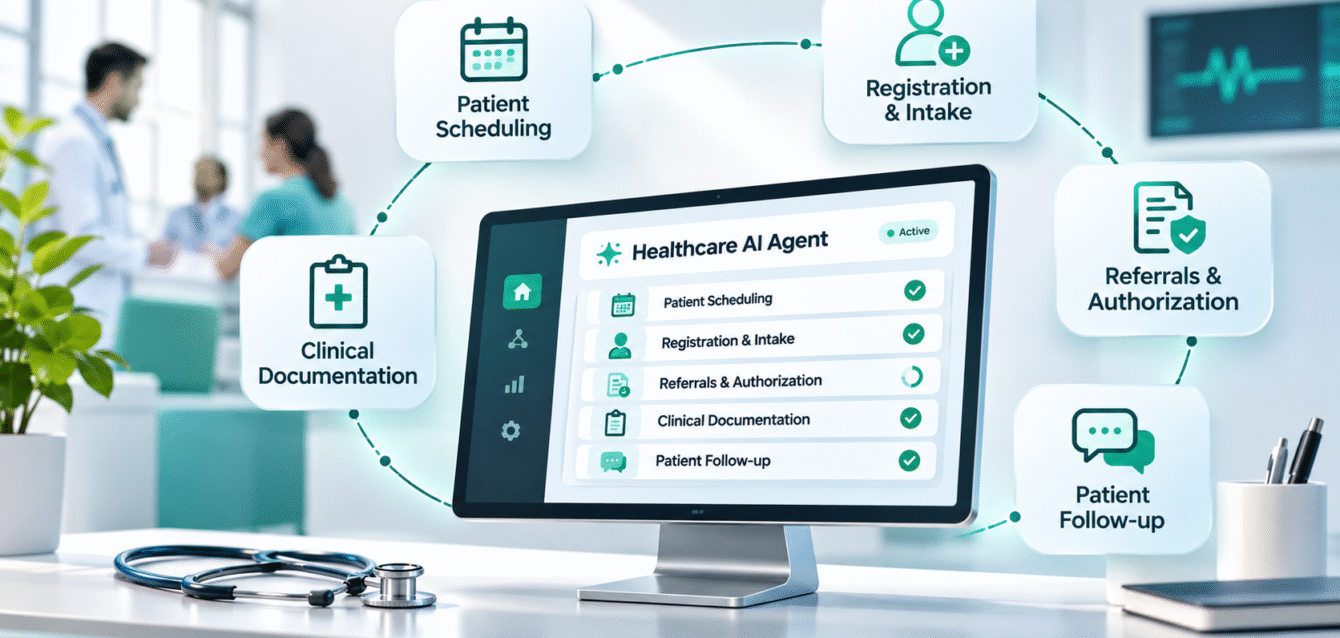
AI agents in healthcare help reduce these operational gaps by coordinating multi-step workflows across connected systems. Unlike conventional chatbots that primarily respond to questions, healthcare AI agents can:
- Coordinate patient schedulingCheck availability, manage rescheduling requests, and handle waitlist updates. AI voice agents for healthcare can also support routine appointment conversations.
- Streamline registration and intakeIdentify missing patient information, request corrections, and prepare records for staff review.
- Track referrals and authorizationsMonitor pending requests, identify missing documents, and coordinate follow-ups.
- Support clinical workflowsRetrieve relevant patient information, prepare documentation summaries, and route tasks for clinical review.
- Manage patient follow-upsSend approved reminders, track responses, and escalate concerns to care teams.
For midsize healthcare providers, these capabilities can reduce repetitive administrative work, improve coordination between departments, and help staff focus on patients and complex cases that require human judgment.
Primary applications
Patient access, scheduling, documentation, care coordination, patient engagement, and revenue cycle operations.
How they work
Retrieve authorized information, determine permitted actions, coordinate tasks, and escalate exceptions.
Required systems
EHRs, scheduling platforms, patient communication tools, and relevant operational applications.
Implementation priority
Start with a defined workflow, measurable operational problem, and appropriate risk controls.
How AI Agents Work in Healthcare
Healthcare AI agents coordinate tasks across systems rather than executing one fixed instruction. For example, an agent supporting appointment scheduling may check available slots, identify missing referral information, request clarification, and complete an authorized booking.
From a Healthcare Request to a Completed Workflow
- 01Receive a workflow request
An AI agent is triggered when a patient books or reschedules an appointment, submits an incomplete registration form, or when a hospital system flags a pending referral, authorization, or follow-up task.
- 02Retrieve relevant information
The agent accesses authorized EHR, scheduling, registration, or payer systems to check patient details, appointment availability, missing documents, and request status.
- 03Determine the next action
Based on workflow requirements, the agent identifies whether to confirm an appointment, request missing information, follow up on an authorization, or assign a task to the responsible team.
- 04Execute or escalate
The agent completes permitted actions, such as updating scheduling records or initiating follow-ups, while routing clinical concerns, conflicting information, and complex exceptions to staff.
- 05Update records and notify
The agent records completed actions in connected systems, sends relevant confirmations or status updates, and keeps unresolved requests visible for follow-up.
AI Agents vs. Traditional Automation, Predictive AI, and Generative AI
| Technology | How it works | Healthcare example | Key limitation |
|---|---|---|---|
| Traditional automation | Executes predefined rules and repetitive tasks | Sends appointment reminders at scheduled times | Limited flexibility when workflows change or exceptions occur |
| Predictive AI | Analyzes data to estimate risks or likely outcomes | Predicts patients at risk of missing appointments | Identifies risks but does not independently coordinate follow-up actions |
| Generative AI | Generates responses, summaries, or documents from available context | Drafts clinical summaries or answers routine patient questions | Generating information does not automatically complete operational tasks |
| AI agents | Coordinates multi-step tasks, uses connected systems, and executes permitted actions | Checks appointment availability, resolves missing information, coordinates booking, and escalates exceptions | Requires reliable integrations, defined permissions, and human oversight |
Traditional automation executes rules, predictive AI identifies risks, and generative AI produces information. Healthcare AI agents can combine these capabilities to coordinate authorized actions across a workflow.
The distinction becomes clearer when an AI agent needs information from several systems before taking action. For example, agentic RAG in healthcare can support authorized retrieval of information from clinical records and documents, helping agents determine the next permitted action within a coordinated workflow.
Healthcare AI Agent Use Cases Across Clinical and Operational Workflows
Healthcare AI agents can reduce the manual coordination that persists across EHRs, scheduling platforms, payer systems, and patient communication tools. Their value lies in moving routine tasks forward, resolving predictable exceptions, and directing complex cases to the right teams.
| Healthcare workflow | Current operational challenge | How AI agents change the workflow | Potential operational impact |
|---|---|---|---|
| Appointment scheduling | Staff manually manage cancellations, rescheduling, available slots, and waitlists | Checks availability, matches eligible patients to open slots, coordinates booking, and updates schedules | Less scheduling effort, faster appointment confirmation, fewer unused slots |
| Patient registration and intake | Patients repeat information while staff correct incomplete forms and reconcile records | Checks submitted information, requests missing details, and routes discrepancies before registration is finalized | Fewer registration delays, less rework, smoother patient check-in |
| Eligibility verification | Teams check payer portals, resolve coverage mismatches, and repeat verification | Retrieves available coverage information, flags discrepancies, and organizes cases requiring review | Less manual verification, earlier identification of coverage issues |
| Prior authorization | Staff gather documents, track payer responses, and repeatedly follow up on pending requests | Identifies documentation requirements, coordinates submissions, tracks status, and flags missing information | Reduced administrative follow-up, fewer avoidable submission delays |
| Referral management | Referrals remain pending because of missing records, unclear routing, or scheduling dependencies | Checks referral completeness, requests missing information, routes cases, and tracks scheduling progress | Fewer unresolved referrals, faster coordination between departments |
| Clinical documentation | Clinicians search fragmented records and spend time preparing or reviewing documentation | Retrieves relevant clinical information, prepares summaries, and identifies documentation gaps for clinician review | Less information retrieval, reduced documentation preparation effort |
| Care coordination | Teams manually track discharge tasks, follow-ups, and handoffs across departments | Monitors assigned tasks, coordinates approved follow-ups, and escalates unresolved actions | Fewer missed handoffs, better visibility into pending care activities |
| Patient engagement | Staff handle repetitive questions, reminders, and follow-up communication across channels | Responds to approved routine requests, sends reminders, tracks responses, and escalates clinical concerns | Faster routine responses, less communication workload |
| Revenue cycle operations | Billing teams manually monitor claims, review work queues, and follow up on exceptions | Retrieves claim status, identifies pending actions, organizes exceptions, and coordinates authorized follow-ups | Less manual claim tracking, faster identification of unresolved issues |
Prior authorization illustrates why task coordination matters. AI agents for prior authorization can support document collection, payer requirement checks, status tracking, and exception routing. Similarly, agentic AI workflows in healthcare RCM can coordinate eligibility verification, claims processing, denial follow-up, and accounts receivable activities.
These are potential operational improvements, not guaranteed results. Actual outcomes depend on workflow design, integration quality, agent permissions, and implementation performance.
Where Healthcare AI Agents Deliver Operational Value
The applications of AI in healthcare operations extend across patient access, clinical coordination, and administrative processes. AI agent priorities differ by organization, depending on which workflows consume staff time, create delays, or require repeated coordination.
| Healthcare organization | Priority applications | Value for decision-makers |
|---|---|---|
| Hospitals and health systems | Patient scheduling, registration, discharge coordination, referrals, and authorization tracking | COOs and CIOs: Reduce administrative bottlenecks and improve coordination across departments |
| Physician groups and practices | Appointment management, intake, documentation preparation, and patient follow-up | Practice executives: Reduce staff workload and improve appointment and patient communication processes |
| RCM and medical billing companies | Eligibility checks, claim-status follow-up, denial work queues, and payer correspondence | CEOs and operations leaders: Reduce manual touches per account and improve processing capacity |
| Healthcare payers | Provider inquiries, claims exception routing, document review, and authorization administration | Payer operations executives: Improve case handling, turnaround visibility, and administrative efficiency |
| Pharma and life sciences | Medical information request routing, approved document retrieval, and regulatory workflow coordination | Operations and compliance leaders: Reduce information-handling effort while maintaining review and approval controls |
| Medical device companies | Service request triage, technical support coordination, and complaint intake routing | Service and quality leaders: Improve request handling and escalation visibility while preserving required quality processes |
The strongest opportunities are workflows where agents can coordinate routine actions across systems while keeping sensitive decisions and exceptions under appropriate human control.
What to Look for in a Healthcare AI Agent Development Partner
Healthcare organizations need an AI agent development partner who understands their clinical and administrative workflows, integrates with existing systems, and delivers measurable operational improvements without disrupting care.
Five capabilities to evaluate:
- Healthcare workflow expertiseIdentify how AI agents can streamline scheduling, registration, referrals, care coordination, and administrative processes by reducing manual handoffs and delays.
- AI agent consulting and designDesign agents for multi-step healthcare workflows, including task execution, system coordination, exception handling, and human approvals.
- Healthcare system integrationIntegrate AI agents with EHRs, scheduling platforms, patient portals, billing systems, and payer applications to coordinate tasks across departments.
- Security, compliance, and clinical oversightProtect patient information through controlled access, audit trails, and human review of sensitive clinical and administrative actions.
- Deployment and performance optimizationTest AI agents against real healthcare workflows and monitor task completion, processing time, errors, and escalation rates.
Related service: Healthcare AI agent development for provider workflows ↗
What Healthcare Organizations Need Before Implementing AI Agents
EHR Integration, Data Access, and Workflow Ownership
Agents need approved access to the systems involved in a workflow. Depending on the application, these may include EHRs, scheduling platforms, patient portals, and communication tools.
Organizations should define data ownership, permitted updates, synchronization rules, and responsibilities when systems return conflicting information.
Privacy, Permissions, and Human Oversight
Access should be limited to the information and actions required for each workflow. Healthcare organizations must assess applicable privacy, security, and regulatory obligations, including HIPAA where relevant.
Human approval requirements should be established before deployment, particularly for clinical or financially consequential actions. The guardrails for deploying generative AI in healthcare also provide relevant considerations for data protection, output validation, human responsibility, and auditability.
Testing and Deployment Readiness
Testing should include routine requests, incomplete information, unavailable systems, unexpected responses, and escalation failures.
A limited deployment with defined acceptance criteria allows teams to evaluate operational performance before expanding access or responsibilities.
Explore how these systems apply to AI agents for healthcare revenue cycle management ↗.
Frequently Asked Questions
Should healthcare organizations choose ready-made AI agent software or custom AI agent development?+
Ready-made AI agent software suits standardized tasks such as appointment reminders and routine patient inquiries. Custom AI agent development is better suited to healthcare organizations requiring specialty-specific workflows, EHR and billing integrations, multi-step automation, and customized approval rules.
Why might off-the-shelf healthcare AI agents fail to meet operational requirements?+
Off-the-shelf AI agents may not accommodate complex scheduling rules, payer-specific requirements, existing system configurations, or departmental workflows. These limitations can leave staff managing exceptions manually. Customized AI agents can be designed around existing healthcare processes, integrations, and operational requirements.
Can custom healthcare AI agents integrate with existing EHR, scheduling, and billing systems?+
Yes, custom healthcare AI agents can integrate with EHRs, scheduling platforms, patient portals, billing applications, and payer systems where supported interfaces and permissions are available. Integration requirements depend on the existing technology environment, data accessibility, security controls, and workflows being automated.
Can healthcare AI agents automate workflows across multiple departments rather than individual tasks?+
Yes. Healthcare AI agents can coordinate authorized tasks across patient registration, scheduling, referrals, prior authorizations, clinical documentation, and billing. For example, an agent can identify missing referral information, coordinate follow-up, and initiate scheduling once requirements are met, while escalating exceptions to staff.
How can RCM companies and medical billing providers benefit from customized AI agents?+
Customized AI agents can support eligibility verification, authorization tracking, claim-status follow-ups, denial work queues, and payer communication. For RCM and medical billing companies, this can reduce repetitive manual work, improve processing capacity, and help teams prioritize exceptions requiring specialist intervention.
How can customized healthcare AI agents meet privacy, security, and compliance requirements?+
Custom healthcare AI agents can incorporate role-based access, data protection controls, audit trails, human approvals, and workflow-specific monitoring. Organizations must evaluate applicable HIPAA requirements, system permissions, and clinical oversight needs. Customization supports tailored controls but does not automatically guarantee regulatory compliance.
Making AI Agents Work Within Healthcare Operations
AI agents in healthcare offer opportunities to reduce administrative workload, improve patient coordination, and connect processes across departments. However, successful implementation depends on how well these agents fit existing workflows, integrate with healthcare systems, and handle operational exceptions.
For healthcare leaders, the priority is not simply adopting AI agents. It is determining where customized AI agents can address persistent workflow challenges while maintaining the oversight required for clinical and administrative operations.
CALIBERFOCUS · HEALTHCARE AI
Need AI Agents That Fit Your Existing Healthcare Workflows?
Whether you are evaluating AI agents for patient access, clinical coordination, or revenue cycle operations, get expert guidance on designing and integrating solutions tailored to your systems, processes, and operational requirements.