
Healthcare has a communication problem. Every day, patients sit on hold. Front desk staff answer the same five questions on repeat. Appointment reminders go out late, or not at all. Physicians spend their evenings catching up on documentation that should have been done at 2 PM.
These aren’t edge cases. They’re the operational reality for most health systems globally.
The technology addressing this is moving fast. The adoption of ai voice agent in healthcare environments has accelerated sharply, the global market was valued at $468 million in 2024 and is projected to reach $3.17 billion by 2030, growing at a 37.79% compound annual growth rate. That’s not speculative growth. That’s health systems voting with their budgets.
This guide covers what ai voice agents for healthcare actually are, where they deliver the most clinical and operational value, what compliance requires, and how to choose a service provider who genuinely understands healthcare.
Scale Faster with AI Innovation
Build AI Voice Agents using Generative AI, automation, and machine learning solutions.
What Are AI Voice Agents for Healthcare?
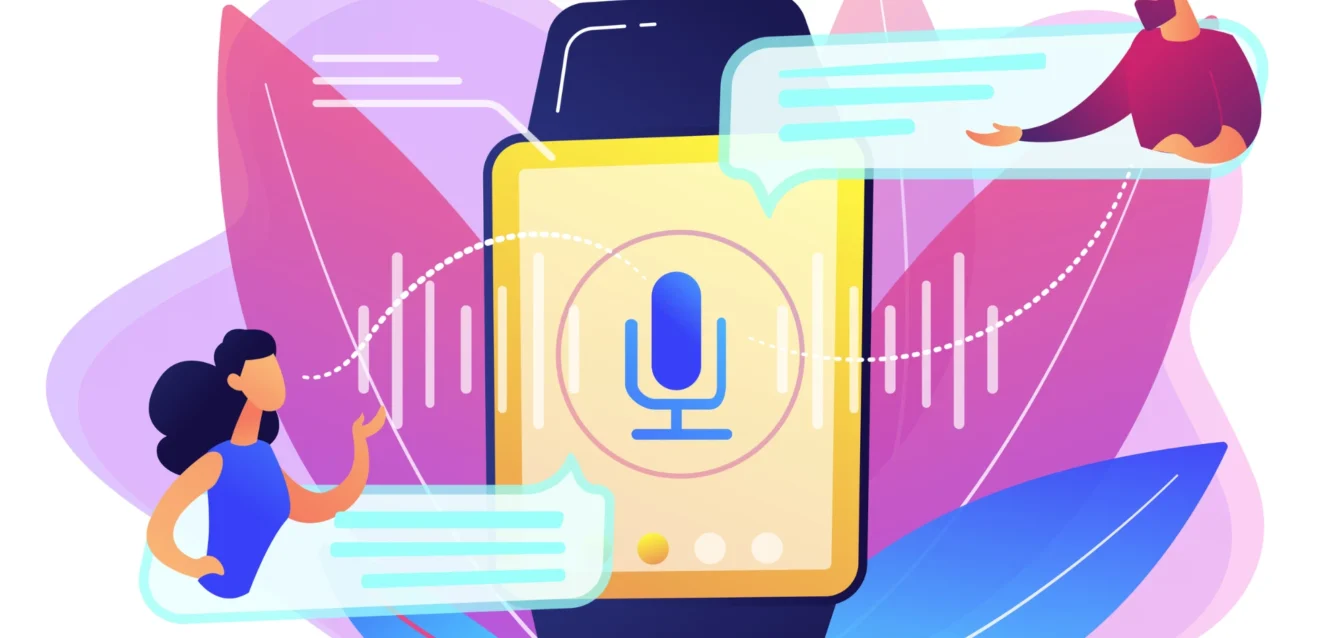
AI voice agents for healthcare are intelligent virtual assistants that use natural language processing (NLP) to handle patient communications via phone or smart devices. They schedule appointments, send medication reminders, process insurance queries, support clinical documentation, and run post-discharge follow-ups, operating 24/7 and integrating directly with EHR systems.
That definition matters because of what it rules out. An ai voice agent in healthcare is not a robocall. It is not the press-1-for-billing phone tree that patients have been abandoning for two decades. It understands what a patient means, not just what they literally say, and it takes real action as a result.
When a patient calls and says “I need to move my Thursday appointment, my daughter has a recital”, the agent doesn’t route them to a menu. It checks availability, confirms a new slot, updates the EHR, and sends a confirmation. The entire interaction takes under two minutes. No hold music. No callback queue.
The distinction between routing calls and resolving them is precisely where voice AI earns its place in modern healthcare infrastructure.
Why Healthcare Is Adopting Voice AI Right Now
The timing isn’t accidental. Three converging pressures are making adoption less of a strategic choice and more of an operational necessity.
Administrative burden is breaking clinical teams. Studies consistently show that administrative tasks consume 30–50% of physician time. That’s time not spent with patients, and it’s a primary driver of the burnout crisis reshaping the healthcare workforce.
Communication failures are a patient safety issue. Research attributes 80% of serious medical errors to communication breakdowns, handoff failures, missed follow-ups, misrouted information. Voice AI systematically eliminates the ones that happen at the front end of patient interaction.
Patient expectations have shifted, permanently. 70% of patients now prefer digital or automated touchpoints for routine tasks. They want to confirm an appointment at 11 PM. They want a refill request handled without sitting on hold. Most health systems are still delivering a 1990s phone experience to a 2025 patient population.
Voice AI addresses all three simultaneously. That’s why adoption is accelerating.
How AI Voice Agents Work
At the core, every healthcare voice AI interaction runs on a three-layer stack:
STT: Speech to Text: The agent hears what the patient says and converts it to text in real time. Healthcare-grade STT is trained specifically on clinical vocabulary, drug names, ICD codes, insurance terminology, not just general conversational English.
NLU: Natural Language Understanding: This is where the intelligence lives. The system interprets intent and context, not just keywords. “I want to reschedule” and “Can I move my appointment to next week?” are the same request, and the agent knows that.
TTS: Text to Speech: The agent responds in a natural, human-like voice in real time, with emotional tone adaptation, recognizing when a patient is confused or distressed and adjusting accordingly.
Underneath all of this is EHR integration. The agent reads patient history, writes updates, confirms insurance status, and logs interactions, without a human manually bridging the gap between conversation and record. And when the conversation exceeds what the agent can confidently handle, it hands off to a live agent cleanly, with full context transferred.
AI Voice Agent vs. Traditional IVR: What’s the Difference?
The difference isn’t incremental. It’s architectural.
| Capability | Traditional IVR | AI Voice Agent |
| Conversation Style | Menu navigation | Natural speech, any phrasing; no menu required |
| Understanding | Detects keywords, fails outside the script | Interprets full intent and conversational context via NLP |
| Personalization | Same script for every caller | Pulls live patient history and adapts the response in real time |
| Error Handling | Loops repeatedly or drops the call | Rephrases, clarifies, and escalates with full context transferred |
| Learning Over Time | Frozen at deployment never improves | Continuously refines accuracy based on real patient interactions |
| Medical Terminology | Not supported misroutes clinical language | Trained on drug names, procedure codes, and insurance terminology |
| After-Hours Capability | Voicemail at best | Full functionality active 24/7, same as business hours |
| EHR Integration | Rare, manual, requires staff follow-up | Native API, reads and writes directly to Epic, Cerner, athenahealth |
Traditional IVR was built to route calls. AI voice agents are built to resolve them. The NLP-powered understanding that drives this difference is what patients feel, and why completion rates, satisfaction scores, and appointment fill rates all improve when health systems make the switch.

6 Key Use Cases of AI Voice Agents for Healthcare
1. Appointment Scheduling and Reminders
The highest-volume use case in healthcare voice AI, and the fastest to deliver measurable ROI.
Voice agents handle inbound booking 24/7, check real-time availability, confirm slots, and send personalized reminders as appointments approach. No hold queues. No callbacks. No missed slots.
The result: No-show rates drop by up to 30%, not because of better technology, but because the right patient gets the right reminder at the right time.
2. Insurance Verification and Prior Authorization
Most claim denials don’t start at billing. They start at the front desk, when insurance isn’t verified before the appointment.
Voice agents close that gap automatically. Before every visit, they confirm coverage, flag discrepancies, collect required documents, and track pending authorizations, escalating delays to the right staff without anyone picking up the phone.
3. Medication Refill Requests
A chronic care patient runs out of medication on a Sunday night. Under the old model, they wait until Monday morning, sit on hold, and hope someone calls the pharmacy before noon.
With voice AI, that patient calls at any hour, speaks naturally, and gets their refill processed, verified against the EHR, routed to the pharmacy, confirmed — without waking a single staff member. For patients managing long-term conditions, that access directly translates into better adherence and measurably better outcomes.
4. Post-Discharge Follow-Ups at Scale
The 72 hours after discharge carry the highest readmission risk. Most health systems have no scalable way to monitor every patient through that window.
Voice agents do. They run structured follow-up calls, checking recovery, symptoms, and medication adherence, across hundreds of patients simultaneously. When something flags, it escalates to clinical staff immediately. The outcome: earlier intervention, lower readmission rates, and stronger performance on value-based care contracts.
5. Clinical Documentation Support
Ask any clinician what they’d eliminate from their day if they could. Charting is almost always the answer.
Voice AI lets physicians dictate notes in real time, during or right after an encounter. The system transcribes, structures, and pushes the update directly to the EHR. No manual entry. No end-of-day catch-up.
Documented deployments show 40–50% reduction in charting time. That time doesn’t disappear, it goes back to patients.
6. Vocal Biomarker Disease Screening
This one is different from every use case above. It’s not about operational efficiency. It’s about what voice AI might do for diagnosis.
Researchers are finding that how we speak pitch, cadence, micro-pauses, tonal variation, carries early biological signals of disease that the human ear simply cannot detect.
- Diabetes: Luxembourg Institute of Health detected it from a 10-second voice sample
- Alzheimer’s: NIA research predicts disease progression with 78%+ accuracy via speech analysis
- Parkinson’s: University of Ottawa identified distinct speech markers before visible symptoms appear
- Clinical validation: VoiceCare AI + Mayo Clinic launched a pilot program in February 2025
Not yet standard practice. But for a technology built to handle appointment reminders, the diagnostic horizon is arriving faster than most expect.
HIPAA Compliance and Data Security
AI voice agents can be fully HIPAA compliant. But compliance depends on how the platform is built and deployed, not the technology category itself. That distinction matters enormously in procurement.
Every healthcare voice AI deployment must include three non-negotiables:
- A signed Business Associate Agreement (BAA): the vendor becomes a covered entity under HIPAA the moment they handle PHI. No BAA means no deal.
- End-to-end encryption: audio recordings, transcripts, and derived data must be encrypted both at rest and in transit. Vague answers about “security” are not sufficient, ask specifically.
- Configurable data retention and deletion policies: you need control over how long voice data lives, where it’s stored, and when it’s purged.
Beyond the baseline: ask about role-based access controls on transcripts, audit logging for regulatory review, and SOC 2 Type II certification. For health systems with strict data sovereignty requirements, clarify whether the platform supports on-premises or regional cloud deployment.
One complexity worth monitoring: the FDA’s classification of diagnostic voice tools, particularly vocal biomarker applications, as Software as a Medical Device (SaMD) is still evolving. Any vendor operating in that space should be able to speak fluently about their regulatory pathway.
How to Choose the Right AI Voice Agent Service Provider for Healthcare
When evaluating the best voice ai agents in healthcare, the most important distinction is this, you’re not just selecting a software platform. You’re selecting a service partner who needs to understand clinical workflows, revenue cycle operations, and compliance obligations simultaneously. Most generic AI vendors understand one of these. The right healthcare-focused provider understands all three.
Here are the eight criteria that should drive your evaluation:
1. Healthcare Domain Expertise Has the provider deployed voice AI specifically in healthcare, hospital networks, specialty practices, revenue cycle operations, or are they adapting a generic enterprise product? The difference shows up immediately in how they handle medical terminology, escalation protocols, and patient communication sensitivity.
2. EHR Integration Capability Native integration with Epic, Cerner, or athenahealth is not a nice-to-have. It’s the difference between a voice agent that reads and writes real patient data in real time and one that creates a parallel workflow your staff manually reconciles. Ask for specific EHR integration references, not general API compatibility claims.
3. HIPAA Compliance Track Record Any vendor can say they’re HIPAA compliant. Ask them to demonstrate it. Request the BAA before the sales process ends. Ask for their last third-party security audit. The providers who answer these questions fluently have built compliance into their architecture, not bolted it on as an afterthought.
4. Medical Vocabulary Training General-purpose voice AI trained on consumer speech will stumble on clinical terminology. Ask specifically how the model is trained on medical vocabulary and what ASR accuracy looks like on clinical language, not just general English.
5. Human Escalation Design How the AI hands off to a live agent is as important as what it handles autonomously. A poorly designed escalation leaves patients more frustrated than a basic IVR. Ask to see real escalation flows, how urgency is detected, what context transfers to the live agent, and how the handoff is communicated to the patient.
6. Customization and Implementation Support Voice workflows in a cardiology practice look nothing like those in a behavioral health clinic or high-volume emergency department. The provider should configure, not just install. Ask what the implementation process looks like, who owns it, and what the timeline is from contract to live deployment.
7. Post-Deployment Support Model Go-live is not the finish line. Voice AI needs continuous tuning as patient language patterns evolve, workflows change, and new use cases emerge. Ask about post-deployment support structure, dedicated success managers, SLA commitments, model retraining frequency, and how performance is reported.
8. Measurable Outcomes Commitment The right provider defines success before deployment, not after. They should be able to say: “Based on your current call volume and no-show rate, here’s what we expect to improve and over what timeline.” If a vendor can’t quantify the outcome, they’re selling technology. The right partner sells results.
The right service provider doesn’t just deploy technology, they understand your patient population, your workflows, and your compliance obligations before writing a single line of configuration.
Challenges and Limitations to Consider
Balanced assessment is part of expert judgment. Go in with eyes open.
Patient trust takes time. Elderly and low-digital-literacy patients may disengage from AI voice calls, or mistake them for spam. Transparent disclosure and opt-out options are not optional. They’re the difference between adoption and abandonment.
95% accuracy is not 100%. A 5% speech recognition error rate sounds manageable until a drug name is misheard or an escalation trigger is missed. Clinical edge cases must always route to humans. No exceptions.
Legacy EHR integration is harder than it sounds. Not every health system runs modern open-architecture EHRs. Legacy systems with limited API access or heavily customized configurations can turn a straightforward deployment into a months-long integration project. Scope this honestly before signing.
Over-automation erodes trust fast. Too many automated calls, even well-designed ones, condition patients to ignore them. Frequency caps, preference management, and channel optionality must be built in from day one, not added later.
Conclusion
AI voice agents for healthcare are not a future investment. They are operational infrastructure running in health systems today — handling patient calls, closing documentation gaps, recovering revenue, and improving care continuity at a scale no human team can sustain alone.
The ROI case is proven. The compliance path is clear. What separates a successful deployment from a costly one is execution — and execution starts with choosing a partner who understands both the technology and the environment it operates in.
That’s the distinction CaliberFocus brings to healthcare voice AI.
We don’t adapt generic AI to fit healthcare. We build for it from the ground up.
CaliberFocus designs and deploys end-to-end NLP and Voice AI solutions purpose-built for complex, high-stakes environments. Our healthcare capabilities span the full voice AI stack — speech recognition trained on clinical vocabulary, NLU that interprets patient intent in real time, and TTS that adapts tone and pacing to the sensitivity of the interaction.
Where most implementations plateau at 70–75% accuracy on medical terminology, our domain-adapted models, fine-tuned on your specific workflows, patient population, and EHR environment, consistently reach 85–95% accuracy in production. That gap matters when a misheard drug name or missed escalation trigger has clinical consequences.
Our approach covers every layer that healthcare voice AI demands:
- Clinical entity recognition: drug names, procedure codes, ICD classifications, insurance terminology
- Conversational AI with context memory: multi-turn dialogue that holds patient history across an interaction
- Real-time STT and TTS: speaker-aware transcription with noise reduction and domain-tuned vocabulary
- Continuous learning pipelines: models that retrain automatically, maintaining 90%+ accuracy as patient language and workflows evolve
- EHR-integrated deployment: voice workflows that read and write directly to your patient record systems
Through our AI as a Service model, healthcare organizations gain enterprise-grade voice and language intelligence without building or maintaining large internal AI teams, accelerating time to value while staying compliant and scalable.
From Data to Decisions in Healthcare
Implement descriptive analytics that drives smarter leadership choices, operational efficiency, and measurable outcomes, safely and compliantly.
Frequently Asked Questions
AI voice agents for healthcare are intelligent virtual assistants that use NLP to handle patient communications, scheduling, reminders, insurance queries, and clinical documentation, via phone or smart device, 24/7, without human intervention for routine tasks.
Yes, when built on platforms that include a signed Business Associate Agreement, end-to-end encryption of audio data and transcripts, and configurable data retention and deletion policies. Always verify SOC 2 Type II certification before procurement.
IVR routes calls through rigid press-1 menus. An AI voice agent in healthcare understands natural speech, accesses live patient data, takes real actions, and escalates intelligently, without any menu navigation. The patient experience is categorically different.
Appointment scheduling and reminders, insurance verification and prior authorization, medication refill requests, post-discharge follow-ups, and clinical documentation support are the highest-adoption use cases as of 2025.