

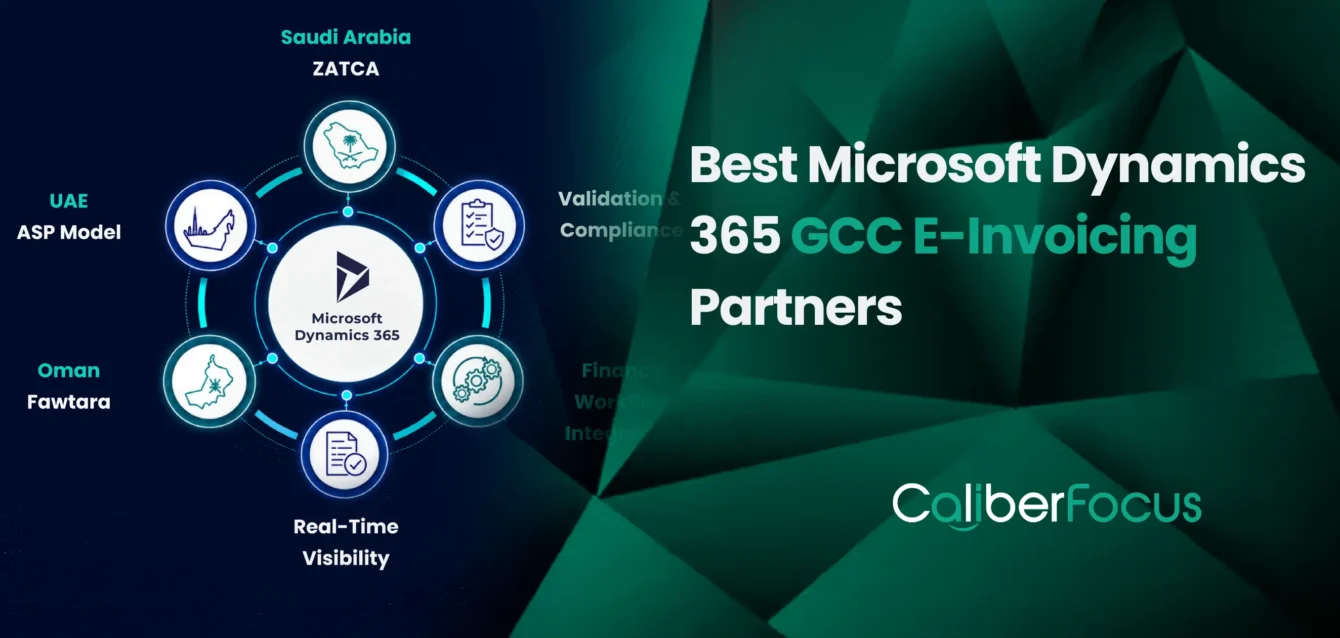
GCC e-invoicing is becoming an ERP readiness issue for enterprises running Microsoft Dynamics 365, not simply another tax compliance task. As GCC markets introduce structured e-invoicing frameworks, businesses need to prepare their D365 environment, financial data, integrations, and operating processes well before their applicable deadlines.
For organizations with high invoice volumes, multiple legal entities, or operations across GCC markets, the challenge is connecting regulatory requirements with existing Dynamics 365 Finance and Operations processes without disrupting invoicing and financial operations. A capable D365 e-invoicing GCC partner therefore needs to address the complete implementation lifecycle, rather than simply configure an invoice format.
What Enterprises Need From a D365 E-Invoicing Partner
A suitable partner should be able to help with:
- Readiness and gap assessment across Dynamics 365 configuration, data, tax processes, and integrations
- E-invoicing architecture and integration between D365 and the applicable regional ecosystem
- Invoice and master-data validation to reduce structured invoice errors and rejections
- Configuration and customization across D365 Finance/F&O environments
- Testing and remediation before mandatory implementation dates
- Multi-entity and multi-country deployment for organizations operating across GCC markets
- Go-live support and ongoing maintenance as regulatory requirements and business processes evolve
GCC e-invoicing services can help enterprises understand the broader requirements involved in preparing their Dynamics 365 environment for GCC e-invoicing.
Executive note: E-invoicing deadlines can expose weaknesses that already exist in ERP data, tax configuration, integrations, and financial workflows. Starting early gives finance, tax, and IT teams time to identify gaps, test integrations, resolve rejection scenarios, and establish ownership before mandatory implementation creates operational pressure.
This is particularly relevant across manufacturing, healthcare and life sciences, retail, financial services, professional services, construction, logistics, and other B2B and B2G operations where invoicing is closely tied to cash flow, reporting, and customer or supplier processes.
A long-term D365 e-invoicing partner should therefore remain involved beyond initial implementation, supporting testing, remediation, go-live, regulatory changes, and post-go-live operations across the GCC. The following comparison examines 10 providers based on their Dynamics 365 capabilities, GCC e-invoicing expertise, implementation scope, regional coverage, and ability to support enterprises beyond the initial rollout.
- What Enterprises Need From a D365 E-Invoicing Partner
- E-Invoicing Deadlines Are Making D365 Integration a Business Priority
- What Enterprises Should Address Before the Deadline
- Why This Makes Partner Selection More Important
- 10 Best D365 E-Invoicing Partners in the GCC
- 1. CaliberFocus
- 2. iSys Solutions
- 3. Dynamics Stream
- 4. NOVASOFT FZCO
- 5. Pioneers Information Technology
- 6. Akaza Software
- 7. Brmg
- 8. Bahwan CyberTek
- 9. Imtac
- 10. Compnet
- How We Compared the 10 D365 E-Invoicing GCC Partners
- What We Evaluated
- How to Choose the Right D365 E-Invoicing Partner for Your GCC Rollout
- Evaluate the Partner Across These Areas
- The Partner Should Own More Than the Integration
- Why CaliberFocus for GCC E-Invoicing and Dynamics 365
- Frequently Asked Questions
E-Invoicing Deadlines Are Making D365 Integration a Business Priority
For enterprises operating across the GCC, e-invoicing deadlines create a narrow window to assess readiness, resolve gaps, and validate processes before mandatory requirements affect live financial operations. The priority now is not simply understanding the mandate, but determining what needs to change across systems, data, processes, and ownership before implementation becomes time-critical.
What Enterprises Should Address Before the Deadline
| Priority | What needs to happen | Why It Matters for GCC E-Invoicing |
| Assess readiness | Review current invoicing workflows, ERP configuration, tax setup, and integrations | Identifies country-specific gaps before implementation timelines become compressed |
| Validate data | Review customer, supplier, tax, entity, and transaction data | Accurate structured data is essential for successful invoice validation and exchange |
| Map requirements | Identify the applicable requirements for each country, entity, and transaction type | Prevents a single-market approach from creating gaps across GCC operations |
| Test end to end | Validate invoice generation, transmission, responses, rejections, and corrections | Exposes technical and process issues before they affect live invoicing |
| Prepare operations | Define ownership for rejected invoices, exceptions, credit notes, and system issues | Keeps finance processes moving after mandatory implementation |
| Plan ongoing support | Establish processes for regulatory updates, remediation, monitoring, and post-go-live support | E-invoicing requirements and operating needs can evolve after initial implementation |
Starting early gives finance, tax, IT, and ERP teams time to address country-specific requirements, resolve data and integration gaps, and validate processes before mandatory e-invoicing creates operational pressure.
Is Your Dynamics 365 Environment Ready for GCC E-Invoicing?
Get a clearer view of the Dynamics 365, finance, data, and integration requirements for e-invoicing across Saudi Arabia, the UAE, and Oman before moving into implementation.
Why This Makes Partner Selection More Important
The complexity increases when an enterprise operates across multiple GCC markets, legal entities, financial processes, and Dynamics 365 environments. A partner may need to coordinate regional requirements with the organization’s existing ERP architecture while ensuring that implementation, testing, remediation, and ongoing support are managed as one connected program.
This is particularly important for businesses in manufacturing, healthcare and life sciences, retail, financial services, professional services, construction, and logistics, where invoice volumes, complex billing structures, and dependencies between invoicing and financial operations can increase the impact of implementation issues.
The goal is not simply to meet an e-invoicing deadline. It is to establish a regional capability that can continue operating as GCC requirements, entities, and business processes evolve.
That is why the partner comparison that follows looks beyond basic e-invoicing functionality and considers GCC coverage, Dynamics 365 expertise, implementation capabilities, integration experience, and post-go-live support.
10 Best D365 E-Invoicing Partners in the GCC
The strongest D365 e-invoicing partners combine Dynamics 365 expertise with regional e-invoicing implementation, integration, testing, and ongoing support capabilities. The companies below are assessed based on their GCC presence, Dynamics 365 capabilities, e-invoicing relevance, and the types of enterprise environments they are positioned to support.
Top 5 D365 E-Invoicing GCC Partners
Leading providers to consider for Dynamics 365 e-invoicing across GCC markets.
CaliberFocus
GCC-focused Dynamics 365 e-invoicing partner supporting readiness, implementation, integration, and ongoing support. Designed for enterprises managing country-specific requirements and multi-entity GCC environments.
iSys Solutions
Provides Dynamics-focused e-invoicing integration capabilities for organizations operating in the UAE. Its solutions support ERP connectivity with the UAE e-invoicing and ASP ecosystem.
Dynamics Stream
Offers Dynamics 365 e-invoicing solutions focused on regional compliance and structured invoice processing. Its capabilities include localized applications and invoice data mapping for GCC requirements.
Pioneers Information Technology
A Saudi-based technology provider with Dynamics expertise and experience supporting ZATCA-related ERP requirements. Its focus is particularly relevant to organizations implementing e-invoicing within Saudi Arabia.
Bahwan CyberTek (BCT)
An Oman-based technology services company with enterprise integration and digital transformation capabilities. Its regional presence makes it relevant for organizations evaluating technology partners for Oman-focused initiatives.
1. CaliberFocus

Overview:
CaliberFocus is an established Dynamics 365 e-invoicing partner supporting enterprises with GCC-specific readiness, implementation, integration, and ongoing support. Its approach connects e-invoicing requirements with Dynamics 365 Finance and Operations, ERP configuration, tax and invoice data, integration workflows, testing, and multi-entity operations. For organizations operating across multiple GCC markets, CaliberFocus helps align country-specific requirements with existing financial processes rather than treating e-invoicing as an isolated compliance project. Its broader Dynamics 365 expertise also supports enterprises that need a partner for implementation, remediation, modernization, and long-term operational support.
Best suited for: Enterprises across the GCC looking for D365 e-invoicing implementation, readiness, integration, and ongoing support across multiple entities and financial operations.
GCC coverage: Saudi Arabia, UAE, Oman, Bahrain, Qatar, Kuwait, and broader GCC operations.
Dynamics 365 & E-Invoicing Capabilities
CaliberFocus approaches GCC e-invoicing as an extension of Dynamics 365 and finance transformation, helping enterprises connect regulatory requirements with their existing ERP processes, data, integrations, and operational workflows.
Key capabilities include:
- GCC e-invoicing readiness and gap assessment
- Dynamics 365 e-invoicing implementation and integration
- D365 Finance and Operations configuration
- Invoice and tax-data readiness
- Integration and end-to-end testing
- E-invoicing remediation and issue resolution
- Multi-entity and multi-country GCC deployment support
- Post-go-live e-invoicing support and maintenance
Why CaliberFocus:
CaliberFocus brings together GCC e-invoicing readiness, Dynamics 365 integration, and production-focused delivery to help enterprises build an e-invoicing setup that works across finance operations and evolving regional requirements.
Ready to Align Your Dynamics 365 Finance Environment for GCC E-Invoicing?
Get expert guidance on D365 Finance configuration, e-invoicing integration, and GCC-specific implementation requirements for your enterprise.
2. iSys Solutions
Overview:
iSys Solutions focuses on Microsoft business application integration and UAE e-invoicing connectivity, with solutions designed to connect ERP environments with Accredited Service Providers. Its positioning is particularly relevant to organizations preparing their invoicing workflows for structured digital exchange under the UAE e-invoicing framework.
Best suited for:
UAE businesses using Microsoft business applications that need localized e-invoicing connectivity and ERP-to-ASP integration.
GCC coverage:
Primarily UAE.
Dynamics 365 & E-Invoicing Capabilities
- UAE e-invoicing integration
- ASP connectivity
- Microsoft Dynamics integration
- API-based invoice exchange
- Structured invoice data workflows
3. Dynamics Stream
Overview:
Dynamics Stream develops localized applications for Microsoft Dynamics 365 environments, with e-invoicing capabilities addressing requirements in markets including Saudi Arabia and the UAE. Its solutions focus on bringing country-specific compliance workflows and structured invoice data into Dynamics 365 Business Central environments.
Best suited for:
Dynamics 365 Business Central organizations in the UAE and Saudi Arabia that need localized e-invoicing capabilities.
GCC coverage:
UAE, followed by Saudi Arabia.
Dynamics 365 & E-Invoicing Capabilities
- UAE e-invoicing capabilities
- ZATCA e-invoicing capabilities
- Dynamics 365 Business Central integration
- XML invoice data mapping
- PINT-AE data mapping
- Country-specific e-invoicing workflows
4. NOVASOFT FZCO
Overview:
NOVASOFT FZCO is positioned around enterprise and e-commerce technology environments where financial, warehouse, and transaction data need to operate across interconnected business processes. Its relevance to GCC e-invoicing is particularly suited to organizations managing complex multi-entity and transaction-heavy operations in the UAE.
Best suited for:
UAE enterprises with complex e-commerce, warehouse, and multi-entity operations requiring coordinated financial and tax data flows.
GCC coverage:
UAE.
Dynamics 365 & E-Invoicing Capabilities
- E-commerce ERP integration
- Multi-entity financial operations
- Warehouse and inventory integration
- Tax data routing
- Enterprise application integration
- Complex transaction-flow management
5. Pioneers Information Technology
Overview:
Pioneers Information Technology has an established presence in Saudi Arabia’s ERP and enterprise technology market. Its positioning around local business requirements and ZATCA-related implementation makes it relevant to Saudi organizations looking to connect their ERP environments with the country’s e-invoicing framework.
Best suited for:
Saudi enterprises seeking locally focused ERP expertise and support for ZATCA e-invoicing implementation.
GCC coverage:
Saudi Arabia.
Dynamics 365 & E-Invoicing Capabilities
- ZATCA e-invoicing implementation
- Phase 2 integration support
- ERP localization
- Custom ERP add-ons
- Saudi tax and invoicing workflows
- Enterprise ERP implementation
6. Akaza Software

Overview:
Akaza Software focuses on localized enterprise technology and cloud environments for organizations operating in Saudi Arabia. Its relevance to e-invoicing is centered on the ERP and infrastructure layer supporting financial transactions, records, and business applications within the Kingdom.
Best suited for:
Saudi enterprises that require localized ERP environments and infrastructure support alongside financial and e-invoicing transformation.
GCC coverage:
Saudi Arabia.
Dynamics 365 & E-Invoicing Capabilities
- Localized ERP environments
- Cloud-based financial systems
- Saudi enterprise technology support
- Transactional data management
- Financial systems integration
7. Brmg

Overview:
Brmg is particularly relevant to Saudi organizations in medical distribution and related sectors, where financial systems need to work alongside inventory and distribution processes. Its sector-focused positioning can support businesses managing interconnected commercial, inventory, and financial workflows.
Best suited for:
Saudi medical distribution and healthcare-related businesses requiring integration between financial, inventory, and operational systems.
GCC coverage:
Saudi Arabia.
Dynamics 365 & E-Invoicing Capabilities
- ERP and financial system integration
- Medical distribution workflows
- Inventory and financial data alignment
- Tax-related system integration
- Distribution process support
8. Bahwan CyberTek

Overview:
Bahwan CyberTek operates across enterprise technology, digital transformation, and systems integration, with a significant presence in Oman. Its broad enterprise capabilities make it relevant to organizations where e-invoicing needs to connect with existing applications, infrastructure, and complex operational environments.
Best suited for:
Large Omani enterprises and infrastructure-intensive organizations with complex application and systems integration requirements.
GCC coverage:
Oman.
Dynamics 365 & E-Invoicing Capabilities
- Enterprise application integration
- Digital transformation
- Infrastructure and systems integration
- Financial technology integration
- Large-scale enterprise deployments
9. Imtac

Overview:
Imtac provides enterprise technology and digital transformation services in Oman, with capabilities spanning business systems, operational technology, and integration. Its relevance to e-invoicing is strongest for organizations that need financial processes to connect with wider supply chain and operational systems as digital tax requirements evolve.
Best suited for:
Omani organizations managing supply chain, asset-intensive, or operational environments that need integrated financial and business systems.
GCC coverage:
Oman.
Dynamics 365 & E-Invoicing Capabilities
- Enterprise systems integration
- Supply chain technology
- Asset and operational data management
- ERP transformation
- Financial process integration
10. Compnet

Overview:
Compnet is relevant to Omani organizations undertaking commercial system modernization and requiring ongoing technology support. Its positioning is particularly applicable where legacy applications and billing environments need to evolve toward more connected digital financial operations.
Best suited for:
Omani organizations modernizing legacy commercial systems and transitioning toward digital billing and financial environments.
GCC coverage:
Oman.
Dynamics 365 & E-Invoicing Capabilities
- Legacy system modernization
- Commercial system migration
- Cloud billing environments
- ERP and application integration
- Implementation and ongoing support
How We Compared the 10 D365 E-Invoicing GCC Partners
Not every e-invoicing provider offers the same depth of Dynamics 365 expertise or GCC implementation capability, so this comparison looks beyond basic invoice compliance. We considered the capabilities enterprises need to connect e-invoicing requirements with their existing ERP environment, financial processes, and regional operations.
What We Evaluated
| Evaluation criterion | What we considered |
| Dynamics 365 expertise | Experience across D365 Finance, Finance & Operations, Business Central, and related ERP environments |
| GCC e-invoicing coverage | Ability to address country-specific requirements across relevant GCC markets |
| Implementation & integration | ERP configuration, e-invoicing integration, data mapping, and end-to-end deployment |
| Readiness & remediation | Gap assessment, data quality, configuration remediation, and pre-go-live preparation |
| Testing capabilities | Sandbox, simulation, validation, rejection handling, and end-to-end testing |
| Multi-entity support | Ability to support complex legal-entity, group, and cross-border environments |
| Post-go-live support | Ongoing monitoring, issue resolution, regulatory updates, and operational support |
| Enterprise suitability | Fit for organizations with complex finance, tax, supply chain, healthcare, retail, and other business processes |
How We Compared the 10 D365 E-Invoicing GCC Partners
We evaluated each provider against the practical requirements of enterprise e-invoicing, from Dynamics 365 expertise and GCC coverage to implementation, testing, scalability, and long-term support.
ERP & GCC Expertise
Implementation Readiness
Scale & Validation
Long-Term Enterprise Fit
What this means: The comparison goes beyond basic e-invoicing availability to assess how well each partner can support a production-ready D365 environment across the GCC.
The Dynamics 365 environment itself is an important part of the evaluation because implementation requirements can vary significantly between Finance & Operations and Business Central. Enterprises comparing their ERP options can also explore the differences between Dynamics 365 Finance and Business Central before assessing which partner is best aligned with their environment.
The comparison prioritizes demonstrated relevance to Dynamics 365 and GCC e-invoicing rather than company size or general ERP capabilities alone. This helps readers assess each partner based on country requirements, ERP environment, implementation complexity, and long-term support needs.
How to Choose the Right D365 E-Invoicing Partner for Your GCC Rollout
The right D365 e-invoicing partner should combine GCC regulatory understanding, Dynamics 365 expertise, integration capability, and long-term operational support rather than treating e-invoicing as a one-time configuration exercise.
Evaluate the Partner Across These Areas
| Evaluation criterion | What a capable partner should deliver |
| GCC regulatory expertise | Country-specific understanding of e-invoicing mandates, tax requirements, invoice standards, and evolving regulatory expectations across the markets you operate in. |
| Dynamics 365 expertise | Hands-on capability across the relevant D365 environment, including Finance, Finance & Operations, Business Central, localization, configuration, and financial workflows. |
| ERP integration | A reliable integration architecture connecting Dynamics 365 with the required e-invoicing ecosystem while preserving existing finance and billing workflows. |
| Data readiness | Structured assessment and remediation of tax data, master data, invoice fields, customer and supplier information, and transaction configuration before integration. |
| Testing and remediation | End-to-end testing covering invoice generation, validation, transmission, acknowledgements, rejections, corrections, credit notes, and exception scenarios. |
| Multi-entity delivery | A scalable approach for organizations managing multiple legal entities, tax registrations, currencies, business units, and GCC jurisdictions. |
| Go-live and ongoing support | Continuous monitoring, issue resolution, regulatory updates, remediation, and operational support after the initial implementation. |
| Enterprise transformation capability | The ability to integrate e-invoicing into broader finance, ERP, tax, data, and business-process transformation initiatives. |
The Partner Should Own More Than the Integration
E-invoicing implementation does not end when the first compliant invoice is transmitted. Enterprises need a partner that can help maintain data quality, resolve rejection scenarios, adapt to regulatory changes, support new entities, and keep the D365 environment aligned as business requirements evolve.
This is particularly important for organizations operating across multiple GCC markets, where a scalable regional approach can reduce fragmented country-by-country implementations and create a more consistent operating model.
The strongest D365 e-invoicing partner is therefore one that can stay involved from readiness and implementation through remediation, go-live, and ongoing compliance support.
Why CaliberFocus for GCC E-Invoicing and Dynamics 365
CaliberFocus combines GCC e-invoicing expertise with Dynamics 365 engineering to help enterprises move from readiness to production-ready implementation.
- GCC-focused readiness: Identify D365, tax, data, and process gaps before integration and testing.
- Dynamics 365 expertise: Support D365 Finance, Finance & Operations, and Business Central environments with e-invoicing requirements built into the ERP workflow.
- Scalable GCC implementation: Design approaches that support multiple entities and GCC jurisdictions without creating fragmented implementations.
- Beyond go-live: Extend support through remediation, monitoring, regulatory changes, and ongoing D365 optimization.
The goal is more than meeting an e-invoicing deadline. It is establishing a reliable D365 foundation that can adapt as your GCC operations and regulatory requirements evolve.
Plan Your GCC E-Invoicing Strategy With Dynamics 365 Experts
Get a focused consultation on GCC e-invoicing requirements, Dynamics 365 readiness, integration considerations, and the next steps for your enterprise environment.
Frequently Asked Questions
Look for a partner with proven Dynamics 365 expertise, GCC regulatory knowledge, integration capabilities, readiness assessment, testing, and post-go-live support. Multi-country experience is particularly valuable when your organization operates across several GCC jurisdictions with different e-invoicing requirements and implementation timelines.
D365 users should first assess invoice data, tax configuration, master data, workflows, legal entities, and existing integrations. A readiness assessment can identify configuration and data gaps before the implementation begins, reducing remediation effort and helping finance and IT teams plan the rollout around regulatory deadlines.
Microsoft Dynamics e-invoicing in Oman requires organizations to consider the country’s evolving e-invoicing framework alongside their existing D365 finance and invoicing processes. Businesses should assess ERP readiness, data structures, integration requirements, and future regulatory changes before committing to a technical implementation approach.
E-invoicing UAE requirements introduce structured invoice exchange and integration considerations that D365 users need to address before mandatory adoption. Organizations should evaluate their D365 environment, invoice data, integration architecture, and Accredited Service Provider requirements early enough to allow adequate testing and remediation.