

GCC E-Invoicing Is Becoming an ERP Readiness Test. What begins as a tax requirement is raising larger questions about enterprise systems, data quality, integration, and operational control.
Across the GCC, e-invoicing is often introduced as a finance or tax compliance initiative. Early conversations usually focus on invoice formats, implementation dates, and service providers.
That does not capture the full change taking place.
An invoice is the final expression of several connected processes. Customer data, product information, tax rules, pricing, approvals, and transaction records all meet at that point. When these elements are fragmented or inconsistent, the weakness eventually appears in the invoice.
This is why e-invoicing is becoming an ERP readiness test. The mandate may begin with compliance, but it quickly reveals the need for stronger GCC E-Invoicing Services across finance, tax, operations, and technology.
- From Invoice Creation to Real-Time Exchange
- What the Invoice Reveals About the Enterprise
- GCC E-Invoicing Progress Across Saudi Arabia, the UAE, and Oman
- Why Early Preparation Leads to Better ERP Decisions
- Three ERP Decisions GCC Leaders Must Make for E-Invoicing Readiness
- Turning the ERP Decision Into an Action Plan
- The Decision Behind the Deadline
From Invoice Creation to Real-Time Exchange
A PDF sent by email may be digital, but it is not necessarily an e-invoice.
E-invoicing requires transaction data to be created in a structured format that systems can read, exchange, validate, and process. Depending on the country and transaction type, that information may also need to pass through a service provider or tax authority platform.
The movement is no longer:
The old path: Transaction → PDF → Customer.
The new path: Transaction → Structured data → Validation and exchange → Customer and authority.
That change places the ERP closer to the regulatory process. Compliance can no longer depend on a manual review at the end. It must be supported by the data and controls built into the transaction from the beginning.
What the Invoice Reveals About the Enterprise
E-invoicing makes weaknesses in data quality, process control, and system integration visible at the transaction level.
Incomplete customer records often begin with inconsistent data ownership. Tax registration numbers, legal names, billing addresses, or branch details may be maintained differently across CRM, ERP, and sales systems. When the invoice is generated, those gaps can lead to validation failures, submission delays, or manual correction.
- Tax classification errors usually originate at the product or service level. If tax codes, exemptions, or jurisdiction rules are not mapped correctly at the source, the invoice carries inaccurate tax information into the exchange process.
- Disconnected POS, ecommerce, logistics, and finance systems create incomplete transaction records. Each platform may hold only part of the required information, resulting in missing quantities, mismatched values, duplicate references, or incomplete invoice data.
- Heavy customization increases the cost and complexity of every regulatory change. Updates may need to be applied across custom workflows, interfaces, and middleware layers, making compliance harder to maintain over time.
- At low transaction volumes, finance teams may still identify and correct these issues manually. As volumes increase, the same approach leads to rework, failed submissions, processing delays, and limited visibility into the root cause.
- The invoice therefore reflects the condition of the wider enterprise environment. Reliable e-invoicing depends on governed data, connected systems, clear ownership, and processes that can adapt to regulatory change without repeated manual intervention.
For organizations using Microsoft Dynamics 365 Finance, e-invoicing readiness starts with the quality of the underlying data and configuration. Customer tax registration numbers, tax groups, number sequences, and legal entity tax registrations should be reviewed before implementation. These details directly affect invoice validation, submission, and compliance.
The invoice, in other words, reflects the condition of the wider enterprise environment. Reliable e-invoicing depends on governed data, connected systems, clear ownership, and processes that can adapt to regulatory change without repeated manual intervention.
Is Your D365 Environment Actually Ready, Or Just Assumed to Be?
We’ve reviewed a lot of GCC rollouts. Almost none passed on the first look. Let’s see where yours stands.
GCC E-Invoicing Progress Across Saudi Arabia, the UAE, and Oman
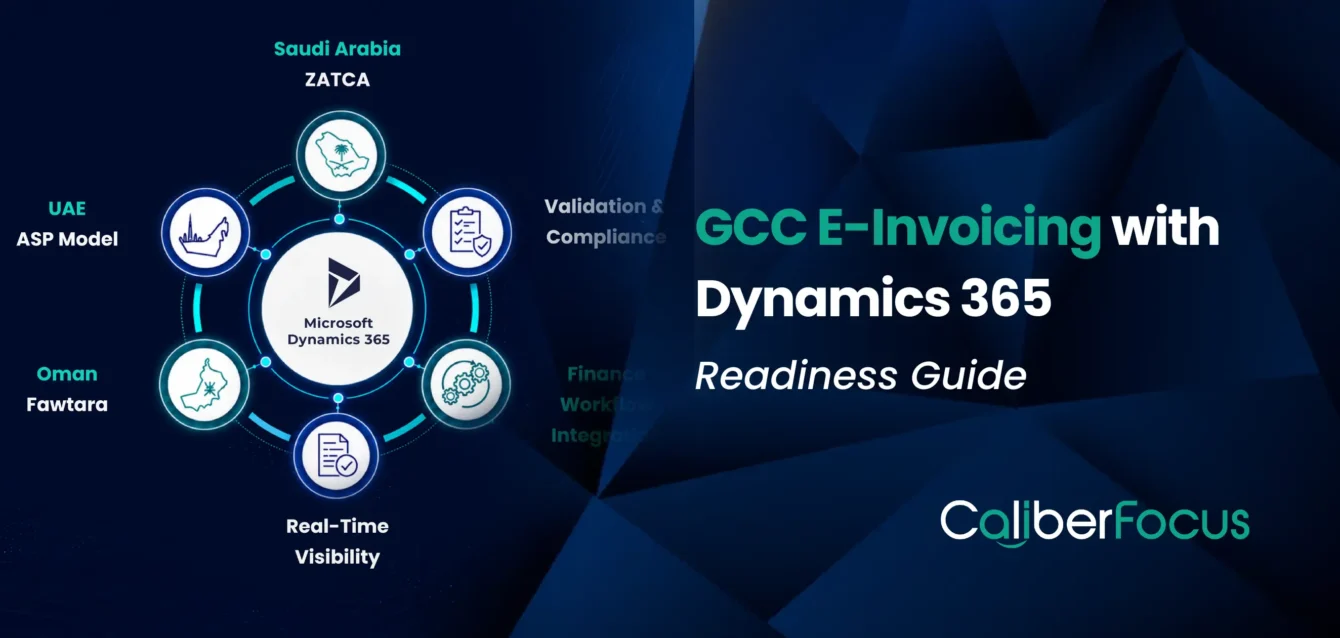
Saudi Arabia, the UAE, and Oman are all moving toward the same structured-data outcome, but from three different starting points. The shared objective is to replace invoice processes built on PDFs, spreadsheets, and manual reporting with structured data that can be exchanged and processed electronically, the timelines and mechanisms, however, differ by country.
| Country | Mandate Model | What It Means for D365 |
| Saudi Arabia | ZATCA Phase 2, rolled out through taxpayer waves | Direct integration with ZATCA systems; already in force for notified organizations |
| UAE | Accredited Service Provider (ASP) model, pilot since July 2026 | Every invoice routes through an ASP, there is no direct connection to the FTA |
| Oman | Fawtara, a five-corner exchange model | Invoices pass through both parties’ service providers, with the Oman Tax Authority receiving a reporting copy |
1. Operating in Saudi Arabia
Saudi Arabia is already implementing Phase 2 of its e-invoicing programme through taxpayer waves. Organizations notified by ZATCA must integrate their invoicing solutions with its systems and meet the applicable technical and business requirements.
For businesses operating in Saudi Arabia, the priority is ensuring that invoice data, system configurations, integrations, and exception-handling processes can support ongoing compliance as additional entities enter scope.
2. Preparing in the UAE
The UAE launched its e-invoicing pilot in July 2026 and is moving toward phased mandatory implementation through its Accredited Service Provider model.
For organizations in the UAE, the immediate focus should be on identifying which entities and transactions are in scope, understanding service-provider requirements, and confirming whether the ERP can generate complete and accurate structured invoice data.
For UAE e-invoicing, businesses do not connect their D365 environment directly to the FTA. Invoices are routed through an Accredited Service Provider (ASP), which acts as the intermediary between the business and the tax authority. As a result, selecting and onboarding the right ASP should be part of the e-invoicing readiness process from the start, alongside D365 configuration and integration.
3. Building Readiness in Oman
Oman is introducing Fawtara through a five-corner model connecting taxpayers, service providers, buyers, and the Oman Tax Authority.
Oman’s five-corner e-invoicing model routes invoices through the seller’s and buyer’s service providers, with the Oman Tax Authority receiving transaction data at the reporting layer. For organizations preparing their Microsoft Dynamics e-invoicing Oman environment, understanding these intermediary connections early is important for planning the right integration and readiness approach.
For businesses in Oman, this is the right stage to review the emerging framework, assess current data and system dependencies, and identify the integration changes that may be required before implementation timelines become more immediate.
The timelines differ, but the direction is consistent. Every organization will need reliable source data, structured invoice generation, tested system connections, clear process ownership, and an ERP environment that can adapt as requirements evolve.
Why Early Preparation Leads to Better ERP Decisions
Saudi Arabia, the UAE, and Oman are progressing at different stages, but waiting until the nearest compliance deadline can limit your ERP options.
Starting early gives organizations time to assess whether their current environment needs configuration improvements, stronger integrations, data cleanup, or broader modernization. It also allows finance and IT teams to test complex invoice scenarios, prepare users, and evaluate the long-term impact of each approach.
When preparation starts late, the focus can shift from choosing a sustainable solution to meeting the deadline. This can lead to rushed integrations, limited testing, continued manual work, and higher support requirements after implementation.
For organizations using D365 Finance, checking the current platform version should also be part of this assessment. Microsoft’s Electronic Invoicing Service for ZATCA became available from D365 Finance version 10.0.29, with capabilities refined through subsequent releases. Organizations on deferred update schedules should factor their current version into the implementation plan before defining the final scope.
Early preparation gives organizations more time to address compliance gaps while building an e-invoicing environment that can support future regulatory and business requirements.
Three ERP Decisions GCC Leaders Must Make for E-Invoicing Readiness
Organizations across the GCC will begin from different technology positions. The right response depends on the ERP environment, the way invoice data moves, and the level of manual intervention involved.
1. Legacy ERP: Decide Whether Integration Is Sustainable
Organizations using AX 2012 or another legacy ERP must determine whether the system can consistently generate the structured data required for e-invoicing.
Where the ERP remains stable and produces reliable data, integration may be sufficient. Where unsupported customizations, rising maintenance costs, and manual corrections continue to increase, a broader migration and platform modernization strategy may be required.
AX 2012 presents a different challenge. Microsoft no longer provides regulatory updates for the platform, so it does not offer a supported path for ZATCA Phase 2 compliance. While middleware workarounds may address individual requirements, they can add long-term maintenance and integration complexity without resolving the underlying platform limitation. For organizations still running AX 2012, migrating to a supported Dynamics 365 platform should be treated as a prerequisite for a sustainable GCC e-invoicing strategy.
2. Dynamics 365: Decide What Must Be Strengthened
Organizations already using Microsoft Dynamics 365 Finance and Operations have a strong foundation for GCC e-invoicing. However, being on D365 does not automatically mean the environment is ready. A readiness review should focus on the areas that can affect invoice accuracy, submission, and ongoing compliance:
- Review your existing D365 configuration: Check data quality, tax configuration, customizations, and integrations that support invoice processing and submission.
- Use the capabilities already available in D365: D365 Finance uses Electronic Reporting (ER) to generate structured invoice data for regulatory requirements. Review the existing configurations before considering additional customization.
- Assess ZATCA capabilities: Microsoft provides native ZATCA Phase 2 capabilities in D365 Finance through the Electronic Invoicing Service from version 10.0.29 onward. Standard environments may be able to use these capabilities as the foundation, with targeted extensions where specific business requirements call for them.
- Plan for regulatory updates: GCC e-invoicing requirements and Microsoft D365 updates can change over time. Establish a process to review updates and confirm that existing configurations remain aligned with current requirements.
- Strengthen Dynamics 365 e-Invoicing Integration: Connect invoice validation, submission, status updates, and rejection handling with the D365 finance workflow to reduce manual intervention and improve visibility across invoice processing.
- Support multiple GCC entities: D365 Finance can support country-specific e-invoicing configurations within the same environment. Each legal entity can have its own tax registration, invoice requirements, and relevant authority or service-provider connections.
- Test before go-live: Validate standard and simplified invoices, credit and debit notes, submission scenarios, and rejection handling. Saudi Arabia requires testing through the ZATCA Fatoora simulation environment, while UAE e-invoicing implementations should account for the relevant Accredited Service Provider and Peppol requirements.
The goal is not to replace what already works in D365. It is to identify the gaps, strengthen the existing environment, and build a GCC e-invoicing setup that can remain compliant as requirements evolve.
Decide What Must Be Strengthened
Being on Dynamics 365 does not automatically mean your environment is ready for GCC e-invoicing. Review these seven areas before moving toward go-live.
Review Your D365 Configuration
Check data quality, tax configuration, customizations, and integrations that support invoice processing and submission.
Data & ConfigurationUse Existing D365 Capabilities
D365 Finance uses Electronic Reporting (ER) to generate structured invoice data for regulatory requirements. Review existing configurations before considering additional customization.
Electronic ReportingAssess ZATCA Capabilities
Review the native ZATCA Phase 2 capabilities available through the Electronic Invoicing Service in D365 Finance and determine where targeted extensions may be required.
ZATCA Phase 2Plan for Regulatory Updates
Establish a process to review GCC e-invoicing requirements and Microsoft D365 updates so existing configurations remain aligned as requirements evolve.
Continuous ComplianceStrengthen e-Invoicing Integration
Connect invoice validation, submission, status updates, and rejection handling with the D365 finance workflow to reduce manual intervention and improve visibility.
Workflow & IntegrationSupport Multiple GCC Entities
Review country-specific configurations across legal entities, including tax registrations, invoice requirements, and authority or service-provider connections.
Multi-Country OperationsTest Before Go-Live
Validate standard and simplified invoices, credit and debit notes, submission scenarios, and rejection handling. Saudi Arabia requires testing through the ZATCA Fatoora simulation environment, while UAE implementations should account for the relevant Accredited Service Provider and Peppol requirements.
Testing & ValidationThe Goal: Strengthen, Don’t Replace
The goal is not to replace what already works in D365. It is to identify the gaps, strengthen the existing environment, and build a GCC e-invoicing setup that can remain compliant as requirements evolve.
3. Multiple Systems: Decide How the Transaction Will Be Unified
Some organizations generate invoice data across CRM, POS, ecommerce, logistics, and finance platforms.
Leadership must determine which system will act as the source of truth and how information from connected applications will be validated, assembled, exchanged, and reconciled through one controlled transaction flow.
Turning the ERP Decision Into an Action Plan
Once the ERP direction is clear, leadership must convert it into a coordinated implementation plan.
The invoice journey should be mapped from the original transaction through validation, transmission, exception handling, and reconciliation. A structured business process optimization assessment can help identify fragmented data, manual handoffs, and unclear ownership.
Finance, tax, IT, operations, and data teams should then define responsibilities and test the solution against credit notes, cancellations, tax adjustments, failed transmissions, resubmissions, and reconciliation.
The outcome should be a phased roadmap with clear ownership, prioritized risks, testing requirements, and implementation milestones.
The Decision Behind the Deadline
E-invoicing does not automatically mean replacing your ERP. It does, however, create a reason to evaluate whether your current environment can support structured data exchange, regulatory changes, and multi-country operations without adding more manual work.
The key question for leadership is not only:
“How do we become compliant?”
It is also:
“Is our finance and operations environment ready to support what comes after compliance?”
An effective e-invoicing strategy can help organizations:
- Strengthen data quality and governance
- Simplify integrations across finance and connected systems
- Reduce manual invoice processing and intervention
- Build a more scalable foundation for multi-country operations
Compliance also continues beyond go-live. ZATCA will continue its implementation waves, UAE requirements will evolve as the mandate matures, and Microsoft will continue to update D365 compliance capabilities. Treating e-invoicing as an ongoing part of your ERP and finance operations can help your organization stay aligned as these requirements change.
The goal is not simply to meet the next compliance deadline. It is to build a finance environment that remains ready for what comes next.
Prepare Your ERP for GCC E-Invoicing
Assess whether your Dynamics 365 Finance and Operations environment is ready to support regulatory integration, structured invoice exchange, and future compliance changes.
Frequently Asked Questions
Microsoft Dynamics 365 e-Invoicing capabilities for ZATCA Phase 2 are delivered natively through the Electronic Invoicing Service, available from version 10.0.29 onward. Organizations on this version can use these Dynamics 365 e-Invoicing Integration capabilities as a foundation, adding targeted extensions only where specific business requirements call for them, rather than building custom solutions from scratch.
UAE e-invoicing does not connect Dynamics 365 directly to the FTA. Invoices route through an Accredited Service Provider handling invoice validation and exchange on the business’s behalf. Selecting and onboarding the right ASP should happen alongside Microsoft Dynamics e-Invoice Integration work, not after it, since the pilot began in July 2026.
Microsoft no longer issues regulatory updates for AX 2012, including for ZATCA or FTA requirements. Middleware can patch individual invoice processing gaps, but it adds long-term maintenance without resolving the underlying platform limitation. Migrating to a supported Dynamics 365 platform with native e-Invoicing Microsoft Dynamics capabilities is a prerequisite for sustainable compliance.
Readiness work should start well before the nearest deadline, not after a wave notification arrives. Early assessment gives finance and IT teams time to review invoice management practices, test invoice tracking across scenarios, and evaluate configuration versus modernization needs, rather than compressing everything into a rushed, deadline-driven rollout.
E-invoicing means transaction data is created in a structured format that electronic invoice software can validate and exchange, not a PDF or scanned copy sent by email. Saudi Arabia, the UAE, and Oman each define specific formats and invoice workflow automation requirements that a digital-only invoice does not meet.