
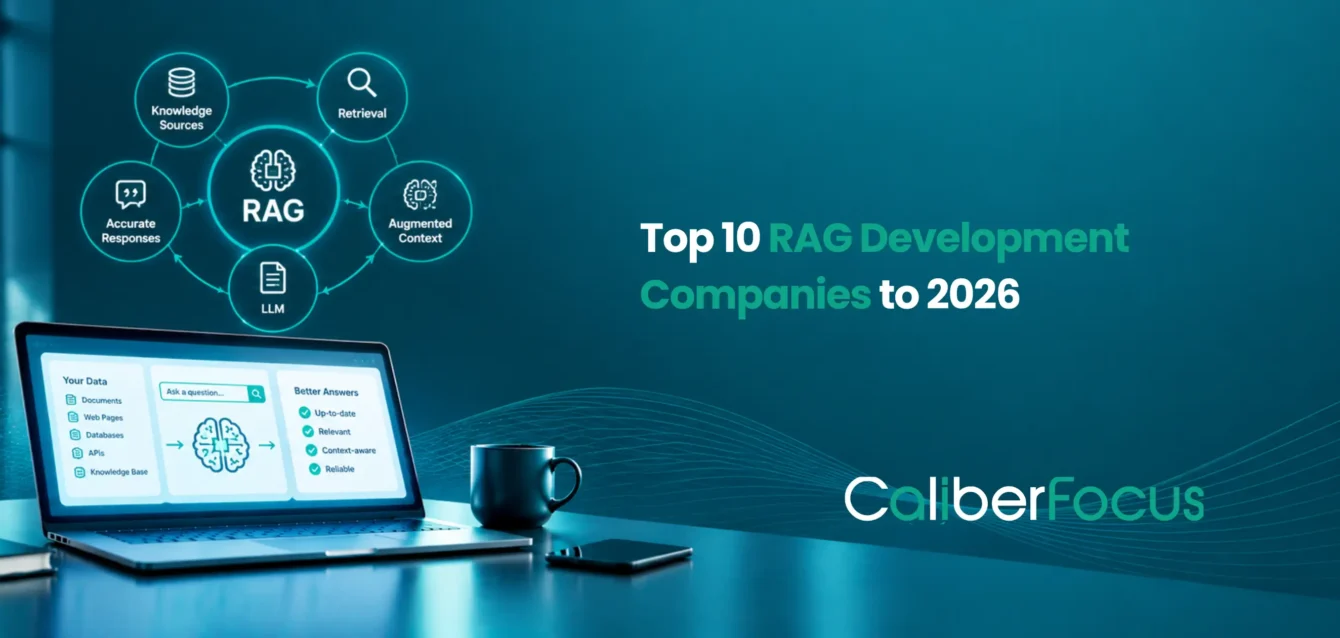
Choosing among RAG development companies requires more than checking whether a provider can connect an LLM to enterprise documents. The stronger fit is a company that can engineer retrieval around the organization’s data, applications, permissions, quality requirements, and production environment.
For enterprises comparing retrieval augmented generation companies, the evaluation usually comes down to five areas:
- Retrieval quality: Can the company design chunking, indexing, semantic or hybrid retrieval, reranking, and context assembly around the actual knowledge base?
- Enterprise integration: Can RAG retrieve from databases, APIs, applications, document repositories, and knowledge systems already used by the business?
- Security and governance: Can retrieval preserve user permissions, protect sensitive information, support source traceability, and operate within enterprise controls?
- RAG evaluation: Can the provider measure retrieval relevance and grounded answer quality rather than judging performance from a handful of successful prompts?
- Production readiness: Can the company deploy, monitor, maintain, and continuously optimize the RAG system as data sources and business requirements change?
What This List Helps You Compare
This guide reviews 10 RAG development companies based on their RAG focus, relevant capabilities, enterprise fit, and ability to support requirements beyond an initial proof of concept.
It also covers how to evaluate a RAG development company, what a RAG engagement should deliver, what matters in a production RAG architecture, and when specialist RAG development services make sense.
The objective is not to identify one universally “best” RAG company. It is to help enterprise decision-makers determine which provider is better aligned with the retrieval problem they actually need to solve.
Need RAG Built Around Your Enterprise Knowledge?
CaliberFocus connects retrieval architecture, enterprise data, AI engineering, integration, and governance to build RAG systems around business and production requirements.
At a Glance
- Which RAG development companies are relevant to the requirement? The list compares providers with different industry, engineering, integration, and deployment orientations rather than assuming every company solves the same retrieval problem.
- What should a RAG development engagement actually cover? The guide looks beyond model selection to the data, retrieval, evaluation, security, integration, deployment, and operational work required around it.
- How should providers be evaluated? The evaluation checklist focuses on capabilities that matter once RAG moves beyond a controlled demonstration into an enterprise environment.
- What should be examined before making a final selection? The later sections cover architecture fit, retrieval quality, data integration, security, production support, and when specialist RAG expertise becomes particularly important.
RAG Development Companies Compared
| Company | RAG Focus | Key Capabilities | Best Fit |
| CaliberFocus | Enterprise and domain-specific RAG | Custom RAG architecture, semantic and hybrid retrieval, enterprise integration, AI engineering, governance | Enterprises connecting RAG with operational data, applications, workflows, and governance requirements |
| Vstorm | Contextual and agentic AI | RAG, contextual intelligence, multilingual retrieval, document intelligence | Organizations seeking specialist RAG capabilities for knowledge-intensive environments |
| Signity Solutions | RAG-enabled workflow modernization | RAG, conversational AI, RPA integration, document retrieval | Organizations introducing retrieval and conversational AI into existing workflows |
| SoluLab | RAG and emerging technology development | RAG, AI development, blockchain integration, application engineering | Digital-first businesses combining RAG with broader application requirements |
| Valprovia | Privacy-oriented retrieval | RAG, multilingual retrieval, enterprise documentation, privacy-focused architecture | Organizations with significant document retrieval and data-protection requirements |
| Prismetric | RAG for digital applications | RAG, personalization, mobile applications, contextual search | Digital products requiring retrieval-driven search and personalized experiences |
| Deviniti | Enterprise search and knowledge access | RAG, enterprise search, knowledge management, integration | Teams improving access to internal documentation and organizational knowledge |
| GeekyAnts | RAG-enabled application development | RAG, application engineering, modular AI components | Product teams embedding retrieval capabilities into digital applications |
| Miquido | RAG-enabled digital experiences | RAG, contextual recommendations, digital products, AI development | Organizations connecting retrieval with content and customer-facing experiences |
| NeenOpal | RAG connected with analytics | RAG, semantic search, business intelligence, data science | Organizations combining enterprise retrieval with analytics and decision-support environments |
The companies are presented as a comparison set rather than a performance ranking. Enterprise fit depends on the retrieval problem, data environment, security requirements, integration scope, and operating model.
How We Evaluated These RAG Development Companies
A company offering generative AI development does not automatically have the depth required to engineer enterprise RAG. This checklist focuses on what becomes important when retrieval has to work reliably against real enterprise knowledge and production requirements.
RAG Development Company Evaluation Checklist
Retrieval architecture and engineering
Can the provider design retrieval around the actual corpus and query patterns rather than relying on a default vector-search configuration? This includes decisions around document preparation, chunking, embeddings, metadata, semantic and keyword retrieval, hybrid search, reranking, query routing, and context assembly.
Enterprise data integration
Can the RAG system retrieve information from the places where business knowledge actually resides, including documents, databases, APIs, enterprise applications, and knowledge repositories? Effective AI data integration becomes particularly important when retrieval depends on information distributed across structured and unstructured enterprise systems.
Retrieval and answer evaluation
Does the provider have a defined method for determining whether the system retrieves relevant evidence and whether generated answers remain grounded in that evidence? Production RAG requires repeatable evaluation against representative questions and source material, not subjective testing of a few successful prompts.
Security and permission-aware retrieval
Can the architecture preserve existing access rules so users cannot retrieve information they are not authorized to see? Identity, roles, source-level permissions, sensitive information, and auditability become increasingly important when one RAG application accesses multiple enterprise repositories.
Enterprise application and workflow integration
Can retrieved information reach the applications and workflows where employees or customers actually need it? Enterprise RAG should not automatically become another standalone interface that users have to work around.
Production engineering
Can the provider address scalability, reliability, latency, deployment architecture, observability, infrastructure dependencies, and operational requirements after the proof of concept? At this stage, RAG becomes an AI engineering problem as much as a retrieval problem.
Ongoing retrieval optimization
Does the engagement account for changing documents, new data, indexing updates, retrieval failures, quality monitoring, feedback, and tuning after deployment? MLOps and LLMOps become relevant when teams need repeatable practices for monitoring and maintaining AI systems in production.
Governance and operational ownership
Does the provider establish how sources are approved, how changes are controlled, how quality issues are escalated, and which responsibilities remain with the enterprise after deployment?
Top RAG Development Companies to Consider in 2026
1. CaliberFocus

RAG focus: Enterprise RAG connected with data, AI engineering, applications, governance, and business workflows.
What they cover: CaliberFocus develops retrieval-augmented generation solutions for organizations that need AI applications grounded in enterprise knowledge rather than model memory alone. Its broader work across enterprise Generative AI, AI agents, data and analytics, application engineering, AI governance, and production operations allows retrieval to be considered within the wider enterprise technology environment.
Key capabilities:
- Custom RAG architecture for enterprise knowledge and application requirements
- Semantic and hybrid retrieval for improving access to relevant business information
- Integration with enterprise data sources, APIs, applications, and operational workflows
- Generative AI, LLM, and AI agent engineering around retrieval-enabled applications
- Data engineering and AI engineering for production implementation
- Governance and operational practices for enterprise AI environments
Best fit: Enterprises that need RAG to operate across business data, applications, knowledge sources, and workflows rather than as an isolated document-search implementation
Vstorm

RAG focus: Contextual and agentic AI with retrieval capabilities for knowledge-intensive environments.
What they cover: Vstorm works across RAG, contextual AI, agentic systems, document intelligence, and multilingual retrieval. Its positioning is relevant to organizations looking for a specialist AI partner where the retrieval requirement involves complex documents, contextual knowledge, or multiple languages.
Key capabilities:
- Retrieval-augmented generation development
- Contextual AI systems
- Agentic AI development
- Document intelligence
- Multilingual information retrieval
- AI implementation for knowledge-intensive workflows
Best fit: Organizations looking for a specialist AI consultancy to address contextual retrieval, document intelligence, or multilingual knowledge requirements.
Signity Solutions
RAG focus: RAG-enabled conversational AI and workflow modernization.
What they cover: Signity Solutions combines retrieval-augmented generation with conversational AI, automation, and application development. Its approach is relevant where RAG needs to improve access to business knowledge within existing operational processes rather than operate as a separate knowledge tool.
Key capabilities:
- RAG application development
- Conversational AI
- Document retrieval
- RPA and workflow integration
- AI assistant development
- Enterprise application integration
Best fit: Organizations introducing RAG and conversational AI into established business processes without replacing the surrounding application environment.
SoluLab

RAG focus: RAG development combined with AI, application engineering, and emerging technologies.
What they cover: SoluLab provides RAG and broader AI development capabilities alongside software and blockchain engineering. This breadth can be relevant where retrieval forms one component of a larger digital product or emerging-technology initiative.
Key capabilities:
- Retrieval-augmented generation development
- Generative AI development
- AI application engineering
- Enterprise software development
- Blockchain integration
- Custom digital product development
Best fit: Digital-first organizations that need RAG as part of a broader application or technology initiative rather than as a standalone enterprise-search project.
Valprovia

RAG focus: Privacy-oriented RAG for enterprise documentation and multilingual retrieval.
What they cover: Valprovia focuses on retrieval systems for document-intensive environments, with emphasis on privacy and multilingual information access. Its positioning is particularly relevant where RAG must operate across enterprise documents while data-protection requirements influence architecture decisions.
Key capabilities:
- RAG development
- Enterprise document retrieval
- Multilingual retrieval
- Knowledge access
- Privacy-oriented architecture
- Enterprise AI implementation
Best fit: Organizations with substantial documentation, multilingual knowledge, or data-protection requirements influencing their RAG architecture.
Prismetric

RAG focus: Retrieval and personalization capabilities embedded in digital and mobile applications.
What they cover: Prismetric combines AI development with mobile and digital product engineering. Its RAG capabilities are relevant where retrieval supports contextual search, personalization, recommendations, or knowledge access inside customer-facing applications.
Key capabilities:
- RAG development
- Contextual search
- AI-powered personalization
- Mobile application development
- AI application engineering
- Digital product integration
Best fit: Consumer-facing and digital businesses that want to incorporate retrieval-driven search or personalization into mobile and application experiences.
Deviniti
RAG focus: Enterprise search and knowledge access using retrieval-augmented generation.
What they cover: Deviniti applies RAG to enterprise search, internal documentation, and knowledge-management requirements. Its positioning is relevant where employees need faster access to information distributed across documentation and organizational knowledge systems.
Key capabilities:
- Retrieval-augmented generation
- Enterprise search
- Knowledge-management solutions
- Document retrieval
- AI-enabled internal tools
- Enterprise system integration
Best fit: Enterprises building internal knowledge assistants, documentation search, or retrieval systems designed to improve access to organizational information.
GeekyAnts

RAG focus: RAG capabilities embedded into custom applications and digital products.
What they cover: GeekyAnts combines AI capabilities with application development, allowing retrieval to be incorporated into broader digital-product environments. This is relevant when the RAG component needs to operate inside an existing or newly developed application rather than as a separate AI product.
Key capabilities:
- RAG development
- AI-enabled application development
- Mobile and web engineering
- Modular AI components
- Contextual information retrieval
- Application integration
Best fit: Product and engineering teams that need retrieval capabilities embedded within customer-facing or internal digital applications.
Miquido

RAG focus: Retrieval-enabled digital products, contextual experiences, and content delivery.
What they cover: Miquido combines AI development with digital-product engineering and user-experience capabilities. Its RAG work is relevant where retrieval contributes to contextual recommendations, information discovery, or personalized digital experiences.
Key capabilities:
- RAG development
- Generative AI
- Contextual recommendations
- Digital product engineering
- AI-enabled content experiences
- Application integration
Best fit: Organizations using retrieval to support content-rich digital products, recommendations, personalization, or customer-facing information experiences.
NeenOpal

RAG focus: Retrieval connected with data science, business intelligence, and analytics.
What they cover: NeenOpal combines RAG and semantic search with analytics and business-intelligence capabilities. Its positioning is relevant where retrieval is intended to help business teams access and interpret information within a broader data and decision-support environment.
Key capabilities:
- Retrieval-augmented generation
- Semantic search
- Data science
- Business intelligence
- Predictive analytics
- Analytics integration
Best fit: Enterprises connecting retrieval with analytics, reporting, business intelligence, or decision-support workflows
What Should a RAG Development Company Actually Deliver?
A RAG engagement should produce more than a chatbot connected to a vector database. The deliverables should establish how enterprise information is ingested, retrieved, governed, evaluated, integrated, and operated.
A practical engagement may include:
| Delivery Area | What the Enterprise Should Expect |
| Use-case and knowledge assessment | Definition of the business questions RAG must answer, intended users, knowledge sources, quality expectations, and situations where the system should decline or escalate rather than generate an unsupported response |
| Data-source assessment | Identification of relevant documents, databases, APIs, applications, repositories, data-quality issues, ownership requirements, and access restrictions. The underlying data engineering approach becomes important when information must be prepared across multiple operational systems |
| Retrieval architecture | Decisions covering ingestion, parsing, chunking, embeddings, indexing, metadata, retrieval methods, reranking, query handling, and context assembly |
| Integration architecture | Definition of how RAG connects with enterprise applications, identity systems, APIs, data platforms, and workflows. API development and system integration becomes particularly relevant when retrieval must operate inside existing business applications |
| Security and permissions | Controls determining what information can be retrieved for each user, role, application, or business context |
| Evaluation framework | Representative test questions and measurable methods for evaluating retrieval relevance, grounded answers, failure cases, latency, and other use-case-specific quality requirements |
| Production implementation | Deployment architecture, reliability, observability, scaling, error handling, and integration with the operating environment |
| Monitoring and optimization | Processes for identifying retrieval failures, refreshing knowledge, re-indexing sources, measuring quality, and improving the system after launch |
| Ownership model | Clear responsibilities for source management, AI operations, governance, technical maintenance, quality review, and future enhancement |
Two RAG providers may both demonstrate a working application while offering very different levels of engineering depth around the system that must support it. The expected deliverables therefore need to be clear before comparing proposals.
What Should Enterprises Evaluate in a Production RAG Architecture?
Production RAG should be evaluated as an information system, not only as an LLM implementation.
1. Data Ingestion and Knowledge Preparation
The first question is whether the system can reliably ingest and maintain the information it needs.
Enterprise knowledge may exist across:
- policies and internal documents
- PDFs and technical manuals
- databases and data platforms
- CRM and ERP records
- product documentation
- support tickets
- intranets and knowledge repositories
- APIs and operational applications
A provider should be able to explain how these sources will be parsed, normalized, refreshed, and prepared for retrieval as information changes.
2. Chunking, Metadata and Indexing
How information is divided and indexed directly affects what the retrieval system can find later.
A default chunk size may perform adequately against simple documents but poorly when the knowledge base contains tables, lengthy policies, nested sections, technical specifications, or information whose meaning depends on surrounding context.
Metadata can also help constrain retrieval by document type, business unit, date, jurisdiction, product, source, user permissions, or other attributes relevant to the query.
3. Retrieval Strategy
Vector similarity alone should not be treated as synonymous with RAG quality.
Depending on the requirement, the retrieval architecture may use:
- Semantic retrieval when information needs to be located based on meaning rather than exact wording.
- Keyword or sparse retrieval when exact names, codes, terminology, identifiers, or phrases matter.
- Hybrid retrieval when semantic and lexical matching need to work together.
- Metadata filtering when results need to be restricted to a particular business, user, product, jurisdiction, date, or document context.
- Reranking when an additional relevance layer is needed to determine which retrieved passages should reach the model.
The provider should be able to explain why a particular retrieval approach fits the corpus and query patterns rather than applying every technique indiscriminately.
4. Grounding and Source Traceability
The generation layer should use retrieved evidence appropriately and provide source references where the use case requires verification.
Enterprises also need to determine what happens when retrieval does not produce sufficient evidence. Depending on the workflow, the system may need to decline the request, ask for clarification, or escalate rather than produce an unsupported response.
Grounding should also be distinguished from model adaptation. RAG retrieves changing knowledge when a query is made, while fine-tuning addresses a different model requirement. Understanding the distinction between RAG and fine-tuning for enterprise AI helps teams choose the appropriate architecture rather than applying retrieval to every model problem.
5. Security and Permission-Aware Retrieval
Connecting an LLM to enterprise knowledge creates a different security problem from simply protecting an AI endpoint.
The retrieval layer must prevent users from accessing information they are not authorized to see. Identity, roles, source permissions, data isolation, and sensitive-information handling therefore need to influence retrieval before context reaches the model.
These controls should sit within the organization’s broader AI governance and responsible AI approach, particularly when retrieval is being introduced across sensitive or regulated enterprise information.
6. RAG Evaluation
A successful demonstration is not enough evidence that retrieval will remain reliable in production.
Evaluation should use representative questions and known source material to determine where the system succeeds and where it fails.
Depending on the use case, evaluation may examine:
- whether relevant information was retrieved
- whether important supporting information was missed
- whether the generated answer is supported by retrieved evidence
- whether citations point to the appropriate sources
- whether retrieval behaves consistently across different query patterns
- whether latency remains acceptable
- whether architecture changes introduce quality regressions
The evaluation method should reflect the business consequences of a poor retrieval result rather than rely on one universal metric.
7. Monitoring and Continuous Improvement
Enterprise knowledge changes continuously.
Documents are revised. Policies expire. Products change. New records enter source systems. Permissions change. User questions expose knowledge gaps that were not apparent during development.
Production RAG therefore needs mechanisms for updating indexes, observing retrieval failures, collecting useful feedback, monitoring system behavior, and retesting quality when the knowledge base or architecture changes.
How to Choose the Right RAG Development Company
The strongest provider on paper is not necessarily the right provider for a particular enterprise. Selection should begin with the retrieval problem and the environment in which the system will operate.
Match the Provider to the Business Requirement
Start by defining what users actually need RAG to accomplish.
Enterprise search, customer support, policy research, product knowledge, document intelligence, analytical assistance, and AI-agent knowledge access can all use retrieval, but they create different architecture and evaluation requirements.
When the requirement extends beyond retrieving knowledge into autonomous decisions or multi-step execution, understanding the architectural distinction between RAG and Agentic AI becomes important before selecting the implementation approach.
The provider should work backward from the requirement rather than beginning with a predetermined LLM, vector database, or framework.
Evaluate Retrieval Engineering Depth
Ask the provider to explain how it approaches:
- Document preparation: How will different file types and knowledge structures be parsed and prepared?
- Chunking and metadata: How will information be divided without losing important context?
- Embedding selection: Why is the proposed embedding approach appropriate for the corpus?
- Retrieval: When will semantic, lexical, hybrid, or filtered retrieval be used?
- Reranking: How will the system determine which retrieved passages are most relevant?
- Query handling: Will different types of questions require different retrieval paths?
- Source attribution: How will users verify the information behind generated answers?
- Evaluation: How will the team know whether retrieval changes actually improve performance?
The objective is not to demand every technique. It is to determine whether the provider understands when each technique is useful and what trade-offs it introduces.
Examine Enterprise Data and Integration Capability
A RAG system becomes useful only when it can reach the information needed for the workflow.
Determine whether the provider can work with the actual data landscape and explain how information will move between source systems, retrieval infrastructure, the LLM, enterprise applications, and the user experience.
The integration approach should also account for how frequently information changes and how those updates reach the retrieval layer.
Assess Security and Access Control Early
Authorization should not be postponed until deployment.
Ask how retrieval will preserve existing access rules when information comes from multiple systems. The provider should be able to explain identity, permissions, sensitive-data handling, auditability, and what prevents unauthorized information from entering generated context.
Ask How RAG Quality Will Be Evaluated
A provider should be able to explain how it will determine whether retrieval is improving.
Useful questions include:
- What representative query set will be used?
- How will retrieval failures be identified?
- How will groundedness and source support be checked?
- How will changes to chunking, retrieval, or reranking be compared?
- How will quality regressions be detected after deployment?
This separates measurable retrieval engineering from repeated prompt adjustment.
Clarify Production and Post-Deployment Ownership
Before selecting a partner, determine what happens after the initial implementation.
Clarify who owns:
- source updates and approvals
- indexing and re-indexing
- retrieval evaluation
- retrieval tuning
- production monitoring
- infrastructure
- model or platform changes
- security reviews
- incident handling
- user feedback
- future integrations
The answer affects both the engagement model and the long-term cost of operating RAG. A structured RAG implementation checklist can help teams verify whether the required data, retrieval, evaluation, integration, security, and production controls have been addressed before rollout.
When Does a Specialized RAG Development Company Make Sense?
Not every retrieval requirement needs an external specialist. A focused internal use case with a small, controlled knowledge base may be within the capability of an experienced enterprise AI team.
Specialist RAG development services become more relevant when:
- Knowledge is distributed across multiple systems. Retrieval has to coordinate information from documents, databases, APIs, SaaS platforms, and enterprise applications rather than search a single document collection.
- Retrieval errors have meaningful business consequences. Systematic evaluation becomes important because an irrelevant, incomplete, or outdated source can materially affect the generated answer.
- Different users have different information permissions. Retrieval must enforce access rules before information is supplied to the model.
- The knowledge base is difficult to retrieve from reliably. Complex PDFs, tables, technical documents, multilingual content, changing information, or domain-specific terminology may require more deliberate retrieval engineering.
- RAG needs to operate inside a business workflow. Retrieved knowledge may need to support applications, processes, or AI agents that use context as part of a broader workflow rather than stopping at question-and-answer retrieval.
- The system must move beyond a proof of concept. Reliability, latency, scaling, observability, evaluation, security, and operational ownership become part of the architecture.
- Internal teams need production support or capability transfer. A specialist provider can address specific retrieval-engineering gaps while establishing a path for internal ownership.
Industry context can also change the architecture. Healthcare, for example, introduces additional considerations around sensitive information, trusted knowledge sources, workflow context, and evidence quality. These requirements are explored more specifically in RAG in healthcare.
CaliberFocus RAG Development Services
CaliberFocus approaches RAG as part of the broader enterprise AI environment in which retrieval has to operate.
That means considering the relationship between enterprise knowledge, data engineering, retrieval architecture, Generative AI, AI agents, application integration, governance, and production operations rather than treating retrieval as an isolated vector-search layer.
Relevant capabilities include:
Design retrieval around enterprise knowledge sources, user requirements, query patterns, and application context.
Combine retrieval approaches where the knowledge base requires more than vector similarity alone.
Connect retrieval with applications, APIs, databases, knowledge repositories, and operational sources.
Ground conversational and multi-step AI workflows in relevant enterprise information.
Engineer retrieval-enabled applications for the reliability, integration, and operational requirements that appear beyond the proof of concept.
Establish appropriate controls around knowledge sources, access, monitoring, and enterprise AI operations.
CaliberFocus treats RAG as an enterprise capability that connects retrieval, AI applications, data, integrations, governance, and production operations.
Have a RAG Pilot That Needs to Work in Production?
Evaluate the retrieval architecture, enterprise integrations, quality controls, and operational requirements before extending the system to more users or workflows.
Frequently Asked Questions
A RAG development company designs and implements AI systems that retrieve relevant information from external knowledge sources before an LLM generates a response.
Enterprise RAG development can include data ingestion, document processing, chunking, embeddings, indexing, semantic and keyword retrieval, reranking, LLM integration, source attribution, security, evaluation, enterprise integration, deployment, monitoring, and ongoing retrieval optimization.
The scope matters because a production RAG system is more than a connection between an LLM and a vector database.
Compare providers against the requirements of the intended production environment.
Important areas include retrieval-engineering depth, enterprise data integration, permission-aware retrieval, evaluation methodology, application integration, production deployment, ongoing optimization, governance, and experience with the type of knowledge involved.
Technology lists alone provide limited evidence. Enterprises should ask providers to explain how retrieval quality will be designed, measured, monitored, and improved.
A proof of concept usually demonstrates that an LLM can retrieve and answer questions from a controlled set of information.
Production RAG has to operate reliably against larger and changing knowledge sources, real user questions, access permissions, application integrations, performance requirements, and operational constraints.
Production readiness therefore introduces additional requirements around evaluation, security, observability, scalability, source updates, error handling, and ongoing retrieval optimization.
External RAG expertise becomes more relevant when the implementation spans multiple enterprise data sources, requires permission-aware retrieval, operates in a high-trust environment, needs systematic retrieval evaluation, integrates with existing applications, or must scale beyond an initial prototype.
An organization with strong internal AI, data, platform, security, and application-engineering capabilities may choose to build internally. Other enterprises may use a RAG development company for architecture, implementation, specialist retrieval engineering, productionization, or capability transfer while retaining long-term ownership internally.
RAG as a Service (RAGaaS) provides managed retrieval capabilities without requiring an enterprise to build and operate the entire RAG infrastructure internally. It can suit standardized retrieval requirements, while custom RAG development offers greater control over data sources, retrieval architecture, integrations, permissions, and evaluation.

More on RAG
RAG vs Fine-Tuning for Enterprise AI
Compare retrieval-augmented generation and fine-tuning to understand which approach fits different enterprise AI requirements.
Read More →RAG Implementation Checklist
Review the key data, retrieval, evaluation, security, integration, and production considerations for implementing RAG.
Read More →RAG vs Agentic AI
Understand how RAG and agentic AI differ and when retrieval can become part of a broader autonomous enterprise AI workflow.
Read More →