

Generative AI is moving into healthcare workflows where the accuracy of information, protection of patient data, and accountability for decisions are essential. Hospitals are evaluating AI-generated clinical summaries, health insurers are using AI to support member services, and physician practices are introducing AI-assisted documentation and patient communication.
These applications create opportunities to reduce administrative work and improve access to information. They also introduce risks that traditional software controls may not fully address.
A generative AI system can retrieve the wrong patient record, introduce unsupported clinical details, misinterpret a payer policy, or generate an action that exceeds its authorized role. Even when the output appears reasonable, the underlying process may not be reliable or appropriate for the healthcare environment.
The question for healthcare leaders is no longer simply whether generative AI can perform a task. It is whether the organization can control what the system accesses, verify what it produces, determine who approves its actions, and investigate its behavior after deployment.
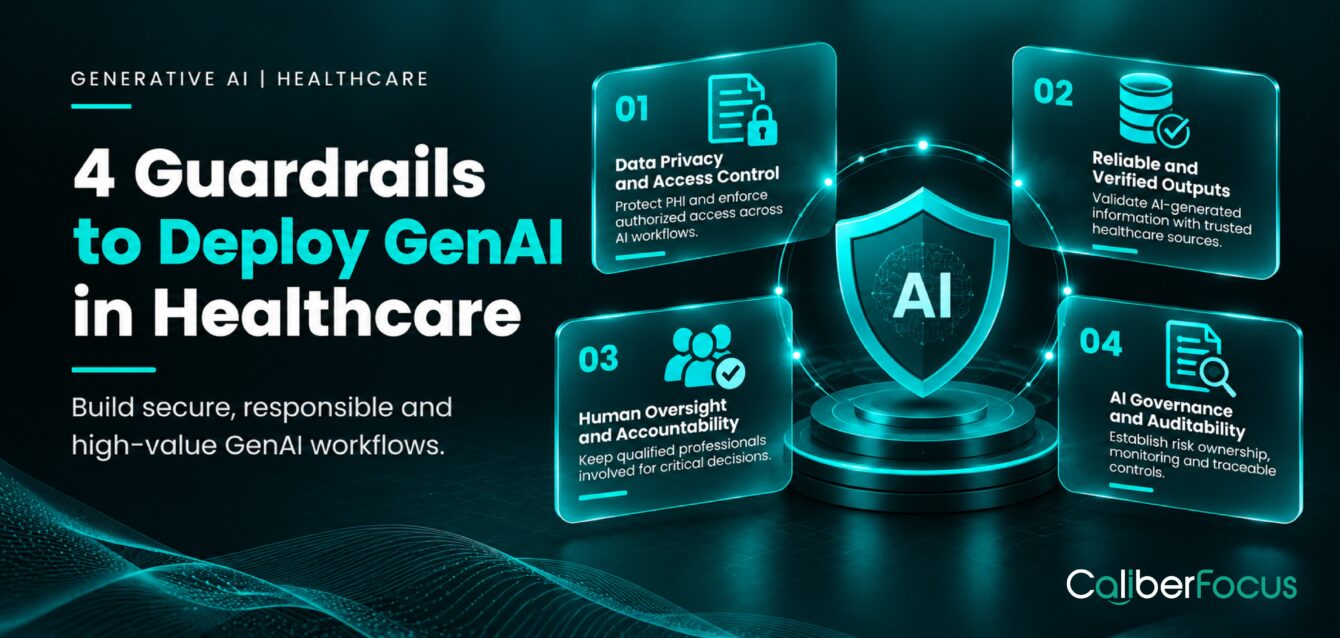
Safe deployment of generative AI in healthcare depends on four essential guardrails: data privacy and access control, reliable and verified outputs, human oversight and accountability, and AI governance and auditability.
These controls must be incorporated into application architecture, clinical and administrative workflows, testing, and ongoing operations.
Make Healthcare GenAI Deployment Safer, from the Start.
Build privacy, validation, human oversight, and governance into your GenAI implementation strategy.
Ready to evaluate your GenAI implementation requirements?
Discuss Your GenAI RequirementsAt a Glance
What healthcare organizations need to know before deploying generative AI.
The Deployment Challenge
GenAI introduces risks involving protected health information, unreliable outputs, unclear accountability, and limited operational visibility.
Four Essential Guardrails
Data privacy and access control, reliable and verified outputs, human oversight and accountability, and AI governance and auditability.
Privacy and Output Reliability
Control PHI access, ground responses in approved sources, and evaluate outputs before they influence healthcare workflows.
Human Responsibility
Define which decisions require human review, who approves AI-generated work, and when issues must be escalated.
Integration and Operational Readiness
Assess EHR connections, HL7/FHIR interfaces, data mapping, workflow ownership, and existing security controls.
From Pilot to Production
Establish evaluation criteria, audit trails, monitoring, incident response, and go-live checkpoints before scaling.
What Are AI Guardrails in Healthcare?
AI guardrails in healthcare are technical, clinical, and organizational controls that define how artificial intelligence systems access information, generate outputs, support decisions, and interact with healthcare applications.
They establish the boundaries within which an AI system can operate and the conditions under which its outputs or actions require further validation.
For example, an AI assistant used by a hospital may be permitted to summarize authorized clinical records but prohibited from modifying medication orders. A payer-facing assistant may retrieve coverage policies and organize supporting documents without independently issuing a medical necessity determination.
These restrictions must be enforced through system permissions, workflow rules, validation mechanisms, and governance processes.
AI guardrails are not limited to preventing harmful language or filtering inappropriate responses. Healthcare generative AI safety also depends on the reliability of retrieved information, the accuracy of generated content, the authorization of connected actions, and the ability to investigate failures.
| Guardrail | What It Controls | Healthcare Applications |
| 1. Data Privacy and Access Control | What information AI systems can access, process, retain, and disclose | Patient records, member data, clinical documents, provider information |
| 2. Reliable and Verified Outputs | Whether generated information is accurate, supported, and appropriate for its intended use | Clinical summaries, coding assistance, payer policy retrieval, patient communication |
| 3. Human Oversight and Accountability | Which decisions require professional review and who is responsible for outcomes | Clinical documentation, claims decisions, medical coding, treatment-related recommendations |
| 4. AI Governance and Auditability | How AI risks, system changes, compliance obligations, and operational behavior are managed | Risk assessments, deployment approvals, monitoring, incident response |
Together, these four guardrails provide a practical foundation for responsible AI in healthcare.
However, the controls needed for a patient-facing clinical application will differ from those required for an internal administrative assistant. The appropriate level of protection depends on the workflow, information involved, and consequences of an incorrect output or unauthorized action.
Why Generative AI Guardrails Differ Across Healthcare Verticals
Healthcare organizations do not use generative AI in identical ways. The technology may support clinical documentation, member communication, claims administration, operational reporting, or scientific knowledge retrieval.
Understanding these differences is essential before defining implementation controls.
The broader landscape of generative AI use cases in healthcare demonstrates why organizations must evaluate each application according to its intended purpose rather than applying a single set of operational assumptions.
Hospitals and Health Systems
Hospitals may introduce generative AI into clinical documentation, discharge planning, patient communication, knowledge retrieval, and administrative coordination.
The primary risks involve inaccurate clinical information, incomplete documentation, inappropriate access to patient records, and unclear responsibility for reviewing generated content.
As AI in hospital operations becomes more closely connected with clinical and administrative processes, healthcare organizations need controls that reflect the consequences of each workflow.
An AI-generated discharge summary, for instance, must preserve relevant medication changes, clinical instructions, and follow-up requirements. Missing or unsupported information may affect downstream care coordination.
Health Insurance Payers
Health insurance organizations may use generative AI to summarize member inquiries, retrieve coverage policies, organize prior authorization documentation, and assist provider relations teams.
These applications require reliable access to current policy information, appropriate member-data permissions, and clear boundaries around coverage-related decisions.
In workflows involving AI-automated claims management, organizations must distinguish between preparing information for review and authorizing a financial or coverage-related action.
An assistant that identifies missing documentation should not automatically deny a claim or change a member’s coverage status unless the action is explicitly permitted within a validated workflow and consistent with applicable requirements.
Physician Groups and Specialty Practices
Independent practices, multispecialty groups, and specialty clinics may use generative AI for clinical note drafting, referral documentation, appointment communication, and revenue cycle support.
These organizations need safeguards that work within their EHR environments and existing clinical review processes.
For example, a specialty practice using AI-assisted documentation must ensure that generated notes accurately represent the encounter and do not introduce diagnoses, procedures, or treatment details that the clinician did not document.
Healthcare Revenue Cycle Operations
Generative AI can assist with coding research, denial analysis, appeal drafting, documentation review, and payer correspondence.
These workflows introduce risks related to unsupported coding recommendations, inaccurate policy interpretation, and inappropriate handling of protected health information.
An AI-generated appeal should be reviewed against the medical record, denial reason, applicable payer requirements, and supporting documentation before submission.
Laboratories, Diagnostics, and Life Sciences
Laboratories and diagnostic organizations may use generative AI for procedure retrieval, controlled document summarization, operational reporting, and quality documentation.
Pharmaceutical and life sciences organizations may use it for scientific literature review, research documentation, and knowledge management.
In these settings, source provenance, document version control, data integrity, and qualified review are particularly important.
The central principle is consistent across healthcare verticals: the greater the potential impact of an AI error, the stronger the required validation, authorization, and oversight.
4 Essential Guardrails for Deploying Generative AI in Healthcare
Build safer healthcare AI workflows with four connected controls covering data protection, output reliability, human oversight, and governance.
Data Privacy and Access Control
Protect PHI, enforce authorized access, and secure information across AI models, connected applications, and data integrations.
Reliable and Verified Outputs
Validate AI-generated information against approved healthcare sources and identify unsupported, incomplete, or inaccurate responses.
Human Oversight and Accountability
Keep qualified professionals responsible for consequential decisions through approval gates, escalation paths, and defined operating boundaries.
AI Governance and Auditability
Establish risk ownership, deployment controls, continuous monitoring, and traceable records of AI-supported actions.
Four guardrails. One accountable healthcare AI operating model.
Guardrail 1: Data Privacy and Access Control
Healthcare generative AI systems frequently interact with protected health information (PHI), personally identifiable information, clinical records, member data, and confidential organizational information.
Protecting this information requires more than selecting a model provider with security features.
Healthcare organizations must understand how data moves through the complete AI workflow, including prompts, retrieval services, connected applications, model endpoints, generated outputs, and operational logs.
Protect PHI Throughout the Generative AI Workflow
A generative AI application may process sensitive information at several stages.
For example, a clinical documentation assistant may retrieve EHR data, construct a prompt using patient information, send that prompt to a model endpoint, and return a generated summary to the user.
Each stage introduces questions about access, processing, storage, retention, and disclosure.
Healthcare organizations should determine:
- Whether PHI is necessary for the intended task.
- Which users and applications are authorized to access the information.
- Where data is processed and whether third-party services receive it.
- How prompts, retrieved content, outputs, and logs are retained.
- Whether required vendor agreements and contractual protections are in place.
- How sensitive information is protected during transmission and storage.
The HIPAA Privacy and Security Rules impose requirements on covered entities and business associates based on their roles and the information involved. Deploying generative AI does not remove these responsibilities.
A HIPAA-compliant AI architecture therefore requires attention to the entire application and data environment, not merely the security claims of the underlying AI model.
Enforce Access Permissions Beyond the Prompt
An AI assistant should not gain unrestricted access to enterprise healthcare information simply because it is connected to an EHR, CRM, or data repository.
Suppose a hospital employee requests a summary of a patient’s treatment history. The system must determine whether that employee is authorized to access the relevant record before retrieving the information.
The same requirement applies when a payer service representative requests member information or a physician practice employee accesses clinical documentation.
Appropriate controls may include identity verification, role-based permissions, contextual authorization, restricted retrieval scopes, and access checks at the connected application layer.
A prompt telling the AI not to reveal unauthorized information is insufficient if the retrieval system already exposes records the user should not access.
Implementation requirement: Authorization must be enforced by the applications, APIs, and data services that provide information to the AI system.
Validate Data Mapping and Healthcare Interoperability
Generative AI applications may retrieve information from EHRs, laboratory systems, payer platforms, practice management software, and other healthcare applications.
These integrations often rely on HL7 messages, FHIR resources, APIs, clinical terminology, and data transformation processes.
A generative AI data mapping and healthcare interoperability solution must preserve both the meaning of the source information and the access restrictions associated with it.
For example, an AI-assisted documentation workflow should distinguish between active and discontinued medications, preserve dosage units, and associate information with the correct patient and encounter.
Incorrect mappings can introduce errors before information reaches the model.
If generative AI is used to suggest field mappings or transformations, those recommendations should be validated against source schemas, destination requirements, terminology standards, and relevant business rules before implementation.
Healthcare interoperability is therefore not only an integration challenge. It is also a data integrity and AI safety requirement.
Guardrail 2: Reliable and Verified Outputs
Generative AI can produce fluent and convincing responses that contain inaccurate, incomplete, or unsupported information.
In healthcare, the consequences depend on how that information is used.
An incorrect internal document summary may cause administrative confusion. An unsupported medication detail in a clinical note may create a more consequential documentation risk.
The objective of this guardrail is to ensure that generated information can be evaluated against reliable evidence before it influences healthcare operations or decisions.
Ground AI Responses in Approved Healthcare Information
For applications that retrieve organizational knowledge, retrieval-augmented generation (RAG) can supply relevant source information during response generation.
A hospital assistant may retrieve approved clinical procedures, while a payer assistant may retrieve current coverage policies.
The use of RAG in healthcare can support source-grounded responses, but retrieval alone does not guarantee accuracy.
A system may retrieve the correct document and still misinterpret a qualification, omit an exception, or combine information from incompatible sources.
Healthcare organizations should verify that the application:
- Retrieves information appropriate to the user’s request and permissions.
- Uses current and approved source documents.
- Preserves important conditions, exclusions, and qualifications.
- Provides source references when needed for verification.
- Recognizes when available evidence is insufficient.
For example, a payer policy assistant should not present an expired medical policy as current simply because the document exists in the retrieval repository.
Validate Clinical and Administrative Outputs
Evaluation should reflect the tasks the application will perform in production.
A generic language-model benchmark cannot establish whether a healthcare application reliably handles clinical documentation, payer requirements, or medical coding.
Clinical documentation systems should be tested for omissions, unsupported additions, incorrect medication details, and failures to preserve patient context.
These concerns also apply to NLP-based clinical documentation, where information extracted from medical records must retain its original meaning when converted into summaries or structured documentation.
Administrative applications require different evaluation criteria.
A medical coding assistant, for example, should be assessed for documentation support, code selection accuracy, applicable coding rules, and its ability to flag insufficient information.
Qualified reviewers should participate in evaluation when the workflow requires clinical, coding, or other specialized expertise.
Establish Safe Responses to Uncertainty
A reliable healthcare AI system should not invent an answer when the available information is incomplete or contradictory.
Depending on the application, appropriate behavior may include requesting additional information, identifying conflicting sources, withholding a recommendation, or escalating the task.
Consider an AI assistant reviewing medication information from multiple records. If the sources disagree, the system should identify the discrepancy rather than silently selecting one value.
Implementation requirement: Evaluation should measure both successful task completion and the system’s ability to avoid unsupported outputs.
Accuracy thresholds must be determined according to the workflow and the consequences of failure, rather than applying a universal percentage across healthcare applications.
Guardrail 3: Human Oversight and Accountability
Generative AI can assist healthcare professionals by preparing documentation, retrieving information, identifying inconsistencies, and recommending next steps.
However, generating a recommendation is different from authorizing a clinical, administrative, or financial decision.
Human oversight establishes where professional judgment is required and who remains accountable for consequential actions.
Identify Decisions That Require Human Review
Healthcare organizations should define which activities AI can perform independently and which require approval.
| Healthcare Workflow | Appropriate AI Role | Human Oversight Requirement |
| Clinical documentation | Draft summaries from authorized records | Clinician verifies and approves the final record |
| Patient communication | Prepare routine administrative responses | Escalate clinical questions and other high-impact requests |
| Prior authorization | Organize documentation and summarize requirements | Authorized personnel review determinations and submissions |
| Medical coding | Suggest codes and identify documentation gaps | Qualified coding personnel validate recommendations |
| Claims and appeals | Prepare explanations using supporting records | Authorized staff approve external submissions |
| Laboratory documentation | Retrieve and summarize controlled procedures | Qualified personnel review information used in regulated or clinical decisions |
These boundaries should be defined during workflow design rather than left to individual users to interpret after deployment.
Control AI Actions in Connected Healthcare Systems
Human oversight becomes especially important when generative AI applications can initiate actions through connected tools.
Unlike systems limited to generating text, AI agents in healthcare may coordinate multiple steps, retrieve information, and interact with enterprise applications.
An AI assistant might identify a missing claim attachment, prepare a correction, and recommend resubmission.
However, preparing a correction does not automatically authorize the system to modify the claim or transmit it to a payer.
Healthcare organizations should establish separate permissions for retrieving information, preparing changes, and executing actions.
Where automated execution is appropriate, controls may include transaction limits, approval gates, exception handling, and the ability to stop or reverse permitted operations.
Assign Accountability for AI-Supported Decisions
A healthcare AI workflow should have an identified owner responsible for its intended use, operational performance, and escalation procedures.
For clinical applications, accountability may involve clinical leadership, health information management, IT, and information security.
For payer operations, it may involve medical management, compliance, member services, and technology teams.
The organization should document who approves outputs, who can override the system, who investigates failures, and who can suspend an application when necessary.
Human oversight is meaningful only when reviewers have sufficient information, authority, and time to evaluate the AI-supported decision.
Implementation requirement: Review mechanisms should reflect the risk of the action. Requiring approval for every routine information retrieval may create unnecessary workload, while allowing consequential decisions to proceed without appropriate authorization creates avoidable risk.
Guardrail 4: AI Governance and Auditability
Data protection, output validation, and human oversight establish controls within individual workflows.
AI governance determines how those controls are approved, maintained, evaluated, and improved across the organization.
AI governance in healthcare is the framework through which healthcare organizations define acceptable AI use, assign responsibility, assess risks, approve deployment, manage system changes, and monitor ongoing performance.
It connects technical safeguards with clinical, operational, security, and compliance responsibilities.
Build a Healthcare AI Governance Framework Around Clear Ownership
A practical AI governance framework for healthcare should identify who is responsible for decisions throughout the application lifecycle.
| Governance Function | Core Responsibility |
| Clinical or business owner | Define the intended use, expected outcomes, and acceptable workflow boundaries |
| AI engineering and IT | Implement architecture, integrations, testing, and deployment controls |
| Information security | Evaluate access permissions, application security, and data protection |
| Privacy and compliance | Assess relevant regulatory and contractual requirements |
| Clinical or domain reviewers | Validate outputs and failure conditions requiring professional expertise |
| Operational owner | Monitor performance, investigate exceptions, and coordinate incident response |
Smaller organizations may combine responsibilities across existing roles. However, accountability should remain explicit.
A structured AI risk management framework can help organizations identify potential harms, assess their likelihood and consequences, select controls, and determine which risks require additional review.
Classify Applications According to Risk
Not every healthcare generative AI application requires identical approval procedures.
An internal policy-search assistant, a clinical documentation system, and a patient-facing decision-support application differ in the information they process and the consequences of incorrect behavior.
Risk classification should consider:
- Sensitivity of the information involved.
- Potential impact of inaccurate or incomplete outputs.
- Influence on clinical, financial, or administrative decisions.
- Ability to execute actions in connected systems.
- Availability of qualified human review.
- Potential consequences for patients, members, providers, and operations.
The resulting classification should determine testing requirements, approval authority, deployment restrictions, and monitoring expectations.
The NIST AI Risk Management Framework and its Generative AI Profile provide voluntary guidance for identifying and managing AI risks. Healthcare organizations should apply these alongside the legal, clinical, and operational requirements relevant to their applications.
Maintain Audit Trails and Version Control
Healthcare organizations need sufficient records to investigate AI-supported outcomes.
Depending on the use case, relevant audit information may include model versions, prompt configurations, source document references, tool execution events, authorization decisions, and human approvals.
These records should be protected using appropriate access and retention controls, particularly when they contain sensitive healthcare information.
Changes to models, prompts, retrieval sources, and connected applications should also follow defined evaluation and approval processes.
A model update that improves one task may introduce errors in another. Regression testing helps determine whether the updated system continues to satisfy its acceptance criteria.
Monitor AI Behavior After Deployment
Governance continues after an application enters production.
Healthcare organizations should monitor output quality, retrieval failures, unauthorized access attempts, human overrides, system performance, and incidents requiring escalation.
For applications interacting continuously with clinical, administrative, or financial systems, AI agents for healthcare compliance and oversight provide a related perspective on monitoring activities and identifying potential compliance issues.
Monitoring should lead to action.
If an application begins retrieving outdated documents, the organization may need to correct the source repository. If a model update introduces unsupported clinical details, the affected workflow may require additional restrictions or suspension until the issue is resolved.
Implementation requirement: Governance is effective when the organization can demonstrate that controls are operating as intended, not simply that policies have been documented.
How to Validate Generative AI Guardrails Before Healthcare Deployment
A successful proof of concept does not establish that a generative AI application is ready for production.
Controlled demonstrations may not reveal how the system behaves when records are incomplete, permissions are restricted, integrations fail, or users submit unexpected requests.
Healthcare AI implementation best practices therefore require evaluation of the complete workflow, including the controls that prevent unsafe or unauthorized behavior.
Test Each Guardrail Against Realistic Scenarios
| Guardrail | Test Scenario | Expected Result | Evidence Required |
| Data Privacy and Access Control | An unauthorized user requests another patient’s record | Access is denied | Authorization test results and access logs |
| Reliable and Verified Outputs | Retrieved records contain conflicting medication information | The system flags the discrepancy without inventing a correction | Output evaluation and reviewer assessment |
| Human Oversight and Accountability | An AI-generated clinical draft requires approval | Finalization is blocked until an authorized reviewer approves | Workflow execution and approval records |
| AI Governance and Auditability | A model or retrieval configuration changes | The change is evaluated, approved, and traceable | Version records, regression results, and release approval |
These tests should include both normal operating conditions and foreseeable failures.
For example, an AI application may produce an accurate summary while retrieving information from a record the user was not authorized to access.
The output may be correct, but the workflow has failed its privacy and access-control requirements.
Similarly, an AI-generated recommendation may be accurate while the system incorrectly bypasses a required approval step.
Production readiness requires validation of the result and the process used to produce it.
Establish Risk-Based Release Criteria
Healthcare organizations should define acceptance criteria before conducting final deployment evaluations.
The criteria may include task reliability, prohibited failure conditions, access-control performance, human approval requirements, and operational recovery procedures.
A minor formatting error in an internal administrative summary may be acceptable. An unsupported medication detail in a clinical document may require the affected workflow to be blocked until corrected.
Release decisions should reflect the severity of unresolved issues and the safeguards available to contain them.
Healthcare AI Implementation Best Practices: Moving From Pilot to Production
Implementing generative AI in healthcare requires a sequence that connects business objectives, technical architecture, governance, and operational readiness.
Organizations should avoid expanding deployment solely because a pilot demonstrates useful responses.
Step 1: Define the Intended Use and Operating Boundaries
Document the healthcare workflow, intended users, information sources, permitted actions, and expected outcomes.
Specify which activities the AI may perform independently and which require review or approval.
Step 2: Assess Data, Technology, and Governance Readiness
Evaluate whether existing healthcare applications, data sources, access controls, and operational teams can support the proposed system.
An AI readiness assessment can help identify gaps in data availability, governance, technical integration, and organizational preparedness before broader implementation.
Step 3: Implement the Four Guardrails
Build privacy controls, output validation, human approval mechanisms, and auditability into the application architecture.
Where the system connects to EHRs, payer platforms, laboratory systems, or administrative applications, verify that underlying permissions and workflow restrictions are enforced.
Step 4: Validate Representative Healthcare Scenarios
Test normal workflows, edge cases, missing information, conflicting records, unauthorized requests, prompt injection attempts, and integration failures.
Include qualified reviewers where clinical, coding, compliance, or other specialized expertise is required.
Step 5: Deploy Within Controlled Boundaries
Begin with defined users, limited workflows, or human-reviewed outputs.
Expand the application only when evaluation results and operational monitoring demonstrate that the relevant controls are functioning.
Step 6: Monitor and Reassess
Track output errors, retrieval problems, access-control events, human overrides, and system changes.
Repeat relevant testing when models, prompts, integrations, or source information change.
The objective is to create a repeatable deployment process in which each expansion of AI capability is supported by appropriate evidence.
Healthcare Generative AI Deployment Checklist
Before approving a generative AI application for production, healthcare organizations should verify the following requirements.
| Readiness Area | Question to Verify |
| Intended use | Are the purpose, users, permitted tasks, and prohibited actions documented? |
| PHI protection | Have data processing, access, retention, and vendor responsibilities been evaluated? |
| Authorization | Are permissions enforced across connected applications and retrieval systems? |
| Source reliability | Are approved information sources and document-version controls established? |
| Output validation | Have representative scenarios and unacceptable failure conditions been tested? |
| Human oversight | Do required review, approval, and escalation mechanisms function correctly? |
| Interoperability | Are data mappings, terminology, patient context, and integrations validated? |
| Governance | Are risk ownership, release approval, and change-control responsibilities assigned? |
| Auditability | Can relevant system actions, versions, approvals, and incidents be investigated? |
| Operational recovery | Are monitoring, incident response, and system suspension procedures established? |
The checklist should support an evidence-based deployment decision rather than serve as a substitute for technical and operational validation.
Key Takeaways
What matters when deploying GenAI in healthcare
- Guardrails must be built into deployment. Privacy, verified outputs, human oversight, and auditability should shape the solution from design through production.
- Healthcare data requires controlled access. Protect PHI through appropriate permissions, data handling policies, and security safeguards.
- AI-generated outputs need verification. Ground responses in approved information, test reliability, and retain human review for consequential decisions.
- Integration readiness matters. Assess EHR connectivity, HL7/FHIR interfaces, data mapping, and the workflows that consume AI-generated information.
- Production readiness goes beyond a successful pilot. Define ownership, evaluation criteria, monitoring, escalation, and incident response before scaling.
- Governance is an ongoing responsibility. Review performance, maintain audit records, and update controls as models, data, and operational requirements change.
Frequently Asked Questions
The four essential guardrails are data privacy and access control, reliable and verified outputs, human oversight and accountability, and AI governance and auditability. Together, they define how healthcare information is protected, how generated content is validated, who authorizes consequential actions, and how the system is monitored throughout its lifecycle.
AI governance establishes responsibilities and processes for assessing privacy, security, operational, and regulatory risks. It supports activities such as access reviews, vendor assessments, documentation, monitoring, and incident response. However, an AI governance framework does not automatically establish compliance with HIPAA or other applicable requirements.
Generative AI can support clinical documentation through drafting, summarization, and information retrieval. Safe implementation requires appropriate data access, source validation, representative testing, and clinician review. Generated information should be checked for omissions, unsupported additions, and inconsistencies before it becomes part of a finalized clinical record.
Generative AI applications often depend on information retrieved from EHRs, payer systems, laboratory platforms, and other applications. Incorrect mappings, outdated records, or missing patient context can produce misleading outputs. Interoperability controls help preserve data meaning, authorization, provenance, and consistency across connected systems.
Organizations should monitor output quality, retrieval failures, unauthorized access attempts, human overrides, system performance, and changes in model or application behavior. Monitoring should be connected to defined investigation, escalation, and recovery procedures.
Deploy Generative AI in Healthcare with Defined Controls
Generative AI can support clinical, administrative, payer, and operational workflows, but each application requires safeguards appropriate to the information it handles and the decisions it influences.
Discuss Your Healthcare GenAI Requirements