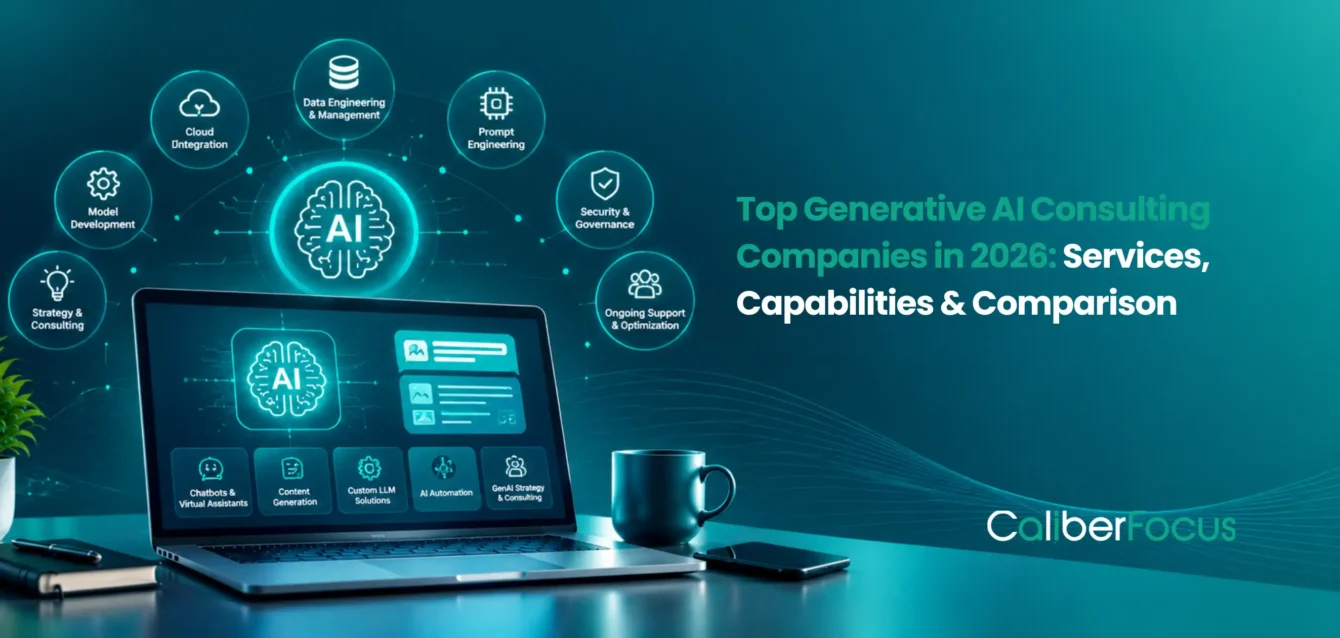
Generative AI consulting companies help enterprises determine how Generative AI can address specific business challenges before investing in development. Rather than starting with a predefined AI application, consultants examine existing workflows, operational bottlenecks, business requirements, and technology constraints to identify where GenAI could deliver practical value.
A Generative AI consulting engagement typically moves through five phases:
| Consultation Phase | What Consulting Companies Assess |
| 1. Business Discovery | Business challenges, operational workflows, stakeholder needs, and expected outcomes |
| 2. Requirements & Readiness | Available data, existing applications, integration dependencies, security, and technical limitations |
| 3. GenAI Solution Assessment | Suitable use cases, LLM options, RAG requirements, and proposed solution architecture |
| 4. Demo & PoC Validation | How the proposed approach could work and whether it meets defined business and technical requirements |
| 5. Implementation Advisory | Delivery scope, estimated investment, dependencies, risks, and implementation roadmap |
Not every engagement requires all five phases. The scope depends on the organization’s existing requirements, technical readiness, and decisions that still need validation.
For enterprises considering Generative AI and LLM solutions, the consulting partner’s value lies in translating business requirements into a justified solution recommendation, supported by feasibility findings and validation where needed.
This guide compares eight specialist Generative AI consulting firms based on their publicly described consulting capabilities, including requirements discovery, technical assessment, solution recommendations, and early validation. The companies are presented as a consideration shortlist, not an independently scored ranking.
Generative AI Consulting Companies in 2026: Quick Overview
The eight Generative AI consulting companies featured in this guide offer different approaches to business discovery, requirements assessment, technical feasibility, and solution planning. Some specialize in identifying and prioritizing GenAI opportunities, while others extend consulting into LLM architecture, data readiness, and proof-of-concept validation.
The comparison focuses on three questions enterprise buyers should consider:
- Business understanding: How does the consulting firm assess operational challenges, existing workflows, and GenAI requirements?
- Solution expertise: Can it recommend suitable LLMs, RAG architectures, integration approaches, and technical requirements?
- Feasibility validation: Does it support demonstrations, prototypes, or PoCs to evaluate the proposed solution before development?
The following comparison highlights five firms from the broader shortlist and the consulting requirements they are positioned to address.
Generative AI Consulting Companies at a Glance
| Company | Generative AI Consulting Focus | Best Suited For |
|---|---|---|
| CaliberFocus | Business requirements, AI readiness, GenAI architecture, implementation roadmaps | Enterprises aligning GenAI solutions with existing data, applications, and workflows |
| HatchWorks AI | AI discovery, use-case prioritization, feasibility assessment | Businesses evaluating multiple GenAI opportunities before investment |
| RTS Labs | GenAI strategy, technical feasibility, proof-of-concept validation | Organizations validating a defined GenAI use case before development |
| Addepto | AI discovery workshops, data readiness, PoC development | Enterprises assessing data requirements and testing solution feasibility |
| LeewayHertz | GenAI use-case assessment, LLM selection, solution architecture | Businesses defining technical requirements and architecture for GenAI adoption |
What to Look for in a Generative AI Consulting Company
Generative AI consulting firms differ in how they assess business requirements and translate them into solution recommendations. Before comparing providers, enterprises should examine three capabilities:
- Business and workflow discovery: Understanding operational challenges, stakeholder requirements, existing processes, and where GenAI is appropriate.
- Technical assessment and solution advisory: Evaluating data readiness, application dependencies, LLM options, RAG architecture, integration requirements, and security constraints.
- Solution validation and planning: Defining prototype or PoC requirements, testing feasibility, identifying limitations, and establishing an implementation roadmap.
The right consulting partner should explain not only which GenAI approach it recommends, but also why that approach fits the business problem and what evidence is needed before development.
8 Generative AI Consulting Companies to Consider in 2026
The following companies offer Generative AI consulting capabilities across business discovery, use-case assessment, technical feasibility, solution architecture, and early validation. Their approaches differ in how they connect business requirements with technology recommendations and implementation planning.
1. CaliberFocus

Consulting focus: Enterprise GenAI strategy, business requirements assessment, AI readiness, solution architecture, and implementation planning.
CaliberFocus approaches Generative AI consulting by connecting business requirements with the enterprise data, applications, and operational workflows a proposed solution must support. Its consulting capabilities cover AI readiness, use-case prioritization, technical assessment, and implementation planning.
For example, an organization evaluating an internal knowledge assistant may need more than an LLM recommendation. The assessment must consider where enterprise knowledge resides, how employees access it, whether retrieval-augmented generation (RAG) is appropriate, and what security and integration requirements affect the solution.
CaliberFocus’s broader capabilities in Generative AI, LLM solutions, data engineering, and application integration are relevant to these decisions.
Best suited for: Enterprises assessing GenAI solutions that depend on existing business systems, proprietary data, and cross-functional workflows.
Key consideration: Establish the expected consulting deliverables, including architecture recommendations, feasibility findings, and any agreed prototype or PoC scope.
2. HatchWorks AI
Consulting focus: AI opportunity discovery, use-case prioritization, feasibility assessment, and strategic roadmaps.
HatchWorks AI provides AI strategy and advisory services that help organizations identify where AI may address business challenges. Its consulting approach emphasizes understanding business objectives, assessing potential use cases, and prioritizing initiatives according to feasibility and expected value.
This is particularly relevant when an organization has several possible GenAI applications but has not determined which should receive investment. Consulting can help distinguish opportunities requiring generative capabilities from problems better addressed through existing automation or conventional software.
Best suited for: Organizations evaluating multiple AI opportunities and seeking a prioritized investment roadmap.
Key consideration: Confirm whether the engagement includes GenAI-specific technical assessment and prototype validation or focuses primarily on strategy and prioritization.
3. RTS Labs
Consulting focus: Generative AI strategy, requirements assessment, technical feasibility, and proof-of-concept validation.
RTS Labs offers Generative AI consulting services that connect business objectives with potential technical solutions. Its published approach includes examining requirements and developing proofs of concept to assess whether a proposed GenAI application can work before broader implementation.
For enterprises with a defined use case, this approach can help test assumptions about model behavior, available data, and solution feasibility. A PoC should also establish which technical limitations remain unresolved before development.
Best suited for: Organizations with a specific GenAI application in mind that require feasibility evidence before approving implementation.
Key consideration: Ask how the firm defines PoC success criteria, evaluates results, and documents the transition from validation to development.
4. Addepto
Consulting focus: AI discovery workshops, business requirements assessment, technical feasibility, and PoC planning.
Addepto structures its consulting around discovery workshops involving business and technical stakeholders. These sessions examine the organization’s challenges, evaluate potential AI applications, and identify the technology and data requirements behind a proposed solution.
Its published workshop offering includes feasibility evaluation, technology-stack recommendations, and PoC design. This makes the approach relevant when business teams have identified an opportunity but need technical guidance to define and test it.
Best suited for: Enterprises requiring collaborative discovery, feasibility assessment, and an initial validation plan.
Key consideration: Confirm whether the engagement includes a working PoC or only its design, and which findings will be documented.
5. ThirdEye Data

Consulting focus: GenAI use-case identification, technology assessment, data preparation, and PoC validation.
ThirdEye Data provides Generative AI consulting that connects business requirements with technology selection and existing operational systems. Its published services include identifying suitable use cases, assessing feasibility, selecting GenAI tools, and preparing data for AI applications.
The company also offers proof-of-concept development and pilot implementations. These capabilities are relevant when the proposed solution depends on enterprise data quality, system compatibility, and integration requirements.
Best suited for: Organizations evaluating data-intensive GenAI applications that must work with established business processes.
Key consideration: Review how the firm compares alternative technologies, tests business-specific requirements, and documents limitations before recommending implementation.
6. LeewayHertz

Consulting focus: GenAI use-case feasibility, model selection, solution architecture, and integration planning.
LeewayHertz offers Generative AI consulting that begins with identifying potential applications and evaluating their feasibility. Its services include technology assessment, model selection, and recommendations for integrating GenAI into existing systems.
The company also addresses responsible AI considerations, including security, privacy, and governance. These requirements matter when enterprises need to assess not only whether an application can function, but also the controls required to operate it.
Best suited for: Enterprises evaluating technically complex GenAI applications that require model-selection guidance and integration planning.
Key consideration: Clarify the architecture deliverables, governance requirements, and boundaries between consulting, development, and implementation support.
7. Markovate

Consulting focus: GenAI opportunity assessment, technical environment review, and technology recommendations.
Markovate’s Generative AI consulting services include evaluating business opportunities, assessing their practicality, and recommending suitable technologies.
Its published consultation process begins with reviewing existing datasets, software architecture, and technology foundations. This provides a basis for determining whether a proposed GenAI application fits the organization’s environment and what changes implementation may require.
Markovate also offers GenAI development services, including solutions integrated into existing business workflows.
Best suited for: Businesses evaluating GenAI opportunities within existing applications and operational environments.
Key consideration: Confirm whether the consulting engagement produces a documented feasibility assessment, solution architecture, or prototype before development begins.
8. InData Labs
Consulting focus: GenAI business-case assessment, data readiness, technology selection, and project planning.
InData Labs offers Generative AI consulting that examines business objectives, existing processes, and data infrastructure before recommending an approach.
Its published services cover business-case analysis, AI technology selection, data assessment, project estimation, and PoC development. The company also provides data governance and infrastructure consulting, which is relevant when information quality or availability could affect the proposed solution.
This combination supports organizations that need to establish both the business justification and technical prerequisites for GenAI adoption.
Best suited for: Enterprises requiring business-case validation, data-readiness assessment, and a defined technical direction.
Key consideration: Request clear separation between consulting deliverables, PoC development, and any subsequent implementation commitment.
What Should Enterprises Expect After Generative AI Consulting?
Five Questions the Consulting Engagement Should Answer
-
Is Generative AI the Right Approach?
The recommendation should explain why GenAI fits the business problem and whether conventional automation or another technology would be more suitable.
-
What Solution Should the Business Consider?
The firm should identify the proposed application, relevant LLM capabilities, architecture options, and fit with existing workflows.
-
What Could Prevent Implementation?
The assessment should identify data-quality issues, integration dependencies, security requirements, governance constraints, and operational risks.
-
What Has Been Validated, and What Remains Uncertain?
Where a prototype or PoC is included, findings should distinguish demonstrated capabilities from assumptions requiring further testing.
-
What Are the Next Steps Toward Implementation?
Decision-makers should understand delivery dependencies, resource requirements, cost assumptions, and responsibilities.
How Generative AI Consultants Validate Solutions Before Development
Generative AI consulting companies use different validation methods depending on what the business needs to confirm before investing in development.
| Validation Method | What the Consulting Company Does | What Business Leaders Can Decide |
| Demo | Shows how employees or customers could use a proposed GenAI solution for a task, such as finding information or preparing a report. | Does this address the identified problem? Would it be useful in daily operations? |
| Prototype | Builds a basic working version to demonstrate selected functions within a business process. | Can teams use this approach in their workflows? What needs to change? |
| Proof of Concept (PoC) | Tests the proposed technology against agreed feasibility criteria using relevant data and defined conditions. | Does the approach meet initial feasibility criteria? Which accuracy, security, integration, or performance requirements remain untested? |
A demo communicates the concept, a prototype demonstrates selected functionality, and a PoC provides technical evidence. Not every engagement requires all three.
A successful PoC also does not establish production readiness. Additional integration, security, reliability, and operational testing may be necessary before deployment.
Generative AI Consulting vs. Development Companies: Which Does Your Business Need?
Generative AI consulting and development companies serve different purposes in an enterprise AI initiative. Consulting helps businesses determine what solution to pursue, whether it is feasible, and what implementation requires. Development turns those requirements into a working application integrated with business systems.
The right choice depends on how clearly the organization has defined its problem, technical requirements, and expected outcomes.
| Business Consideration | Generative AI Consulting Companies | Generative AI Development Companies |
| When to engage | You have identified a business challenge but need guidance on whether and how GenAI should address it. | You have a defined GenAI solution and need a team to build and implement it. |
| Understanding business needs | Examine existing workflows, operational bottlenecks, stakeholder expectations, and business objectives to define solution requirements. | Translate agreed requirements into application features, integrations, and development tasks. |
| Choosing the right technology | Assess LLM options, RAG, data readiness, security requirements, and architecture alternatives before recommending an approach. | Configure and implement the selected models, architecture, data pipelines, and application components. |
| Testing the proposed solution | Use demos, prototypes, or PoCs to determine whether the proposed approach is suitable and technically feasible. | Conduct functional, integration, security, and performance testing to prepare the application for deployment. |
| What you receive | Requirements documentation, feasibility findings, architecture recommendations, validation results, and an implementation roadmap, depending on scope. | A developed GenAI application, integrated components, technical documentation, and deployment deliverables. |
| Primary business decision | Should we invest in this GenAI solution, and what approach should we take? | How do we build, integrate, deploy, and maintain the approved solution? |
When Should You Choose Consulting, Development, or Both?
- Choose GenAI consulting when the business problem is clear but the appropriate AI approach, technical feasibility, or implementation requirements remain uncertain.
- Choose GenAI development when requirements, solution direction, and success criteria are sufficiently defined to begin engineering.
- Choose a combined engagement when you need one provider to assess requirements, validate the approach, and subsequently develop the approved solution.
For example, a manufacturer exploring a GenAI assistant for maintenance documentation may first need consulting to assess document quality, technician workflows, access permissions, and whether RAG is suitable. Once the requirements and technical approach are validated, development can focus on building the assistant and integrating it with existing systems.
Organizations ready to move into implementation can compare Generative AI development companies based on their engineering, integration, and deployment capabilities.
How to Choose a Generative AI Consulting Partner
Before engaging a consulting firm, determine whether its proposed assessment will answer the decisions your organization needs to make.
Evaluate whether the provider can:
- Understand the business challenge before recommending GenAI.
- Explain when conventional software or automation may be more appropriate.
- Assess data availability, existing systems, and security requirements.
- Define measurable success criteria for a prototype or PoC.
- Document technical recommendations, limitations, and implementation dependencies.
- Clarify ownership of consulting deliverables and subsequent development.
The right partner should provide a clear basis for deciding whether to proceed, revise the proposed approach, or stop the initiative.

Define the Right Generative AI Approach for Your Business
CaliberFocus connects business requirements with Generative AI architecture, enterprise data, applications, and implementation planning. Explore how its solutions address the technical and operational requirements behind enterprise GenAI adoption.
Frequently Asked Questions
Start with firms that understand your industry, business workflows, and existing technology environment. Compare their approach to requirements discovery, data readiness, solution architecture, and feasibility validation. Ask what recommendations and deliverables you will receive, how success will be measured, and whether the firm can support implementation if needed. The best fit depends on your business requirements, not the provider’s size or range of AI technologies.
Generative AI consulting services commonly include use-case discovery, AI readiness assessments, LLM and RAG architecture recommendations, data and integration assessments, security and governance planning, and implementation roadmaps. Some firms also provide prototypes, proofs of concept (PoCs), and development services. Confirm which activities are included in the proposed consulting scope.
Costs depend on the engagement’s scope, technical complexity, number of use cases, and validation requirements. A focused feasibility assessment will generally require less effort than an enterprise-wide GenAI strategy involving multiple systems and departments. Request a proposal that separates consulting fees, optional PoC development, infrastructure or model-related expenses, and subsequent implementation costs.
Yes. Consultants can examine operational bottlenecks, repetitive knowledge-intensive tasks, available enterprise data, and existing applications to identify potential GenAI opportunities. Each use case should be evaluated against business value, technical feasibility, security requirements, and implementation effort. The assessment may also identify processes better suited to conventional automation or software improvements.
Consulting is particularly useful when your organization has identified a business problem but has not finalized the solution, technical architecture, or implementation requirements. If the use case and requirements are already validated, a development partner may be more appropriate. Enterprises with complex integration or governance requirements may benefit from a provider that offers both consulting and development.
Ask how the firm will assess your business requirements, evaluate technical feasibility, and determine whether a PoC is necessary. Clarify the engagement timeline, deliverables, acceptance criteria, security responsibilities, and ownership of resulting documentation or prototypes. Also establish whether implementation support is included or requires a separate agreement.