

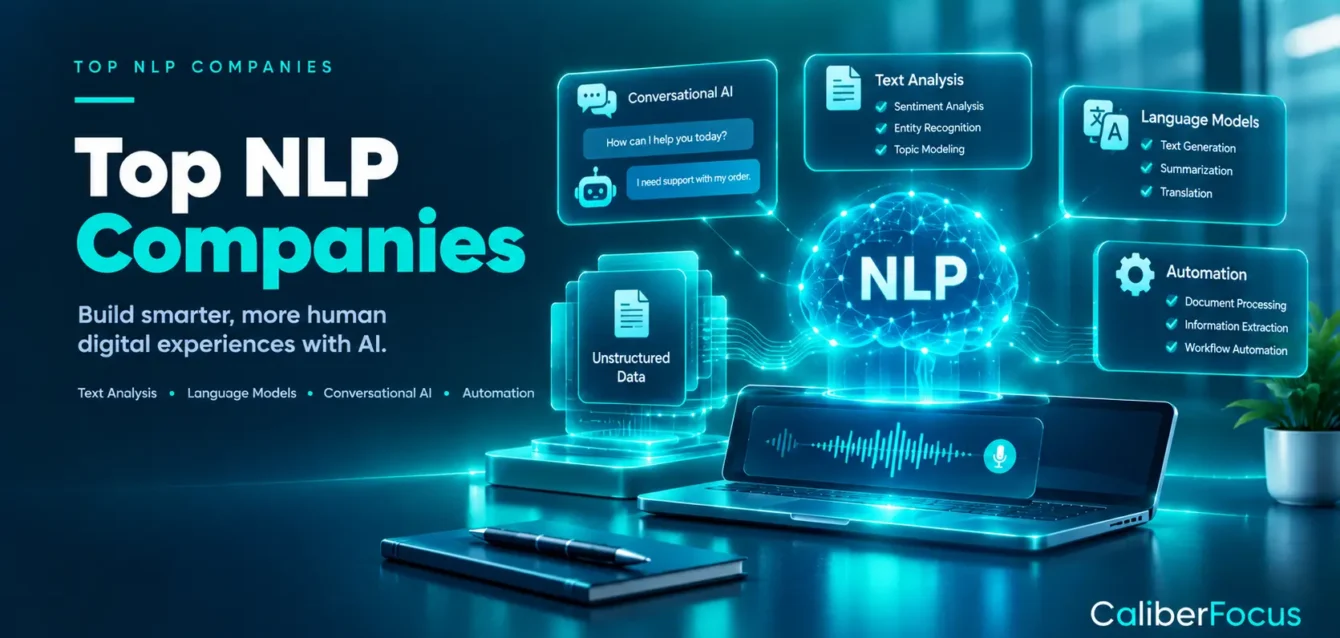
Natural language processing (NLP) companies develop AI solutions that help enterprises extract, classify, interpret, and use information from documents, emails, customer conversations, service requests, and other language-based records.
For businesses evaluating natural language processing companies, the priority is finding a provider that can turn unstructured information into usable data and integrate language processing with existing operations. Providers differ in their expertise across document intelligence, conversational AI, model development, enterprise integration, and production support.
Where NLP supports enterprise operations:
| Business Function | NLP Applications |
| Finance and Procurement | Invoice extraction, document classification, and exception identification |
| Customer Operations | Request classification, customer feedback analysis, and service-ticket routing |
| Healthcare and Life Sciences | Clinical documentation processing and medical information extraction |
| Legal and Compliance | Contract clause identification, obligation extraction, and document review |
| IT Operations | Ticket categorization, incident analysis, and enterprise knowledge retrieval |
| Sales and Market Intelligence | Sentiment analysis, feedback classification, and communication insights |
Organizations evaluating Natural Language Processing and Voice AI Services should assess how language-processing capabilities can connect with their existing information systems, applications, and operational workflows.
This guide compares ten NLP companies, their specializations, and the factors enterprises should consider when choosing between NLP software, platforms, and custom development services.
NLP Companies at a Glance
These five companies represent different approaches to enterprise NLP development. The complete list of ten providers follows.
| Company | Primary NLP Focus | Suitable Business Requirements |
|---|---|---|
| 01 CaliberFocus |
Enterprise NLP, document intelligence, conversational AI, and application integration | NLP integrated with business processes and information systems |
| 02 CHI Software |
Custom NLP applications and document processing | Document-intensive workflows and tailored language-processing applications |
| 03 N-iX |
AI engineering, data platforms, and cloud integration | NLP implementations involving complex data and application environments |
| 04 ITRex Group |
Custom AI, language processing, and intelligent automation | Business-specific AI applications and operational workflows |
| 05 Toptal |
Access to NLP engineers and AI specialists | Organizations supplementing internal teams with specialized development talent |
Why Enterprises Are Prioritizing NLP in 2026
Many organizations have digitized their documents, customer interactions, and operational records. However, much of the information inside these systems still requires employees to read, interpret, categorize, and transfer it manually.
A finance team may receive invoices digitally but still extract information for validation. Customer service teams may manage requests through CRM platforms while manually identifying intent and routing cases. Legal teams may store contracts centrally but continue reviewing individual clauses and obligations.
NLP addresses these information-processing requirements by making business language easier to interpret and use within digital workflows.
How NLP Has Evolved in Enterprise Operations
| Stage | Enterprise Application |
| Earlier Adoption | Keyword extraction, text classification, sentiment analysis, and rule-based language processing |
| Current Implementations | Document intelligence, semantic search, domain-specific models, and NLP integrated with enterprise applications |
| Emerging Direction | NLP combined with LLMs, retrieval systems, and AI agents supporting connected business workflows |
These approaches continue to coexist. A focused NLP model may be sufficient for predictable classification tasks, while an LLM-based system may be appropriate when workflows require contextual interpretation, synthesis, or natural-language generation.
The distinction matters when choosing a provider. NLP vs. LLM: Differences, Use Cases and How to Choose explains where focused language-processing models, LLMs, and combined architectures fit within enterprise operations.
What Do Natural Language Processing Companies Deliver?
Natural language processing companies design, customize, and integrate systems that convert business language into information employees and applications can use.
Their core services typically include:
- Document Processing: Extracting fields, identifying entities, classifying records, and preparing information for downstream systems.
- Customer Communication Analysis: Identifying intent, sentiment, recurring concerns, and service requirements.
- Enterprise Knowledge Access: Retrieving relevant information from policies, contracts, technical documentation, and internal repositories.
- Speech and Conversation Intelligence: Converting speech into text and analyzing conversations for operational information.
- Business Application Integration: Connecting NLP outputs with ERP, CRM, document management, and internal workflow systems.
- Model Evaluation and Maintenance: Testing accuracy, monitoring language changes, and managing exceptions.
Implementation also depends on document consistency, language variations, domain terminology, and information quality. These considerations are examined in Challenges of NLP and How AI Is Solving Them in Enterprises.
NLP vs. Conversational AI: What Is the Difference?
Natural Language Processing (NLP) enables systems to analyze, classify, extract, and interpret information from human language. Conversational AI enables people to interact with software through natural-language conversations, using NLP, language models, and other technologies to understand requests and generate responses.
| Aspect | NLP | Conversational AI |
| Primary Purpose | Process and interpret text or speech | Enable interactive conversations |
| Business Applications | Invoice extraction, contract analysis, ticket classification, sentiment analysis | Customer support assistants, employee helpdesks, virtual agents |
| Workflow Role | Converts language into usable information | Handles user requests and guides interactions |
| Best Fit | Document-heavy and information-processing operations | Customer-facing and employee-facing interactions |
Which should businesses choose? NLP is suitable when the priority is processing information within existing workflows. Conversational AI is appropriate when employees or customers need to interact with systems through natural language.
Both can work together. For example, customer support systems can interpret incoming requests and coordinate responses through connected applications. The article AI Agents for Customer Support examines how these capabilities can extend into service operations.
How NLP Fits Into an Existing Business Process
Consider an organization receiving large volumes of supplier documents.
Document received → Information extracted → Details validated → Exceptions reviewed → Business system updated
NLP supports extraction and classification, while validation rules, integrations, and human approvals determine how information moves through the process.
Similar requirements appear in healthcare, where clinical records contain specialized terminology and contextual information. NLP in Clinical Documentation provides an industry-specific example of language processing within documentation workflows.
NLP Software vs. NLP Platforms vs. Development Companies
Enterprises do not always need custom NLP development. The appropriate delivery model depends on language complexity, existing systems, internal technical capabilities, and customization requirements.
| Option | What It Provides | When to Consider It |
| NLP Software | Prebuilt applications for document extraction, text classification, or customer feedback analysis | Requirements are standardized and existing functionality meets business needs |
| NLP Platforms | Models, APIs, and development tools for building language-processing applications | Internal teams can configure, integrate, evaluate, and maintain the solution |
| NLP Development Companies | Custom architecture, domain adaptation, application integration, deployment, and support | Processes involve proprietary information, specialized terminology, complex integrations, or business-specific controls |
A platform may be sufficient for extracting standard information from consistent documents. A development partner becomes more relevant when information must be interpreted in a specialized business context and integrated with multiple enterprise applications.
When language applications must also retrieve relevant enterprise knowledge and generate grounded responses, retrieval architecture becomes another consideration. RAG vs. Fine-Tuning: Enterprise AI Comparison Guide explains two approaches to adapting language-based applications to enterprise requirements.
Top 10 Natural Language Processing Companies in 2026
The following companies offer different approaches to NLP development, from document intelligence and conversational AI to enterprise integration and specialist engineering teams. The comparison focuses on capabilities, industry relevance, delivery models, and suitability for business requirements.
1. CaliberFocus

Core Specialization: Enterprise NLP, Voice AI, document intelligence, and business workflow integration.
CaliberFocus develops language-processing solutions for organizations managing substantial volumes of business documents, communications, and operational information. Its NLP capabilities sit alongside data engineering, application development, and AI services, making it relevant to enterprises that need language intelligence connected with existing systems.
Core NLP Capabilities
- Document classification, information extraction, and text analytics
- Sentiment analysis and natural-language understanding
- Conversational AI and speech-processing applications
- Domain-specific language-processing solutions
- Integration with enterprise applications and workflows
Key Strength: Connecting NLP capabilities with enterprise data, applications, and operational processes rather than treating language processing as a standalone tool.
Industries Served: Healthcare and life sciences, banking and finance, manufacturing, retail and e-commerce, logistics, and other enterprise sectors.
Best Suited For: Enterprises implementing NLP within document-heavy operations, customer communication processes, and existing business applications.
Buyer Consideration: Evaluate CaliberFocus when the requirement includes NLP development, application integration, and ongoing workflow ownership. Ask for a relevant demonstration using representative business information.
2. CHI Software
Core Specialization: Custom NLP development, text analytics, and language-processing consulting.
CHI Software offers dedicated NLP consulting and development services. Its published capabilities cover NLP strategy, solution design, and custom applications for interpreting business text and supporting customer interactions.
Core NLP Capabilities
- NLP consulting and implementation roadmaps
- Text analysis and information extraction
- Conversational AI and chatbot development
- Document-processing applications
- Language-processing integration within custom software
Key Strength: Combining dedicated NLP consulting with application development, allowing organizations to assess business requirements before choosing an implementation approach.
Industries Served: Finance, retail, healthcare and wellness, insurance, and education.
Best Suited For: Organizations seeking a custom NLP application for document processing, customer interaction, or specialized text analysis.
Buyer Consideration: Ask CHI Software to demonstrate its approach to domain-specific terminology, training data requirements, model evaluation, and integration with existing applications.
3. N-iX
Core Specialization: AI engineering, enterprise data platforms, and cloud-based application development.
N-iX provides broader AI, data engineering, and cloud development services. This makes it a potential option for organizations where NLP is part of a larger modernization initiative involving data infrastructure and enterprise applications.
Relevant Capabilities
- AI and machine learning engineering
- Enterprise data engineering
- Cloud application development
- Model deployment and integration
- Software engineering for enterprise systems
Key Strength: Its broader data and cloud engineering orientation may suit projects requiring significant infrastructure and integration work.
Industries to Evaluate: Financial services, healthcare, manufacturing, retail, and other data-intensive enterprises. Relevant NLP-specific delivery experience in each industry requires confirmation.
Best Suited For: Enterprises incorporating language-processing features into larger data modernization, analytics, or cloud transformation programs.
Buyer Consideration: Confirm whether N-iX has delivered comparable NLP projects, rather than relying only on its general AI engineering experience. Request examples of model evaluation, deployment, and production support.
4. Beetroot
Core Specialization: NLP development, conversational AI, speech technologies, and dedicated engineering teams.
Beetroot provides a dedicated NLP service offering alongside custom AI development and engineering-team support. Its published services cover document processing, knowledge extraction, conversational applications, and speech technologies.
Core NLP Capabilities
- Document processing and information extraction
- Chatbots and conversational AI
- Knowledge extraction from unstructured information
- Speech-to-text and text-to-speech
- Sentiment analysis and brand monitoring
- Domain-specific language model development
Key Strength: A combination of dedicated NLP services and flexible engineering-team arrangements, including support for continued improvement after deployment.
Industries Served: HealthTech, GreenTech, EdTech, FinTech, retail and e-commerce, and manufacturing.
Best Suited For: Businesses developing language-enabled products or requiring dedicated technical capacity for document intelligence, speech applications, and customer-facing NLP systems.
Buyer Consideration: Establish whether Beetroot will provide end-to-end solution ownership or augment an internal engineering team. Clarify responsibility for model monitoring, updates, and integration.
5. ITRex Group

Core Specialization: Custom AI engineering, NLP-enabled applications, and intelligent automation.
ITRex Group develops AI-driven software for organizations seeking business-specific applications. Its positioning is relevant to NLP projects where language interpretation needs to support operational decisions or automated workflows.
Relevant Capabilities
- Custom NLP application development
- Text and document analysis
- Conversational AI
- AI-enabled workflow automation
- Enterprise software integration
Key Strength: Custom AI engineering for applications requiring business-specific processing rather than standardized software functionality.
Industries to Evaluate: Healthcare, finance, retail, logistics, and other industries with document-intensive operations. Specific NLP project evidence should be requested.
Best Suited For: Organizations with specialized language-processing requirements that cannot be addressed adequately through standard NLP software.
Buyer Consideration: Ask for comparable NLP implementations, including the data preparation approach, business-system integration, error handling, and support responsibilities.
6. Unicsoft

Core Specialization: NLP consulting, intelligent document processing, and custom language-processing applications.
Unicsoft offers dedicated NLP development services covering consulting, implementation, and maintenance. Its published applications include document analysis, language-based insights, and text processing across multiple industries.
Core NLP Capabilities
- Smart document analysis and information extraction
- Text analytics and language-based data processing
- NLP consulting and custom development
- Data preparation and model implementation
- Application maintenance and ongoing optimization
Key Strength: A dedicated NLP service offering with emphasis on extracting useful information from unstructured business data.
Industries Served: Finance, healthcare, legal services, education, e-commerce, and marketing.
Best Suited For: Organizations looking to analyze large document collections, interpret customer feedback, or develop language-processing applications around specialized information.
Buyer Consideration: Request examples involving similar document types and industry terminology. Evaluate how Unicsoft measures extraction quality, handles ambiguous information, and supports models after deployment.
7. Prismetric
Core Specialization: Custom NLP applications, multilingual language processing, and conversational AI.
Prismetric offers dedicated NLP services covering model development, text and speech analytics, chatbot development, and application integration. Its offering is relevant to organizations evaluating both information-processing and conversational applications.
Core NLP Capabilities
- Custom NLP application development
- Data preprocessing and annotation
- Text and speech analytics
- Sentiment analysis
- Chatbots and virtual assistants
- Multilingual NLP solutions and integration
Key Strength: A broad NLP service portfolio spanning data preparation, model development, and application integration, with dedicated NLP proof-of-concept services.
Industries Served: Prismetric’s broader engineering portfolio includes healthcare, finance, retail, education, logistics, and travel. NLP-specific delivery references should be confirmed for the relevant industry.
Best Suited For: Businesses developing customer-facing conversational applications, multilingual NLP systems, or text analytics solutions.
Buyer Consideration: Evaluate its experience with the languages, document formats, and customer channels relevant to your business. Ask how the team validates multilingual accuracy and conversational performance.
8. JustSoftLab
Core Specialization: Custom AI and information-processing applications; current NLP specialization requires further verification.
JustSoftLab appears in the existing provider list for language-processing and information-retrieval requirements. However, the available research does not sufficiently establish its current dedicated NLP service portfolio.
Capabilities to Verify
- Semantic search and information retrieval
- Document analysis and summarization
- Custom language-processing applications
- Integration with enterprise information systems
Potential Strength: Custom application development for information-intensive workflows, subject to confirmation of its current service capabilities.
Industries Served: Industry-specific NLP experience has not been established from the available evidence.
Best Suited For: Organizations considering custom document intelligence or enterprise knowledge applications, provided relevant delivery experience can be demonstrated.
Buyer Consideration: Request an official NLP service portfolio, comparable case studies, technology capabilities, and production references before including JustSoftLab in a final shortlist.
9. JPLoft
Core Specialization: NLP application development, conversational AI, sentiment analysis, and language-enabled digital products.
JPLoft offers a dedicated NLP development service covering language-processing applications, consulting, text analytics, chatbots, and document analysis. Its broader software engineering capabilities are relevant when NLP needs to be incorporated into customer-facing or internal applications.
Core NLP Capabilities
- Custom NLP application development
- Sentiment and intent analysis
- Text analytics and information extraction
- Chatbots and conversational applications
- Document analysis and review analysis
- NLP integration and model optimization
Key Strength: Combining NLP development with broader digital product and application engineering.
Industries Served: Healthcare, finance, e-commerce, education, and logistics are among the industries identified in its NLP offering.
Best Suited For: Organizations adding language understanding, customer communication analysis, or conversational interfaces to digital applications.
Buyer Consideration: Confirm whether the proposed solution will use existing NLP APIs, customized models, or purpose-built components. Assess the implications for integration, model ownership, ongoing costs, and maintenance.
10. Toptal
Core Specialization: Access to independent NLP engineers, machine learning specialists, and AI development professionals.
Toptal differs from traditional NLP consulting companies because its primary model connects organizations with specialist technical talent. Its NLP network includes engineers with experience in language models, information extraction, RAG, model evaluation, and production AI systems.
Core Capabilities Available Through Its Talent Network
- NLP model development and fine-tuning
- Text classification and entity recognition
- Language model integration
- Retrieval-augmented generation
- Model evaluation and optimization
- AI application engineering
Key Strength: Flexible access to NLP specialists with different technical backgrounds and experience.
Industry Experience: Individual profiles demonstrate experience across healthcare, finance, manufacturing, legal, and other sectors. Industry expertise depends on the specialists selected.
Best Suited For: Enterprises with established technical leadership that need additional NLP expertise, specialized engineering capacity, or support for a defined development initiative.
Buyer Consideration: Unlike a conventional managed development engagement, hiring individual specialists may leave more responsibility for architecture, project management, integration, and ongoing operations with the client. Toptal also offers managed consulting engagements, so buyers should clarify the delivery arrangement.
How to Choose the Right NLP Development Company
Selecting an NLP company starts with understanding how language moves through the business, where manual interpretation creates delays, and what the system must do with extracted information.
| Evaluation Area | Questions for Prospective NLP Companies |
|---|---|
| Business Process Fit | Can the provider demonstrate how NLP would work with our documents, communications, and operational steps? |
| Data Readiness | Can it handle inconsistent formats, specialized terminology, incomplete records, and multilingual information? |
| Enterprise Integration | Can the solution connect with our ERP, CRM, document management, and internal applications? |
| Accuracy and Review | How will extraction and classification quality be tested? What happens when confidence is insufficient? |
| Security and Governance | How are sensitive information, access permissions, retention, and audit requirements handled? |
| Production Support | Who monitors performance and updates the solution as terminology, documents, and business rules change? |
Before comparing proposals, enterprises should assess whether their documents, data sources, integrations, and internal ownership arrangements are ready for implementation. An AI Readiness Assessment provides a framework for evaluating these dependencies before committing to development.
Evaluate NLP Accuracy Against Real Business Information
A vendor demonstration should use representative documents and language patterns, including ambiguous records, missing fields, and specialized terminology.
Enterprises should evaluate accuracy by task. Document extraction may require field-level precision and recall, while customer-request classification may require measuring incorrect routing and manual review rates.
Document Extraction
Measure field-level precision and recall to assess whether the system extracts the required information correctly.
Request Classification
Measure incorrect routing and manual review rates to understand the impact of classification errors.
For business-critical workflows, evaluation should establish acceptable error thresholds, escalation procedures, and ownership of corrections. These are among the broader AI Implementation Challenges organizations must address when moving language-processing applications into production.
What Affects NLP Implementation Cost and Timeline?
NLP implementation scope depends on document volume, language diversity, model customization, data preparation, system integration, testing, and operational support.
A standardized classification requirement may be addressed with an existing platform. Processing specialized documents across multiple applications may require custom development, integration work, and more extensive validation.
Before selecting a provider, request a proposal covering discovery, data preparation, development, integration, testing, deployment, and ongoing maintenance.
Choosing an NLP Partner for Your Business
The right NLP company should demonstrate how language-processing capabilities will work with your organization’s information, applications, and operational controls.
Start with a defined process, establish what information the system must interpret, and evaluate providers against representative business data. Effective implementation depends on appropriate technology selection, integration, accuracy requirements, and ongoing ownership.
For organizations planning to extend NLP into enterprise knowledge retrieval or more advanced information workflows, Enterprise Generative AI: Use Cases and Implementation provides additional context on how language models, enterprise information, and connected applications can work together.
Bring NLP Into Your Existing Business Workflows
CaliberFocus supports NLP development for document processing, information extraction, conversational applications, and enterprise integration.
Related Case Study
AI-Powered Medical Coding in Healthcare
Clinical documentation illustrates why language understanding must connect with operational workflows. CaliberFocus’s Healthcare Operations Transformed with AI Medical Coding case study examines how AI-supported coding can improve the handling of clinical information and coding operations.
FAQs
Start with document-heavy or communication-intensive processes such as invoice extraction, customer-request classification, contract review, and service-ticket routing. Prioritize workflows with accessible digital information, recurring manual effort, and measurable quality requirements.
Yes, when the systems support suitable integration methods. NLP can extract or classify information and pass results into existing applications through APIs or other supported interfaces. Integration feasibility should be assessed before development.
Choose a platform when existing functionality meets your requirements and your team can manage integration. Consider custom development when specialized terminology, proprietary documents, complex workflows, or business-specific controls require additional engineering.
Measure processing time, extraction accuracy, manual review volume, incorrect classifications, and exception rates. Establish a baseline before implementation and evaluate results against representative operational workloads.
Identify the target process, document or conversation samples, relevant applications, data owners, security requirements, and expected outcomes. These inputs help providers assess feasibility, integration complexity, and implementation scope.