

The healthcare industry sits on a mountain of data, clinical notes, lab reports, patient histories, discharge summaries, and research papers. Yet for decades, most of this information remained locked away in unstructured text formats that computers couldn’t meaningfully read. That’s where NLP in healthcare changes everything.Natural Language Processing (NLP), a branch of Artificial Intelligence focused on enabling machines to understand and generate human language, is now one of the most powerful forces reshaping modern medicine. The rise of NLP healthcare solutions has moved from experimental pilots to enterprise-scale deployments across health systems worldwide. From automating administrative workflows to accelerating disease detection, NLP solutions for healthcare are no longer a future aspiration, they are driving real outcomes in AI transforming patient care and hospital operations today.
What Is NLP, and Why Does It Matter for Healthcare?
NLP is a subfield of AI that uses algorithms, machine learning, and deep learning to interpret, analyze, and generate natural human language. It powers everything from voice assistants to spam filters, and increasingly, it powers some of the most critical decisions in medicine.
In the context of healthcare NLP, the technology is specifically designed to process the kind of unstructured, free-form text that dominates clinical environments: physician chart notes, discharge summaries, radiology reports, and patient-provider conversations. Studies estimate that up to 80% of all healthcare data is unstructured, meaning it exists as text rather than neatly formatted, machine-readable entries. Without NLP, that vast reservoir of clinical knowledge goes largely unutilized.
The applications of NLP in healthcare span the full care continuum, from clinical documentation and coding to real-time patient communication and population health monitoring.
AI and NLP in healthcare work together to bridge the data gap, transforming raw, unstructured language into structured, actionable insights that can inform treatment, improve outcomes, and reduce the burden on care teams.
How Is NLP Used in Healthcare?
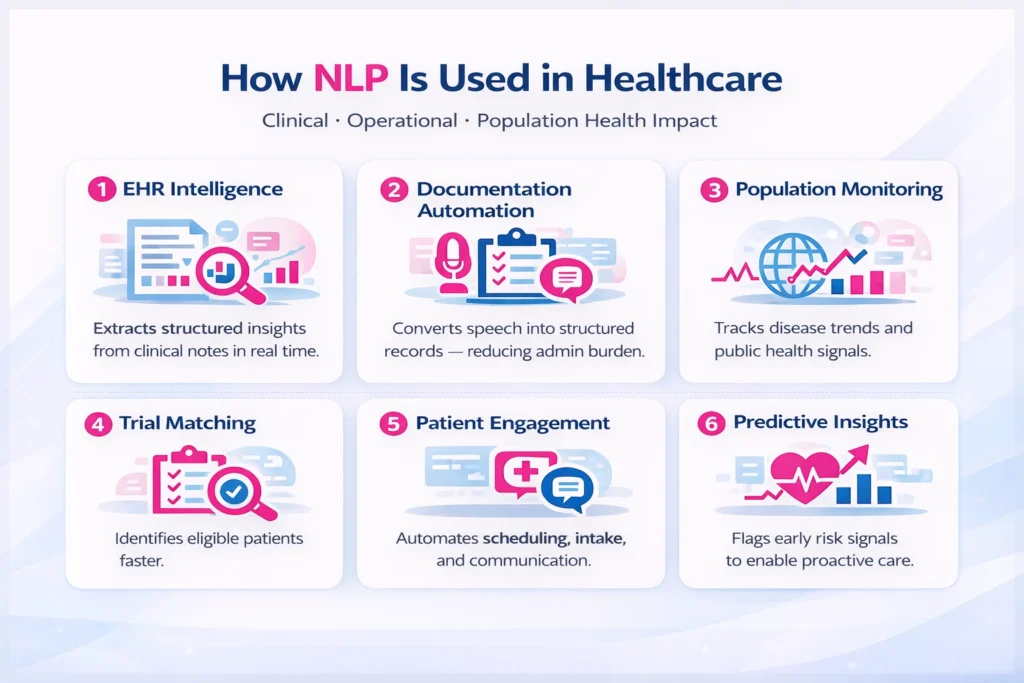
Understanding how NLP is used in healthcare is essential for any organization evaluating an AI investment. The answer isn’t a single use case, it’s a layered ecosystem of nlp healthcare capabilities spanning clinical, operational, and population health domains. Below are the six most impactful areas where NLP is delivering measurable results today.
1. Unlocking Electronic Health Records (EHRs)
One of the most immediate and impactful NLP applications in healthcare is in the analysis of Electronic Health Records. Physicians spend enormous amounts of time documenting patient encounters in clinical notes, but this free-text data is difficult for traditional computer systems to parse and use.
Healthcare NLP engines can scan these chart notes in seconds, extracting meaningful clinical details such as diagnoses, medication dosages, symptom descriptions, and risk factors. What once took medical coding teams weeks or months to manually review can now be processed in near real-time. This not only reduces administrative overhead but also uncovers previously missed or improperly coded patient conditions, a significant advantage for value-based care, risk adjustment, and RAG in healthcare that grounds AI-generated clinical responses in verified source data.
2. Clinical Documentation and Physician Burnout
EHR burnout is a well-documented crisis in medicine. Physicians routinely cite excessive documentation demands as a primary driver of career dissatisfaction and early retirement. Purpose-built NLP solutions for healthcare documentation are directly addressing this problem, and doing so at scale.
Speech-to-text NLP tools allow clinicians to dictate notes naturally, with AI converting spoken language into structured clinical documentation in real time. Natural Language Understanding (NLU) systems can then interpret the content of those notes, auto-populate relevant fields, and flag incomplete or inconsistent entries, dramatically reducing the time physicians spend on administrative tasks and giving them more time with patients. NLP equally underpins AI patient intake in healthcare operations, capturing structured patient data before the encounter begins.
3. Public Health Surveillance and Sentiment Analysis
Beyond the clinic, the applications of NLP in healthcare extend powerfully to the population level. Researchers and public health agencies are using NLP applications in healthcare surveillance to mine social media platforms and online forums for signals about public health trends, tracking the spread of disease, monitoring adverse drug reactions, and gauging public sentiment toward health policies and vaccines.
During the COVID-19 pandemic, for example, NLP tools were applied to social media posts to assess public attitudes toward vaccines and identify communities with high vaccine hesitancy. This real-time intelligence helped guide targeted public health communication campaigns. NLP is also being used to develop pandemic prediction models based on reported symptoms drawn from social media data, a capability that could provide critical early-warning signals for future outbreaks.
4. Clinical Trial Matching
Recruiting patients for clinical trials is notoriously slow and expensive. Identifying eligible candidates requires manually cross-referencing complex inclusion and exclusion criteria against individual patient records, a task that is both time-consuming and prone to human error.
NLP automates this process by scanning EHR data and research documentation simultaneously, matching eligible patients to relevant trials in a fraction of the time. This accelerates clinical research, helps patients gain access to cutting-edge treatments sooner, and reduces the operational costs of trial recruitment, the same language intelligence that powers autonomous AI agents for RCM across healthcare billing and revenue workflows.
5. Patient Communication and Chatbots
NLP healthcare tools are also powering a new generation of patient communication solutions. AI-driven chatbots and virtual assistants, built on healthcare NLP models, can answer patient questions around the clock, provide medication reminders, and collect pre-visit information, with AI chatbots for appointment scheduling and patient triage now handling front-end patient engagement at enterprise scale.
More importantly, advanced NLP systems can recognize context and nuance in patient conversations, making interactions feel natural rather than robotic. Multilingual NLP capabilities are also helping healthcare providers overcome language barriers, facilitating more equitable communication between providers and patients who speak different languages.
6. Risk Prediction and Diagnostic Support
NLP systems are increasingly being integrated into predictive analytics platforms. By continuously analyzing clinical documentation, lab results, and patient histories, these systems can identify patterns that signal elevated risk for conditions such as sepsis, readmission, or medication non-adherence, often before clinical teams would recognize them manually.
This predictive capability enables proactive interventions, potentially preventing adverse outcomes and reducing costs. It also informs personalized medicine approaches, where treatment plans are tailored to the specific profile of each patient rather than generalized protocols, with the same NLP intelligence extending into AI agents for medical billing and claims that automate coding, reduce denials, and accelerate reimbursements.
Real-World Impact: What the Research Shows
A 2024 narrative review published in Inquiry: A Journal of Medical Care Organization, Provision and Financing (University of Virginia School of Medicine) confirmed the broad and growing impact of NLP healthcare on clinical delivery. The review highlighted how NLP and deep learning technologies are extracting valuable insights from large unstructured datasets across the clinical spectrum, from medical record analysis and patient communication to public health advertising and social media sentiment monitoring.
The review also noted that as NLP solutions for healthcare are exposed to greater volumes of clinical documentation, their accuracy improves over time, meaning the technology becomes a better and more reliable partner the more it is used within a healthcare organization. For any health system asking how is NLP used in healthcare today, the evidence is clear: the technology is already delivering real value, and its impact will only compound with adoption.
Challenges and Limitations of NLP in Healthcare
Despite its promise, healthcare NLP is not without challenges. Honest assessment of these limitations is important for organizations evaluating NLP applications in healthcare for their own systems.
- Data quality and standardization remain significant obstacles. NLP systems are only as good as the data they learn from, and clinical documentation is often inconsistent, abbreviated, or laden with specialty-specific jargon that general-purpose models may not understand.
- Privacy and regulatory compliance are also critical concerns. Health data is among the most sensitive personal information in existence, and any NLP deployment must comply with HIPAA compliance for AI in healthcare standards governing how patient information is stored, processed, and shared, built into the architecture from day one, not retrofitted later.
- Bias in training data is another concern. If NLP models are trained primarily on data from specific populations, they may perform less accurately for underrepresented groups, potentially exacerbating existing healthcare disparities rather than reducing them.
Finally, clinician trust and adoption can be barriers. For NLP tools to deliver on their potential, healthcare providers must understand how the technology works and trust its outputs, which requires thoughtful implementation, training, and ongoing validation.
| Challenge | Impact on Healthcare | How NLP Solutions Address It |
| Data Quality & Standardization | Inconsistent, jargon-heavy clinical notes reduce model accuracy | Domain-specific NLP models trained on healthcare data improve over time with more clinical exposure |
| Privacy & Regulatory Compliance | Patient data handling must meet HIPAA standards | HIPAA-aligned NLP architectures with encryption, access controls, and audit logging built in from day one |
| Bias in Training Data | Models trained on narrow populations underperform for others | Diverse, representative training datasets and continuous model validation reduce disparity in accuracy |
| Clinician Trust & Adoption | Providers won’t use tools they don’t understand or trust | Transparent, explainable NLP outputs with phased rollout and clinical validation build confidence over time |
The Future of NLP in Healthcare
The future of NLP in healthcare is one of continued acceleration. Large Language Models (LLMs), the same foundational technology behind widely known AI tools, are being adapted for clinical environments, bringing new levels of language comprehension and generative capability to healthcare applications. As AI and NLP in healthcare converge with advances in multimodal models and real-time data processing, the possibilities for clinical impact will grow exponentially.
Looking ahead, the future of NLP in healthcare will be defined by its role in areas such as:
Global health equity: Multilingual NLP tools expanding access to quality healthcare information and communication across language barriers worldwide
Ready to Turn Clinical Language Into Actionable Intelligence?
We help healthcare organizations unlock unstructured EHR data, automate clinical documentation, and build NLP workflows that deliver real results in practice.
Conclusion: Partner with CaliberFocus to Put NLP to Work in Healthcare
AI and NLP in healthcare are no longer a future investment, they are a present-day operational imperative. Organizations that act now on how NLP is used in healthcare, from unlocking EHR data and reducing documentation burden to powering intelligent patient communication, will be the ones delivering faster, smarter, and more equitable care.
Turning that potential into clinical reality requires the right partner. CaliberFocus’s NLP & Voice AI services are purpose-built for exactly this challenge, offering a comprehensive suite of NLP solutions for healthcare that span the full language intelligence stack, all delivered through an AI-as-a-Service model that scales without the overhead of building internal teams.
From text analytics and clinical sentiment analysis that surface insights buried in unstructured records, to Named Entity Recognition systems that convert free-form clinical notes into structured, queryable data with up to 80% less manual effort, CaliberFocus brings proven nlp healthcare engineering to every layer of the care continuum. Their conversational AI and intelligent chatbots handle patient interactions 24/7 with full EHR integration, while speech recognition and Voice AI tools give clinicians a natural way to document encounters and reclaim time at the bedside. Every solution is designed for production readiness and HIPAA-aligned compliance from day one.
Discover how purpose-built healthcare NLP can transform your organization’s clinical and operational performance, backed by the top AI agent development companies in the USA building healthcare-grade NLP solutions.
Frequently Asked Questions
NLP in healthcare is the use of AI to read, interpret, and extract meaning from the unstructured clinical text, chart notes, discharge summaries, radiology reports, that makes up 80% of all health data. Healthcare NLP turns that locked, inaccessible language into structured, actionable insights for care teams and administrators.
How NLP is used in healthcare spans six core areas: EHR analysis, clinical documentation automation, public health surveillance, clinical trial matching, patient communication chatbots, and risk prediction. Each nlp healthcare application converts raw clinical language into structured intelligence that directly improves outcomes and reduces operational overhead.
The highest-value NLP applications in healthcare include clinical entity recognition, ambient documentation tools, AI-driven patient triage chatbots, and predictive risk analytics. These applications of NLP in healthcare reduce manual coding effort, cut documentation time, and give clinicians more time at the bedside.
NLP solutions for healthcare deliver up to 80% reduction in manual data capture, faster claims processing, improved diagnostic accuracy, and scalable patient communication, all without large internal AI teams. The right nlp healthcare platform turns previously untapped clinical text into a continuous source of operational and clinical value.
AI and NLP in healthcare are related but distinct, AI is the broad field encompassing machine learning, computer vision, and predictive analytics, while NLP is the specialized layer that handles human language. Together, ai and nlp in healthcare systems process unstructured clinical text, power conversational interfaces, and surface insights from EHRs and patient records.