

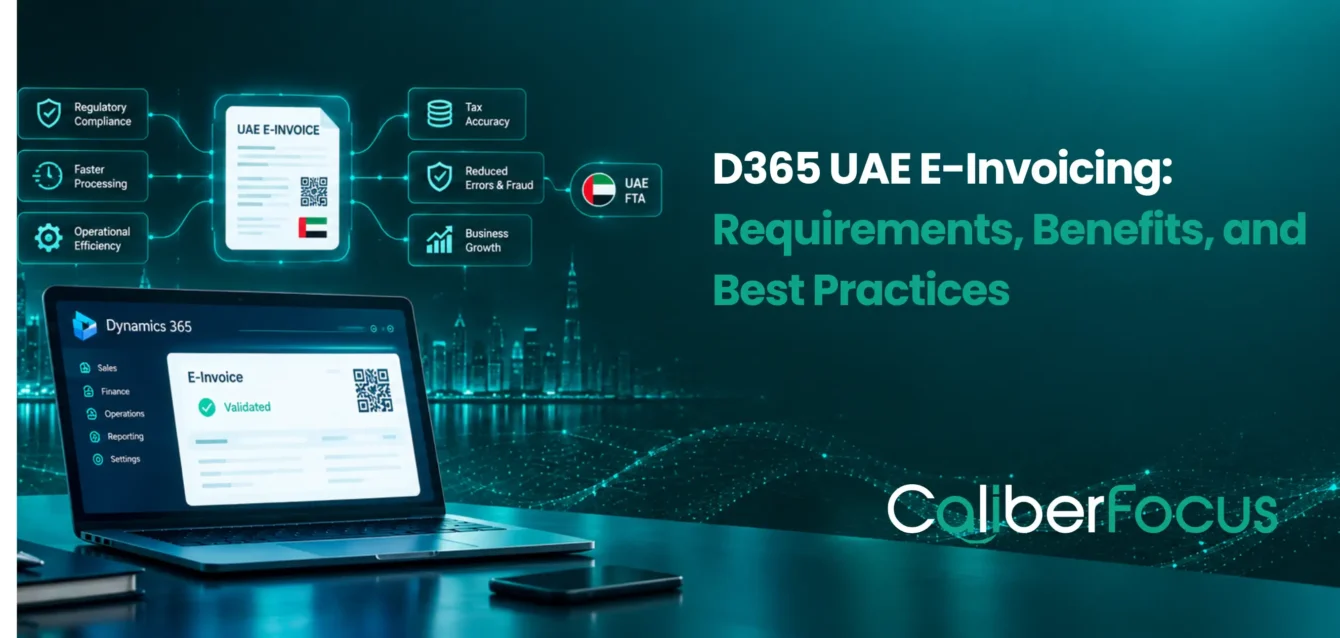
A Dynamics 365 invoice can be accurate inside the ERP and still be unprepared for UAE e-invoicing if required tax data, structured invoice fields, validation controls, or ASP connectivity are missing.
That is the practical challenge behind D365 UAE E-Invoicing. Businesses are not simply replacing emailed PDFs with another invoice format. They are moving toward structured electronic invoices in which transaction and tax data need to travel reliably from Dynamics 365 through the UAE e-invoicing framework.
The UAE Ministry of Finance defines an eInvoice as structured invoice data issued and exchanged electronically between a supplier and buyer and reported electronically to the Federal Tax Authority. PDFs, Word documents, scans, images, and emailed files are not considered eInvoices.
UAE E-Invoicing Timeline at a Glance
| Business category | ASP appointment deadline | Mandatory implementation |
| Annual revenue of AED 50 million or more | October 30, 2026 | January 1, 2027 |
| Annual revenue below AED 50 million | March 31, 2027 | July 1, 2027 |
| In-scope government entities | March 31, 2027 | October 1, 2027 |
The ASP appointment deadline for businesses at or above AED 50 million was extended to October 30, 2026. The January 1, 2027 mandatory implementation date remains unchanged.
The pilot and voluntary implementation phase began on July 1, 2026. Business-to-consumer transactions remain outside mandatory e-invoicing until a later date determined by the Minister.
D365 UAE E-Invoicing in Brief
- Dynamics 365: Maintains the underlying financial transaction and invoice data.
- PINT AE: Defines UAE-specific structured invoice requirements.
- Accredited Service Provider: Connects the business to the UAE e-invoicing ecosystem.
- Peppol: Provides the interoperability framework used for invoice exchange.
- FTA reporting: Required tax information is transmitted through the UAE e-invoicing framework.
Organizations moving from regulatory understanding into ERP implementation can review the broader Dynamics 365 UAE e-invoicing framework.
Prepare Dynamics 365 for UAE E-Invoicing
Bring invoice data, tax configuration, ASP integration, PINT AE requirements, and testing into one connected finance process.
What Is D365 UAE E-Invoicing and When Does It Become Mandatory?
D365 UAE e-invoicing connects invoice and financial data managed in Dynamics 365 with the UAE’s structured electronic invoicing requirements, with mandatory implementation beginning in phases from January 2027.
Dynamics 365 remains the ERP where transactions, customer information, tax details, invoice lines, credit notes, legal entities, and accounting records are managed. What changes is how that data leaves the ERP and enters the regulated electronic invoicing process.
When Do Businesses Need to Comply?
The UAE e-invoicing implementation timeline depends on annual revenue and entity type:
- Businesses with annual revenue of AED 50 million or more: appoint an Accredited Service Provider by October 30, 2026, with mandatory implementation from January 1, 2027.
- Businesses below AED 50 million: appoint an ASP by March 31, 2027, with mandatory implementation from July 1, 2027.
- In-scope government entities: appoint an ASP by March 31, 2027, with mandatory implementation from October 1, 2027.
For Dynamics 365 teams, these dates are more than compliance milestones. The available preparation window needs to cover ERP configuration, master-data validation, PINT AE mapping, ASP integration, invoice scenario testing, exception handling, and production readiness.
Having electronic invoicing functionality inside Dynamics 365 does not automatically make an environment compliant. Data, tax configuration, provider connectivity, ERP integration, and finance workflows need to operate together before the applicable mandatory date.
What Does Dynamics 365 Need for UAE E-Invoicing?
The core UAE e-invoicing requirements for Dynamics 365 cover structured invoice data, PINT AE alignment, accurate tax configuration, ASP connectivity, and reliable validation and exception handling.
Structured Invoice Data
Electronic invoices need machine-readable information rather than a document designed only for human review.
That includes seller and buyer identifiers, invoice dates, references, tax information, line-level data, amounts, payment information, and other mandatory elements required for electronic processing.
PINT AE Alignment
PINT AE is the UAE implementation of the Peppol International Invoice model.
For Dynamics 365 teams, the question is not simply whether an XML document can be produced. Customer, product, tax, legal-entity, and transaction data stored across D365 need to map correctly to the required PINT AE elements.
Accurate Tax and Registration Data
VAT registration information, TRNs where applicable, legal-entity details, addresses, tax categories, customer identifiers, supplier information, and invoice references need to remain consistent.
This is central to VAT compliance. An integration can transmit data accurately, but it cannot correct inaccurate source information on its own.
Validation and Exception Handling
The process also needs to account for:
- invoices missing mandatory fields or tax data
- invoices that fail PINT AE or business-rule validation
- transmission failures between D365 and the ASP
- invoices rejected during electronic exchange
- credit notes and corrections linked to earlier invoices
- status responses that need to return to Dynamics 365
- failed invoices requiring correction and resubmission
These exceptions should return to a manageable finance workflow instead of creating separate spreadsheet or email-based processes.
Which D365 Environments Need Different UAE E-Invoicing Approaches?
The compliance objective is common, but Dynamics 365 e-invoicing implementation differs across Finance, Business Central, and legacy Dynamics environments.
Dynamics 365 Finance
For Dynamics 365 Finance in the UAE, businesses need to assess available electronic invoicing capabilities together with tax configuration, legal entities, localization, integrations, and their selected ASP connection model.
Organizations reviewing the wider finance platform can align this work with their Dynamics 365 ERP services strategy so e-invoicing is part of the core enterprise architecture rather than a standalone compliance layer.
Dynamics 365 Business Central
Business Central provides an E-Document framework for electronic documents and supports connections to external e-invoicing services.
UAE compliance still needs to be validated against PINT AE, required transaction data, the chosen ASP, and country-specific configuration rather than assumed from generic Peppol support alone.
Businesses can review their existing Dynamics 365 Business Central integration architecture when planning external connectivity.
Dynamics AX and NAV
Legacy AX and NAV environments require a different assessment.
Teams need to determine whether required invoice fields exist, how heavily the ERP has been customized, whether modern integration options are available, and whether further customization remains practical.
Where these constraints become significant, Dynamics 365 migration services may need to form part of the e-invoicing roadmap.
DATA READINESS
What Data Needs to Be Ready in Dynamics 365?
UAE e-invoicing depends on the quality and completeness of the data already stored in Dynamics 365. Missing invoice, customer, tax, or legal-entity information can surface immediately during invoice validation and electronic exchange.
| Data area | What needs to be ready in Dynamics 365 | Why it matters for UAE e-invoicing |
| Legal entity data | Registered business name, identifiers, tax registration details, and business address | Identifies the correct issuing entity and supports regulatory reporting |
| Customer and supplier records | Registered names, addresses, tax identifiers, and registration information | Ensures invoice parties are correctly identified during invoice data exchange |
| VAT and tax configuration | TRN, VAT category, tax rate, exemptions, and applicable tax treatment | Supports accurate VAT compliance and reduces validation errors |
| Invoice header data | Invoice number, issue date, currency, invoice type, payment terms, and references | Provides the core fields required to identify and process the Dynamics 365 e-invoice |
| Invoice line data | Product or service, quantity, unit, price, taxable amount, and tax | Supports line-level PINT AE mapping and accurate invoice totals |
| Credit and debit notes | Original invoice reference, adjustment reason, amount, and tax treatment | Keeps corrections traceable to the original transaction |
| Cross-border data | Country codes, currencies, addresses, and applicable tax identifiers | Supports transactions involving entities outside the UAE |
| Multi-entity configuration | Legal entity, tax registration, numbering series, and transaction ownership | Prevents invoices from being reported under the wrong entity |
What Should Finance and IT Teams Check First?
Before integration begins, confirm whether Dynamics 365 can consistently produce:
- the correct legal entity and tax registration
- complete customer and supplier identification
- accurate VAT treatment at invoice and line level
- required invoice references and transaction information
- traceable credit and debit note information
- consistent data across multi-entity and cross-border transactions
The priority is not simply adding fields for compliance. Teams need to know which data already exists, where it is stored, whether it is reliable, and what needs remediation.
A UAE e-invoicing readiness assessment can identify D365, data, tax, and integration gaps before configuration begins.
How Does D365 UAE E-Invoicing Work?
The process begins with the business transaction in Dynamics 365 and continues through validation, ASP connectivity, electronic exchange, tax reporting, and returned status information.
Invoice Created in Dynamics 365
Customer, transaction, tax, pricing, product or service, and legal-entity information originate in the ERP.
Required Invoice Data Is Prepared
Relevant business and tax information is extracted and prepared according to the implementation architecture.
Data Moves to the Accredited Service Provider
The ASP validates the data and, depending on the agreed architecture, can transform it into the UAE-required structured format.
Invoice Moves Through Peppol
The supplier’s ASP exchanges the structured invoice with the buyer’s provider through the Peppol network.
Buyer Receives the Electronic Invoice
The buyer’s ASP validates and delivers the invoice into the receiving organization’s business process.
Required Tax Data Is Reported
Applicable tax invoice information is transmitted to the FTA through the UAE e-invoicing framework.
Status and Exceptions Return to the Finance Workflow
Validation results, processing statuses, errors, and exceptions can return to the connected finance process for review and action.
Dynamics 365 does not necessarily need to perform every transformation itself. The responsibilities of D365 and the ASP should be defined early so the business avoids unnecessary ERP customization.
What Business Benefits Can D365 UAE E-Invoicing Create?
When Dynamics 365 e-invoicing is integrated correctly, regulatory compliance can also remove manual breaks across invoice processing.
Fewer Manual Invoice Handoffs
Structured invoice data can move directly from Dynamics 365 into electronic processing rather than relying on PDF creation, email delivery, and repeated data entry.
Business impact: Less administrative effort and more consistent invoice automation.
Earlier Detection of Invoice Errors
Invoice validation can identify missing tax information, incomplete fields, and incorrect transaction data before the invoice reaches an external provider or buyer.
Business impact: Fewer rejections, corrections, and processing delays.
Better Visibility Into Invoice Status
Validation outcomes, transmission failures, acknowledgements, and rejected invoices can return to the connected finance process.
Business impact: Faster exception handling and less dependence on manual follow-up.
Stronger Traceability and Reconciliation
Structured invoice data exchange creates a clearer link between the original D365 transaction, electronic invoice, returned status, and subsequent adjustments.
Business impact: Better control, easier reconciliation, stronger audit readiness, and improved VAT compliance.
Less Dependence on PDFs and Offline Tracking
A connected process reduces the need to manage invoice delivery and exceptions across email, spreadsheets, and disconnected tools.
Business impact: A more standardized and scalable finance workflow.
In practice, the value comes from connecting the full process:
Dynamics 365 → Validation → Electronic Exchange → Status Handling → Reconciliation
The outcome still depends on integration quality. Moving an existing manual process into another interface does not create end-to-end automation.
Turn Compliance Into a Connected Finance Process
Identify where invoice creation, validation, ASP exchange, and exception handling currently break away from Dynamics 365.
What Is the Role of an Accredited Service Provider and Peppol in UAE E-Invoicing?
The Accredited Service Provider provides the regulated service connection, while Peppol provides the interoperable framework that supports electronic invoice exchange.
Their roles are related but different.
Dynamics 365 manages the underlying transaction and source invoice information.
The Accredited Service Provider connects the organization to the UAE e-invoicing framework, supporting validation, electronic exchange, applicable data transformation, and reporting responsibilities.
Peppol provides the standardized interoperability framework through which participating providers exchange electronic invoices.
What to Evaluate When Selecting an ASP
Look beyond basic Peppol connectivity. The provider needs to fit your Dynamics 365 environment and operational requirements.
- Dynamics 365 integration: Confirm supported APIs, connectors, and data exchange methods.
- PINT AE support: Verify validation against current UAE e-invoicing requirements.
- Error handling: Check how failed or rejected invoices return for correction.
- Testing environment: Ensure real transaction scenarios can be tested before go-live.
- Multi-entity support: Confirm support for multiple legal entities and tax registrations.
- Security and controls: Review access, audit trails, data protection, and monitoring.
- Scalability: Ensure the service can support current and future invoice volumes.
- Ongoing support: Assess regulatory updates and post-go-live technical support.
- MoF accreditation: Confirm that the provider remains an accredited ASP.
For groups operating beyond the UAE, the Dynamics 365 GCC e-invoicing readiness guide provides broader context because country-specific mandates should not be treated as one common GCC specification.
7 Best Practices for D365 UAE E-Invoicing Implementation
A reliable UAE e-invoicing implementation depends on decisions made before the first production invoice enters electronic exchange.
1. Assess the Existing D365 Environment
Document the deployed product and version, legal entities, tax setup, invoice types, integrations, customizations, and transaction volumes.
2. Resolve Data Gaps Before Integration Testing
Correct missing tax identifiers, customer information, addresses, invoice references, and other source-data issues before end-to-end testing.
3. Map Required PINT AE Data Early
Establish how D365 data maps to required invoice elements before development progresses too far. Early mapping exposes missing source information before final validation.
4. Define the ASP Architecture Before Customizing D365
Agree on what Dynamics 365 will generate and what the ASP will transform, validate, transmit, report, and return.
The objective is to configure what is required rather than customize the ERP simply because the integration architecture is unclear.
5. Test Real Transaction Scenarios
Testing should reflect actual business activity, including invoices, credit notes, debit notes, VAT scenarios, currencies, multi-entity transactions, and intercompany processes where applicable.
6. Design Exception Handling Alongside Successful Processing
Establish how finance teams identify validation failures, rejected invoices, transmission errors, corrections, and resubmissions.
A successful API test alone does not prove that the operational process is production-ready.
7. Plan Beyond Go-Live
The UAE e-invoicing framework, PINT AE specifications, ASP capabilities, and Microsoft functionality can evolve.
Define ownership for monitoring, configuration updates, testing, data validation, and regulatory changes.
These controls should form part of wider Dynamics 365 implementation best practices, particularly where ERP integration and finance processes are business-critical.
What Determines D365 UAE E-Invoicing Implementation Effort?
Implementation effort depends more on the condition and complexity of the existing Dynamics 365 environment than on the mandate alone.
| Lower-complexity environment | Higher-complexity environment |
| Current D365 platform | Legacy or heavily customized environment |
| Few UAE legal entities | Multiple legal entities |
| Reliable master data | Significant data remediation |
| Standard invoice processes | Customized transaction scenarios |
| Established ERP integration | New or fragmented integrations |
| Limited cross-border complexity | Multi-country GCC environment |
Transaction volume, ASP architecture, tax complexity, invoice automation requirements, testing scope, and existing customizations further influence the level of implementation effort.
For enterprises using one ERP across several GCC jurisdictions, GCC e-invoicing services can help coordinate the architecture without treating different national mandates as interchangeable.
How CaliberFocus Supports D365 UAE E-Invoicing
CaliberFocus helps enterprises connect UAE e-invoicing requirements with the Dynamics 365 finance environment they already operate.
The approach brings together D365 configuration, invoice and tax data, PINT AE requirements, ASP connectivity, ERP integration, testing, exception management, and production readiness.
The focus is on keeping tax compliance and electronic invoice processing within the normal finance workflow while minimizing unnecessary ERP customization.
Key Takeaways for D365 UAE E-Invoicing
UAE e-invoicing readiness depends on ERP data, regulatory configuration, external connectivity, and finance operations working as one process.
Frequently Asked Questions
D365 UAE e-invoicing is the process of connecting invoice and transaction data managed in Microsoft Dynamics 365 with the UAE’s structured electronic invoicing framework. It involves required invoice data, PINT AE alignment, an Accredited Service Provider, Peppol exchange, applicable FTA reporting, validation, and operational exception handling.
No. The UAE Ministry of Finance states that PDFs, Word documents, images, scanned copies, and emailed invoice files are not eInvoices. An eInvoice must contain structured invoice data that can be exchanged electronically between businesses and reported through the UAE e-invoicing framework.
No. Dynamics 365 provides relevant ERP and electronic invoicing capabilities, but compliance also depends on the deployed functionality, source data, tax configuration, PINT AE requirements, selected ASP, integration design, testing, and operational processes. Those components need to be validated together before production.
PINT AE is the UAE-specific implementation of the Peppol International Invoice model. It defines how electronic invoice and credit-note data should be structured for the UAE environment. D365 implementations therefore need to map applicable ERP data to the required PINT AE elements.
Peppol provides the interoperability framework used to exchange structured electronic invoices between participating service providers. The business connects through an Accredited Service Provider, while the ASP uses the applicable Peppol framework and UAE specifications to support electronic invoice exchange.
An Accredited Service Provider connects a business to the UAE e-invoicing ecosystem. Depending on the agreed architecture, the ASP can support invoice-data validation, structured-format conversion, Peppol exchange, required tax-data reporting, status responses, and other processes defined by the UAE framework.
Business Central provides the E-Document framework and supports external e-invoicing connectors, including Peppol options. UAE implementation still needs to be validated against the relevant localization, PINT AE requirements, ASP capabilities, required source data, and the architecture used by the business.
Get Dynamics 365 Ready for UAE E-Invoicing
CaliberFocus helps enterprises connect Dynamics 365 configuration, invoice data, PINT AE requirements, ASP integration, testing, and exception management into a production-ready e-invoicing process.

More on D365 E-Invoicing
Explore related resources on Dynamics 365 e-invoicing integration, ZATCA readiness, and FATOORA implementation.
Dynamics 365 E-Invoicing Integration
Understand how Dynamics 365 supports invoice data, validation, external exchange, and reconciliation.
Read More →ZATCA Readiness Assessment in Dynamics 365
Review the key areas involved in preparing Dynamics 365 for ZATCA e-invoicing requirements.
Read More →FATOORA Integration with Dynamics 365 Finance & Operations
Learn how FATOORA integration fits into Dynamics 365 Finance & Operations e-invoicing workflows.
Read More →