

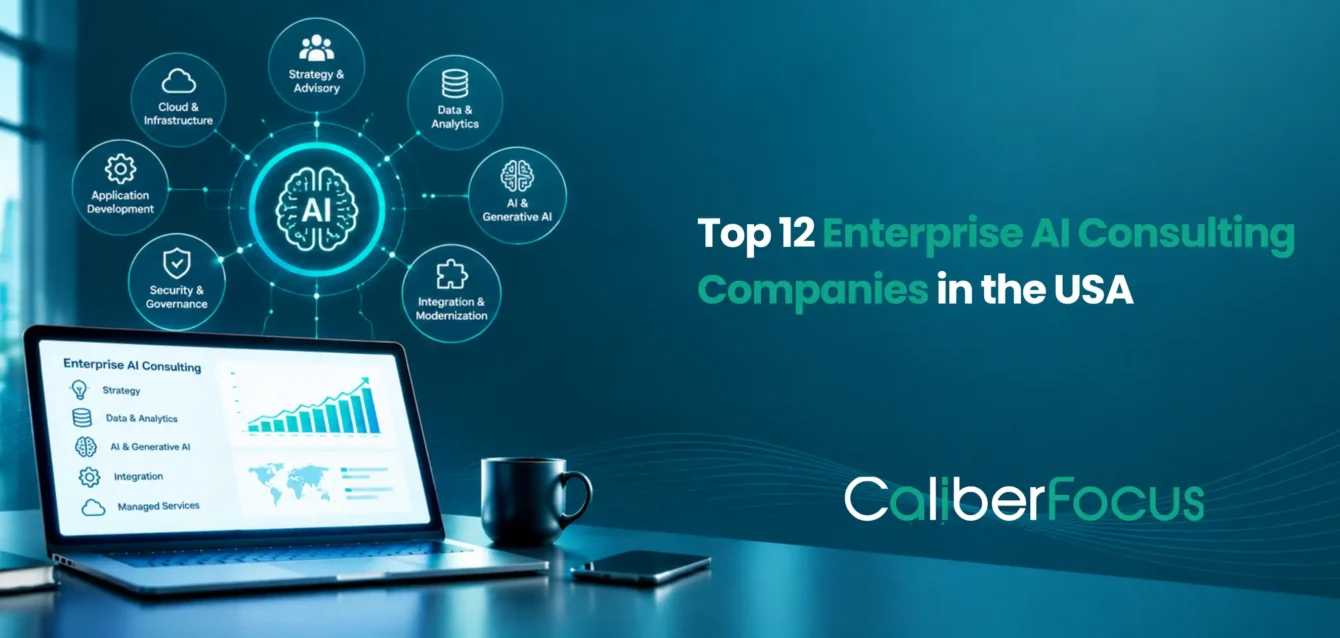
Enterprise AI is becoming a strategic priority for organizations looking to improve how decisions are made, workflows operate, knowledge is accessed, and teams work across business functions. Turning those opportunities into enterprise capabilities requires clear decisions about where AI can create meaningful value, which initiatives deserve investment, and what is required to implement and scale them successfully.
This is where enterprise AI strategy and consulting plays a central role. A consulting partner can help connect business priorities with use-case selection, AI readiness, data and architecture decisions, governance, implementation planning, adoption, and measurable outcomes.
Choosing an enterprise AI consulting company therefore goes beyond comparing technical capabilities. Enterprises need to understand how each firm supports the journey from business priorities → AI strategy → readiness → implementation → governance → scale, what the engagement will actually deliver, and where responsibility sits between the consulting partner and internal teams.
This guide compares 12 enterprise AI consulting companies with a focus on the strategy, implementation, engineering, integration, governance, and operating capabilities that matter when selecting a partner for enterprise AI initiatives.
Capabilities are based on publicly available company information reviewed in 2026. Enterprises should validate current service scope, delivery location, industry experience, implementation responsibility, and engagement requirements directly with each provider.
How We Evaluated These Enterprise AI Consulting Companies
Enterprise AI consulting requires more than access to AI developers or a broad technology portfolio. The comparison should consider whether a provider can help an organization make the decisions between identifying an AI opportunity and operating it successfully within an enterprise environment.
The companies in this list were considered across the following areas.
Enterprise AI Strategy
Can the consulting firm connect AI opportunities with business priorities, prioritize viable use cases, establish an implementation direction, and define how value will be measured?
This is where AI strategy and consulting differs from commissioning a predefined AI application. The engagement may need to establish what the enterprise should pursue, which initiatives deserve investment, what capabilities need to be ready, and how those decisions translate into an executable roadmap.
Data and AI Readiness
Enterprise AI depends on the condition of the underlying data, systems, infrastructure, integrations, governance, skills, and operational processes.
A consulting company should be able to determine whether these foundations can support the proposed use cases and identify dependencies that need to be addressed before implementation.
AI Capability Breadth
The appropriate technology depends on the business requirement.
An enterprise may need predictive machine learning for forecasting, GenAI for document-heavy workflows, RAG for enterprise knowledge, computer vision for visual operations, or AI agents for work spanning multiple systems.
The evaluation therefore considers whether the provider can select and apply appropriate AI approaches rather than treating one technology as the answer to every business requirement.
AI Engineering and Implementation
Strategy establishes direction. Implementation determines whether that direction can become a working enterprise capability.
Relevant capabilities include solution architecture, model and application development, data pipelines, evaluation, testing, deployment, integration, and production engineering.
Enterprise Integration
AI often needs to operate alongside ERP, CRM, data platforms, cloud infrastructure, enterprise applications, APIs, knowledge repositories, identity systems, and operational platforms.
Integration capability therefore matters when AI is expected to become part of an existing workflow rather than operate as an isolated application.
Governance and Production Readiness
Production AI introduces decisions around security, data access, model behavior, monitoring, human oversight, auditability, risk, and operational ownership.
The evaluation considers whether providers can address these requirements as part of implementation rather than treating governance as a separate activity.
Adoption and Operating Model
Enterprise AI can change how work is performed, reviewed, approved, and owned.
A consulting partner may therefore need to help establish responsibilities across business teams, technology teams, AI teams, governance functions, and end users. Adoption, workflow redesign, training, and knowledge transfer can become as important as the underlying technology.
Enterprise Delivery Evidence
Capabilities listed on a services page are only one part of provider evaluation.
Enterprises should also examine relevant case studies, implementation evidence, industry experience, production delivery, technical depth, and examples that resemble the proposed engagement. Evidence from a narrow AI prototype should not automatically be treated as evidence of enterprise-scale integration or production operations.
12 Enterprise AI Consulting Companies to Consider
1. CaliberFocus

Enterprise AI focus: Connecting AI strategy with data, engineering, enterprise applications, governance, and implementation.
What they cover: CaliberFocus works across AI and Generative AI, AI agents, data and analytics, application engineering, and enterprise applications. Its consulting approach connects use-case prioritization and readiness with the technical and operational requirements needed to move AI initiatives toward production.
Relevant capabilities:
- AI strategy and use-case prioritization
- AI readiness assessment
- Machine learning and predictive AI
- Generative AI and LLM solutions
- RAG
- AI agent development
- AI engineering
- MLOps and LLMOps
- AI governance
- Enterprise application and workflow integration
Enterprise fit: Relevant for organizations evaluating AI as part of broader business operations and technology environments across industries including healthcare and life sciences, manufacturing, banking and finance, retail and ecommerce, logistics and supply chain, energy and utilities, media and entertainment, travel and hospitality, and education.
2. LeewayHertz

Enterprise AI focus: AI consulting combined with custom AI development and enterprise integration.
What they cover: LeewayHertz supports AI strategy, opportunity mapping, readiness assessment, business-process evaluation, technical design, development, data engineering, integration, deployment, and ongoing optimization.
Relevant capabilities:
- AI strategy and roadmap development
- AI readiness assessment
- Machine learning and predictive analytics
- Generative AI
- AI agents
- NLP
- Computer vision
- Data engineering
- Enterprise integration
- AI deployment and optimization
Enterprise fit: Relevant for organizations looking for a provider that can participate in both advisory and technical delivery rather than separating strategy from implementation.
3. Fractal

Enterprise AI focus: Enterprise AI transformation supported by data, engineering, decision intelligence, and workforce adoption.
What they cover: Fractal positions its enterprise AI work around AI-led transformation, AI foundations, and AI-enabled work. Its approach connects data and analytics with agentic systems, evaluation, governance, workflow redesign, and adoption.
Relevant capabilities:
- Enterprise AI transformation
- Data and analytics
- Decision intelligence
- Agentic AI
- AI foundations
- AI engineering
- Evaluation and monitoring
- AI governance
- Workflow redesign
- Workforce adoption
Enterprise fit: Relevant for enterprises where AI strategy is closely tied to analytics, decision-making, data foundations, operating-model change, and enterprise-scale adoption.
4. Slalom

Enterprise AI focus: Connecting AI strategy with business transformation, technology, data, workflows, governance, and organizational change.
What they cover: Slalom’s AI work spans strategy, technology and data, process and experience, governance, security, workforce considerations, and AI-enabled workflows.
Relevant capabilities:
- AI strategy
- Data and technology consulting
- Generative AI
- Agentic AI
- Workflow redesign
- Governance
- Trust and security
- Workforce enablement
- AI operations
- Enterprise implementation
Enterprise fit: Relevant for organizations where AI initiatives affect both the technology landscape and how employees, teams, and business processes operate.
5. West Monroe
Enterprise AI focus: Enterprise AI strategy combined with operational transformation and implementation.
What they cover: West Monroe brings AI strategy and implementation together across agentic transformation, workforce enablement, AI-native software engineering, governance, data, and workflow redesign.
Relevant capabilities:
- Enterprise AI strategy
- AI transformation
- Agentic AI
- Predictive AI
- AI-native engineering
- Data and analytics
- Governance
- Workflow redesign
- Workforce enablement
- Enterprise implementation
Enterprise fit: Relevant for enterprises evaluating AI as part of a broader operational or technology transformation where workflow, adoption, governance, and implementation need to be considered together.
6. RTS Labs

Enterprise AI focus: Applied AI consulting that connects defined business requirements with production implementation.
What they cover: RTS Labs supports AI opportunity identification, feasibility and ROI assessment, data preparation, AI solution development, system integration, monitoring, and optimization.
Relevant capabilities:
- AI strategy
- AI opportunity assessment
- Feasibility and ROI analysis
- Data engineering
- Machine learning
- RAG
- AI automation
- System integration
- Deployment
- Monitoring and optimization
Enterprise fit: Relevant for organizations that need advisory support combined with hands-on technical implementation and production-focused delivery.
7. Perceptive Analytics

Enterprise AI focus: AI implementation for mid-market organizations moving from opportunity identification or prototypes toward production.
What they cover: Perceptive Analytics supports use-case identification, AI strategy, data readiness, architecture, development, integration, deployment, monitoring, and internal team enablement.
Relevant capabilities:
- AI strategy
- Use-case prioritization
- Generative AI
- Machine learning
- Data readiness
- AI architecture
- Enterprise integration
- Deployment
- Monitoring
- Team enablement
Enterprise fit: Relevant for organizations at different maturity stages, from early use-case definition to production hardening and integration of existing AI prototypes.
8. Intuz

Enterprise AI focus: AI strategy and advisory connected with custom AI engineering.
What they cover: Intuz supports data-readiness assessment, use-case prioritization, model selection, roadmap development, custom AI engineering, integration, governance, and production operations.
Relevant capabilities:
- AI strategy and advisory
- AI readiness
- Generative AI
- AI agents
- Predictive AI
- Computer vision
- Enterprise integration
- AI governance
- MLOps
- Custom AI engineering
Enterprise fit: Relevant for enterprises that want to connect early-stage AI planning with custom technical implementation within the same engagement.
9. Addepto

Enterprise AI focus: AI and data consulting spanning discovery, engineering, and deployment.
What they cover: Addepto combines AI consulting with data engineering, machine learning, generative AI, analytics, computer vision, and production deployment.
Relevant capabilities:
- AI strategy
- Machine learning
- Generative AI
- Computer vision
- Data engineering
- Advanced analytics
- MLOps
- AI architecture
- Enterprise integration
- Production deployment
Enterprise fit: Relevant where AI success depends heavily on the underlying data foundation, engineering environment, and production deployment requirements.
10. Azati
Enterprise AI focus: AI transformation combining readiness, engineering, integration, and production operations.
What they cover: Azati supports AI opportunity identification, data and infrastructure readiness, implementation planning, AI engineering, integration, and ongoing production operations.
Relevant capabilities:
- AI strategy
- AI readiness
- Data engineering
- Generative AI
- RAG
- Enterprise integration
- AI architecture
- Deployment
- Monitoring
- Production AI operations
Enterprise fit: Relevant for organizations that need to connect initial assessment and planning with hands-on implementation and ongoing operation.
11. ThirdEye Data

Enterprise AI focus: AI strategy combined with data science and AI implementation.
What they cover: ThirdEye Data supports AI strategy, technology selection, proof-of-concept development, model development, testing, enterprise integration, and broader AI engineering.
Relevant capabilities:
- AI strategy
- Technology selection
- Machine learning
- Generative AI
- AI agents
- Computer vision
- RAG
- Predictive analytics
- Data engineering
- Enterprise integration
Enterprise fit: Relevant where the business requirement is known but the organization still needs to determine the most suitable AI architecture and implementation approach.
12. Markovate

Enterprise AI focus: AI opportunity identification, feasibility, strategic planning, and custom development.
What they cover: Markovate combines early-stage AI consulting with proof-of-concept development, custom engineering, agentic AI, and enterprise integration.
Relevant capabilities:
- AI opportunity identification
- Feasibility assessment
- AI strategy
- Proof-of-concept development
- Generative AI
- AI agents
- Process mapping
- Agent architecture
- Enterprise integration
- Custom AI development
Enterprise fit: Relevant for organizations looking to move from AI opportunity assessment and feasibility into custom solution development without separating consulting from engineering.
What Should Enterprise AI Consulting Cover?
The scope of enterprise AI consulting depends on what the organization already has internally and what decisions have already been made.
An organization still evaluating its AI portfolio may require strategy, use-case prioritization, readiness assessment, and business-case development. Another may already know what it wants to implement but need architecture, AI engineering, integration, governance, or production support.
A broader enterprise engagement can span:
Business priorities → AI use cases → Readiness → Architecture → Implementation → Integration → Governance → Adoption → Measurement → Scale
Each stage introduces dependencies. Data availability can affect feasibility. Existing applications can shape architecture. Governance requirements can change how an AI workflow is designed. Internal skills and ownership can influence the appropriate delivery model.
These AI implementation challenges become particularly important when an organization is determining what support it needs from an external consulting partner.
The key question is therefore not whether a provider offers “end-to-end AI.” It is which parts of this lifecycle the provider will actually own and what the enterprise will receive from the engagement.
What Should an Enterprise AI Consulting Engagement Deliver?
AI consulting deliverables should reflect the decisions the enterprise needs to make and the stage of the initiative.
Depending on the scope, an engagement may produce:
| Deliverable | Decision It Supports |
| Prioritized AI use-case portfolio | Where should the enterprise invest first? |
| AI readiness and gap assessment | What needs to be ready before implementation? |
| Business case and value model | Why should the initiative receive investment? |
| Target AI architecture | How should the capability fit into the enterprise technology environment? |
| Data and integration requirements | What systems, data, APIs, and dependencies are involved? |
| Build, buy, or partner recommendation | What should be developed internally, purchased, or delivered externally? |
| Governance requirements | What controls, approvals, oversight, and risk processes are needed? |
| AI operating model | Who owns AI decisions, delivery, monitoring, and business outcomes? |
| Implementation roadmap | What should happen, in what sequence, and with what dependencies? |
| Pilot or production plan | How will the selected use case be validated and operationalized? |
| Success and scale criteria | What evidence will justify expansion? |
Current enterprise AI consulting offerings increasingly distinguish advisory deliverables such as roadmaps, assessments, architecture, governance frameworks, and build-versus-buy recommendations from implementation deliverables such as deployed systems, integrations, monitoring, and production infrastructure.
A provider should therefore be evaluated not only on what it can discuss, but on what the enterprise will own at the end of the engagement.
Which AI Consulting Engagement Model Fits the Requirement?
Not every enterprise needs the same consulting model.
The appropriate engagement depends on how clearly the problem is defined, what capabilities already exist internally, and how much delivery responsibility the organization wants the consulting partner to assume.
| Enterprise Requirement | Engagement Model to Consider |
| Determine where AI should create value | AI strategy and advisory |
| Assess data, technology, governance, and organizational readiness | AI readiness assessment |
| Validate a defined AI opportunity | Discovery, PoC, or proof of value |
| Build and integrate a selected solution | AI implementation |
| Move an existing pilot into production | AI engineering and productionization |
| Establish enterprise-wide ownership and controls | AI governance and operating model |
| Operate and improve production AI | Managed AI, MLOps, or LLMOps |
| Build internal capability while delivering | Co-delivery or capability-transfer model |
The distinction matters during provider selection. A strategy-led consultancy may be appropriate when leadership is still determining priorities and investment direction. An engineering-heavy partner may be more suitable when the use case and architecture are already defined. A co-delivery model may fit enterprises that want external expertise while building internal capability.
Current market offerings increasingly separate strategy, implementation, and managed AI or ongoing operations rather than treating “AI consulting” as a single engagement type.
Enterprise AI Consulting vs Specialized AI Consulting
An enterprise does not always need a broad AI consultancy. If the business requirement and technical direction are already established, a specialist provider may offer deeper capability in the technology being implemented.
| Enterprise Requirement | Provider Type to Evaluate |
| Coordinate AI investment across business functions | Enterprise AI consulting company |
| Develop predictive models and ML systems | Machine learning specialist |
| Build GenAI and LLM applications | Generative AI specialist |
| Ground LLM applications in enterprise knowledge | RAG specialist |
| Build multi-step AI-driven workflows | AI agent specialist |
| Analyze images and video within operations | Computer vision specialist |
For a clearly defined predictive modeling requirement, enterprises can evaluate machine learning development companies around modeling, data engineering, deployment, and production capabilities rather than requiring a broader AI transformation engagement.
When the requirement centers on LLM-powered applications, the evaluation shifts toward model selection, enterprise context, application architecture, evaluation, security, integration, and production deployment. Comparing generative AI development companies in the USA can therefore be more useful than evaluating broad consultancies when the GenAI requirement is already defined.
When AI needs to perform defined actions across applications and decision points, AI agent development companies become a more relevant comparison set. Evaluation then shifts toward orchestration, system integration, permissions, human oversight, and production reliability.
Knowledge-intensive applications create another specialist requirement. Enterprises evaluating RAG development companies should look closely at retrieval architecture, source quality, permissions, evaluation, grounding, and enterprise knowledge integration.
The provider category should follow the problem being solved rather than the popularity of a particular AI technology.
Specialist AI Consultancy vs Large Global Consulting Firm
Company size alone does not determine whether a consultancy fits an enterprise AI initiative.
Large consulting organizations can provide extensive geographic coverage, multidisciplinary teams, transformation experience, and support across large technology and organizational programs.
Specialist and mid-sized AI consulting firms can offer a different engagement model, particularly when the initiative requires focused AI expertise and direct involvement in implementation.
| Consideration | Specialist or Mid-Sized AI Consultancy | Large Global Consultancy |
| Engagement scope | Often centered on defined AI or data requirements | Can support broad enterprise transformation programs |
| Team structure | Often smaller specialist delivery teams | Larger multidisciplinary teams |
| Engineering involvement | May be closely connected to consulting | Varies by practice and engagement |
| Geographic scale | Varies by provider | Typically extensive |
| Organizational transformation | Depends on provider | Often a significant capability |
| Engagement model | Can suit focused strategy and implementation programs | Often structured for larger transformation programs |
The practical evaluation is whether the provider has the strategy, technical depth, industry context, integration capability, governance experience, delivery capacity, and engagement model required by the initiative.
How to Choose an Enterprise AI Consulting Company
Start With the Business Requirement
Define what the organization expects AI to change before comparing consulting firms.
Is the objective to improve forecasting? Reduce manual processing? Make enterprise knowledge easier to use? Introduce intelligence into customer interactions? Coordinate work across systems? Improve a product or service?
For organizations considering LLM-based applications, enterprise generative AI requires decisions around enterprise context, architecture, integration, governance, and workflow design in addition to model selection.
A defined business requirement makes it easier to determine what type of external expertise is actually required.
Decide Whether to Build, Buy, Partner, or Combine Approaches
Selecting a consulting company is not always the first technology decision.
An enterprise may be able to address the requirement through an existing AI product, build the capability internally, engage an external consulting and engineering partner, or combine these approaches.
The decision affects:
- Time to implementation
- Internal skills required
- Customization
- Integration requirements
- Intellectual property and ownership
- Technology dependencies
- Ongoing operating responsibility
- Total cost over the lifecycle
Build-versus-buy analysis is increasingly included in enterprise AI advisory engagements because model, platform, architecture, and ownership choices can materially affect the implementation that follows.
The consulting partner should be able to explain the trade-offs rather than automatically steering every requirement toward custom development.
Assess Enterprise AI Readiness
Partner selection is partly determined by what the enterprise already has.
An organization with mature data platforms, internal AI engineering, established governance, and a defined use case may require specialized implementation support. Another may need to establish the foundation before development begins.
An AI readiness assessment can identify dependencies across data, architecture, integrations, governance, skills, infrastructure, and organizational capabilities before they become implementation constraints.
Determine Where Consulting Ends and Engineering Begins
Ask precisely what the provider will own.
Will the engagement end with recommendations and a roadmap? Will the consultancy design the architecture? Build the application? Prepare data pipelines? Integrate enterprise systems? Deploy the solution? Establish monitoring?
For initiatives requiring the partner to take responsibility beyond advisory work, AI engineering becomes an important evaluation criterion.
Two firms can both offer AI consulting services while delivering fundamentally different outcomes.
Examine Enterprise Integration Capability
A production AI system rarely operates in isolation.
The provider may need to work with enterprise data platforms, APIs, ERP, CRM, document repositories, cloud infrastructure, identity systems, operational applications, or existing automation.
Architecture discussions should therefore cover how AI will interact with systems where work already occurs, what information needs to move between them, what actions the AI system can perform, and how existing security and access controls will apply.
Evaluate Technology and Vendor Fit
AI technology consulting should help the enterprise make informed architecture choices, not simply map every requirement to a preferred model, cloud, or platform.
Ask how the provider evaluates:
- Commercial vs open-source models
- Existing enterprise AI platforms vs custom development
- Cloud and infrastructure options
- Model portability
- Data residency and security requirements
- Integration with the existing technology landscape
- Licensing and consumption dependencies
- Long-term operating requirements
Vendor-neutrality is explicitly positioned by some enterprise AI consultancies as a way to align architecture and platform recommendations with the organization’s requirements rather than a predetermined technology ecosystem.
For enterprises, the important point is transparency: understand why a particular architecture, model, or platform is being recommended and what dependencies that choice creates.
Evaluate Governance Before Production
Governance needs to reflect what the AI system will do, what information it can access, and the consequences of its outputs or actions.
Enterprises may need to establish responsibilities around data access, security, model evaluation, human oversight, explainability, monitoring, risk, auditability, and escalation.
Where these responsibilities are not established internally, AI governance and responsible AI may need to form part of the consulting and implementation scope.
Evaluate Adoption and Workflow Change
Enterprise AI implementation can alter how work moves between people and systems.
Ask whether the provider evaluates:
- Existing workflow and decision points
- Roles affected by the new capability
- Human review and approval requirements
- User training
- Process redesign
- Adoption measurement
- Business ownership after implementation
Enterprise providers increasingly position workforce adoption, workflow redesign, training, and operating-model changes alongside architecture and implementation because AI value depends on how the capability is used within actual business operations.
Establish How Business Value Will Be Measured
Technical performance is only one part of the investment decision.
Depending on the use case, the relevant measure could include:
- Cycle time
- Throughput
- Manual effort
- Forecast accuracy
- Service performance
- Revenue contribution
- Operating cost
- Risk exposure
- Capacity
- Adoption
- Customer or employee experience
The consulting partner should connect implementation decisions with the outcome the enterprise expects to improve and establish the evidence leadership will use when deciding whether an initiative should expand.
Assess Knowledge Transfer and Internal Ownership
Ownership should be established before implementation is complete.
Clarify who will own:
- Architecture
- Models
- Prompts
- Data pipelines
- Integrations
- Infrastructure
- Evaluation frameworks
- Monitoring
- Documentation
- Future enhancements
Then determine how that ownership will be transferred.
The engagement may need to include architecture documentation, technical handover, operational procedures, training, model or prompt management guidance, and support for internal teams taking responsibility for the solution.
The objective is not simply to know what the enterprise owns. It is to understand whether internal teams will be equipped to operate and extend what has been implemented.
How Enterprise AI Strategy Shapes Partner Selection
The consulting model an organization needs becomes clearer once its enterprise AI strategy defines where AI investment should go, which enterprise capabilities are required, what should remain internal, and where external expertise is needed.
An enterprise still evaluating opportunities may need stronger strategy, readiness, use-case prioritization, and roadmap support. One with defined use cases, architecture, governance, and ownership may need a provider weighted more heavily toward engineering, integration, and production deployment.
This distinction allows enterprises to evaluate consulting companies against the work that actually remains to be done rather than comparing providers against a generic list of AI services.
What Should Enterprises Compare in AI Consulting Proposals?
Once the shortlist moves into proposals or statements of work, provider capabilities need to translate into a clearly defined engagement.
Compare proposals across the same dimensions.
Scope
What business problem, workflow, business unit, users, data, and systems are included?
Deliverables
Will the enterprise receive recommendations, an architecture, a roadmap, a working pilot, a production system, integrations, governance controls, or some combination?
Dependencies
What data, APIs, systems, infrastructure, SMEs, security approvals, and internal resources does the provider expect the enterprise to supply?
Delivery Ownership
Who owns strategy, architecture, data engineering, development, integration, testing, deployment, monitoring, and project management?
Success Criteria
What evidence determines whether the engagement has achieved its objectives?
Commercial Model
Understand whether the engagement is:
- Fixed scope
- Time and materials
- Milestone based
- Retainer based
- Managed service
- A hybrid model
Commercial structures vary across AI consulting providers, with current offerings spanning fixed-scope advisory, implementation projects, managed AI, retainers, and hybrid arrangements.
Total Cost Considerations
The initial consulting fee is only one part of the economics.
Depending on the implementation, enterprises may also need to account for:
Data preparation + development + integrations + cloud infrastructure + model/API consumption + licensing + monitoring + support + future enhancements
This makes total cost of ownership more useful than comparing proposals only on the initial professional-services fee.
Handover and Ongoing Support
What happens after implementation?
Determine whether the provider will transfer responsibility, operate the solution, provide managed support, continue optimization, or work alongside the internal team for a defined transition period.
A clear proposal should make these boundaries visible before delivery begins.
Key Takeaways
- Enterprise AI consulting is broader than AI development. It can span strategy, readiness, architecture, implementation, integration, governance, adoption, operating model, and scale.
- Define the engagement before comparing firms. Strategy, implementation, co-delivery, and managed AI require different provider capabilities.
- Compare deliverables, not service labels. Understand what the enterprise will actually receive and own.
- Technical fit is only part of partner selection. Industry context, integration, governance, adoption, commercial structure, and knowledge transfer also matter.
- Build, buy, and partner decisions should remain open until the requirements are clear.
- Evaluate the proposal as carefully as the provider. Scope, dependencies, ownership, success measures, total cost, and handover determine how the engagement will operate.
Choosing an Enterprise AI Consulting Partner
The right shortlist should reflect what the enterprise needs to accomplish, what capabilities already exist internally, and what responsibility the external partner needs to assume.
Start with the business outcome. Define the required consulting deliverables. Establish whether the need is primarily strategy, implementation, specialized engineering, co-delivery, or ongoing operations. Then evaluate providers across AI expertise, enterprise integration, governance, delivery evidence, commercial fit, adoption, and ownership.
That creates a more useful basis for comparing enterprise AI consulting companies than company size or the number of AI technologies listed on a services page.
Planning an Enterprise AI Initiative?
Define the use cases, readiness requirements, implementation scope, governance, ownership, and partner responsibilities before committing to the delivery model.
Frequently Asked Questions
Look for an approach that considers business value, workflow impact, feasibility, data readiness, risk, implementation requirements, and measurable outcomes. The recommended AI approach should follow the business requirement rather than a predetermined technology.
The assessment should cover data quality and accessibility, enterprise systems, integrations, infrastructure, security, governance, internal skills, and business ownership. The provider should then explain why the proposed combination of predictive AI, GenAI, RAG, AI agents, or other technologies fits the use case.
Clarify whether the firm will provide strategy and architecture only or also handle data engineering, AI development, enterprise integration, testing, deployment, and production support. This makes the boundary between consulting and implementation clear before the engagement begins.
Ask how the provider will address permissions, security, human oversight, evaluation, auditability, monitoring, and escalation. Also establish what internal teams will eventually own and how knowledge will be transferred. For production AI, MLOps and LLMOps can provide the operational practices needed for deployment, evaluation, monitoring, and lifecycle management.
Define success before implementation begins. Measures may include cycle time, throughput, manual effort, accuracy, service performance, operating cost, revenue impact, adoption, or another use-case-specific KPI. The same evidence should help leadership decide whether the initiative should expand across additional workflows, teams, or business units.