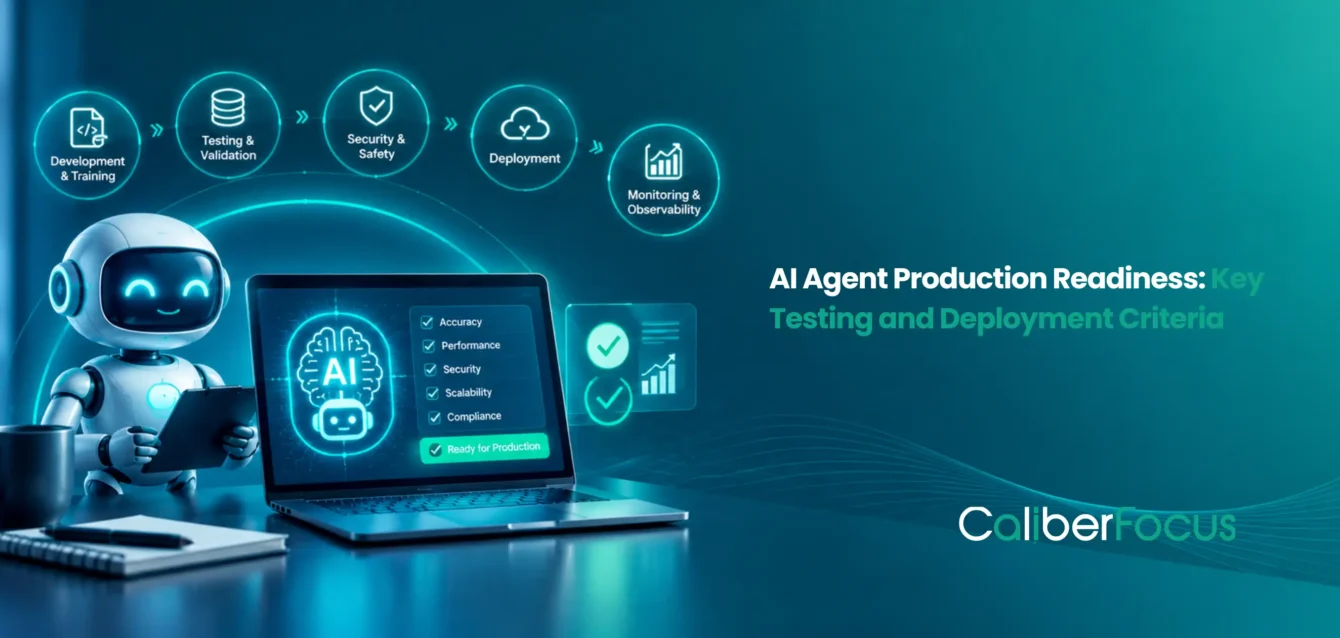
AI agent production readiness means verifying that an agent can complete business tasks reliably, execute authorized actions, recover from failures, and operate safely within enterprise systems. A successful pilot alone does not establish that readiness.
Consider an AI agent that processes supplier invoices. It may correctly identify discrepancies during testing, but production introduces additional questions:
- What happens when the ERP system becomes unavailable?
- Can the agent prevent duplicate transactions?
- Will it stop when an action requires employee approval?
These requirements matter whether an enterprise is planning its first AI agent or preparing an existing solution for deployment.
This guide explains the testing, security, integration, deployment, and monitoring requirements enterprises should establish when developing production-ready AI agents.

Build AI Agents with Production Readiness in Mind
Connect enterprise integration, secure execution, deployment controls, and monitoring throughout the AI agent development lifecycle.
What Makes an AI Agent Production-Ready?
An AI agent is production-ready when it can execute its assigned workflows under realistic business conditions while respecting system permissions, approval requirements, and operational boundaries.
Readiness depends on the consequences of an incorrect action.
| Enterprise Workflow | Production Requirement |
| Finance and accounting | Validate transactions, prevent duplicate postings, and enforce approval limits. |
| Customer service | Access authorized records, apply service policies, and escalate restricted requests. |
| IT operations | Execute permitted service actions without making unauthorized access or configuration changes. |
The distinction between agentic AI and generative AI becomes important here.
A generative AI application might identify a discrepancy in an invoice. An AI agent could retrieve the purchase order, verify supporting records, create an exception case, and route it for approval.
That sequence introduces dependencies across applications, business rules, and employee responsibilities. Production readiness must therefore evaluate the entire workflow, not just the accuracy of an individual response.
AI Agent Testing and Validation Before Production Deployment
Testing should establish whether an agent completes the correct task, follows the permitted execution path, and responds appropriately when conditions change.
1. Validate Task Completion and Decision Paths
Define the agent’s responsibilities and expected outcomes before testing.
For an accounts payable agent, evaluation should verify whether it can:
- Match invoices with approved purchase orders.
- Identify missing or conflicting information.
- Select the appropriate ERP tools.
- Prevent unauthorized transaction updates.
- Escalate discrepancies requiring human approval.
Similar controls apply to AI agents for customer support, where a correct response is insufficient if the agent accesses restricted records or bypasses service policies.
Evaluate task outcomes and execution behavior separately. An agent that reaches the expected result through an unauthorized action has failed the relevant test.
2. Test Enterprise Integrations and Failure Recovery
Enterprise agents depend on APIs, databases, ERP platforms, CRM systems, and other connected applications.
Testing should cover unavailable services, authentication failures, timeouts, unexpected responses, and interrupted transactions.
For example, an ERP update may succeed even when the agent receives a timeout. Retrying without checking transaction status could create a duplicate record.
Where appropriate, transaction identifiers, status verification, idempotency controls, and recovery procedures should prevent repeated actions. When recovery is uncertain, the agent should escalate rather than continue.
These considerations also apply to AI workflow automation across operations, finance, and HR, where workflows combine AI interpretation with application actions and business rules.
3. Evaluate Security and Execution Boundaries
Security testing must establish that agents access only authorized information and perform permitted actions.
Critical scenarios include unauthorized record access, prompt injection through retrieved documents, credential exposure, and attempts to bypass approval requirements.
An agent should never treat instructions embedded in an email or retrieved document as permission to override its operating controls.
Enforce access restrictions through enterprise applications and connected tools, not prompts alone. An AI risk management framework can support broader governance and accountability.
4. Run Regression and Workflow Tests
Changes to models, prompts, APIs, business rules, or connected data can affect agent behavior.
Maintain representative test scenarios covering normal operations, exceptions, security boundaries, and previously identified failures.
| Test Scenario | Expected Behavior |
| Invoice exceeds approved purchase order | Flag discrepancy and request review. |
| ERP update times out | Verify transaction status before retrying. |
| Action exceeds approval limits | Stop and request authorization. |
| Model or integration changes | Rerun relevant workflow and security tests. |
Document results so reviewers can identify passed requirements, unresolved failures, and deployment risks.
Production Readiness Criteria for Enterprise AI Agents
Before go-live, enterprises should evaluate readiness against documented acceptance criteria.
| Readiness Area | What Must Be Verified |
| Task reliability | Assigned workflows produce correct business outcomes. |
| Enterprise integration | Connected systems exchange information and execute actions reliably. |
| Security | Access permissions, sensitive information, and credentials remain protected. |
| Exception handling | Missing information and system failures trigger safe recovery or escalation. |
| Human oversight | Employees can approve, override, or stop restricted actions. |
| Performance | Processing time, workload capacity, and operating costs meet requirements. |
| Observability | Teams can trace agent actions and investigate failures. |
| Business continuity | Affected workflows can be suspended and recovered safely. |
Acceptance criteria should reflect business risk. An incorrect knowledge-base response and an unauthorized financial transaction do not require identical release thresholds.
Organizations comparing AI agent development companies in the USA should examine how prospective partners validate these requirements and support production operations.
How Should Enterprises Make the Go-Live Decision?
| Decision | When It Applies |
|---|---|
| Approve deployment | Required tests pass, critical controls work, and remaining risks are accepted. |
| Approve controlled rollout | Essential requirements are met, but restricted access or additional supervision remains necessary. |
| Delay deployment | Critical security, transaction, authorization, or recovery failures remain unresolved. |
AI Agent Deployment Best Practices for Enterprise Environments
Production deployment requires controlled access, gradual adoption, and clearly assigned operational responsibilities.
1. Prepare Production Systems and Permissions
Before deployment, confirm that agents have access only to approved applications, records, and actions.
Separate test and production environments, enforce transaction limits, preserve approval controls, and maintain a record of changes to models, tools, and configurations.
For example, a procurement agent may prepare purchase requests while purchasing authorization remains with designated employees.
2. Introduce AI Agents Through Controlled Rollouts
A phased approach allows enterprises to validate real-world performance before increasing autonomy.
| Stage | Agent Responsibility |
| Observe | Analyze workflows without executing actions. |
| Assist | Prepare recommendations or actions for employee approval. |
| Execute within limits | Perform selected actions under predefined controls. |
| Expand responsibly | Support additional workflows after reviewing production evidence. |
These stages are illustrative rather than mandatory. Expansion should depend on demonstrated reliability, exception rates, and operational risk.
AI Agents for Healthcare Revenue Cycle Automation
Fragmented eligibility, authorization, claims, and collections processes create manual effort and operational delays. CaliberFocus implemented AI agents across connected revenue cycle workflows to coordinate tasks and improve operational performance.
Explore the Case Study3. Establish Operational Ownership and Recovery
Every production agent needs a designated workflow owner, technical support responsibility, intervention authority, and recovery procedure.
If an agent updates one application but fails to update another, the organization must determine which actions succeeded, correct inconsistent records, and resume safely.
Production autonomy should never eliminate enterprise accountability.
AI Agent Monitoring and Observability After Deployment
Monitoring requirements should be designed during development and validated before go-live.
Effective observability connects technical execution with business outcomes.
| Monitoring Priority | What to Track | Required Response |
| Workflow accuracy | Completed, failed, corrected, and escalated tasks | Investigate recurring errors and rework. |
| Integration reliability | API failures, timeouts, retries, and transaction status | Identify dependencies and prevent unsafe retries. |
| Execution control | Tool actions, approval events, and permission violations | Restrict unauthorized behavior. |
| Operational performance | Processing time, throughput, and cost per completed task | Address bottlenecks and capacity issues. |
| Human oversight | Escalations, overrides, and unresolved exceptions | Review approval patterns and autonomy limits. |
Why Execution Traces Matter
An unsuccessful CRM update could result from incorrect tool selection, invalid parameters, expired credentials, or an unavailable API.
Execution traces help engineering teams identify where the workflow failed instead of treating every unsuccessful task as a model-quality issue.
Monitoring should also support continuous evaluation after model upgrades, integration changes, or business-policy updates.
For example, if task completion remains high but employees increasingly correct agent-generated records, the organization should investigate workflow accuracy before expanding deployment.
Define alert thresholds, incident ownership, and conditions for pausing affected workflows.
Common Reasons AI Agents Fail Production Readiness Reviews
Many AI implementation challenges emerge when successful demonstrations are mistaken for reliable enterprise operations.
Five failure patterns deserve particular attention.
Correct Outcomes Through Incorrect Actions
An agent completes a customer request but bypasses required identity verification. Evaluate the execution path, not just the final result.
Unreliable Enterprise Integrations
An API change interrupts workflow execution. Test dependency failures and rerun relevant integration tests after system changes.
Excessive Operational Permissions
An IT agent receives authority beyond its assigned tasks. Apply least-privilege access and enforce approval boundaries.
Duplicate or Inconsistent Transactions
Interrupted workflows produce repeated actions or partial updates. Verify transaction status and implement safe recovery procedures.
Insufficient Investigation and Intervention Controls
Teams cannot explain unexpected agent actions or suspend problematic workflows. Establish traceability, monitoring, ownership, and intervention authority.
Frequently Asked Questions
Define the business workflow, required integrations, permitted actions, approval boundaries, testing requirements, and operational ownership. Addressing these dependencies during development reduces the risk of discovering fundamental deployment limitations later.
Testing verifies specific components, integrations, and expected behaviors. Evaluation measures how effectively an agent completes tasks, selects tools, follows business rules, and handles different scenarios. Production readiness requires both.
Yes. Relevant regression testing should follow changes that may affect behavior, including model upgrades, prompt revisions, API changes, and permission updates. The testing scope should reflect the affected workflow and its operational risk.
Moving From Tested AI Agents to Reliable Enterprise Operations
Production-ready AI agents require more than accurate responses. Enterprises must establish reliable execution, secure integrations, enforceable permissions, failure recovery, and continuous operational oversight.
The right approach begins during development, uses documented evidence to support deployment decisions, and preserves business control as agent responsibilities expand.

Move AI Agents From Testing to Enterprise Deployment
Connect AI agent development with secure enterprise integrations, controlled deployment, and production monitoring.