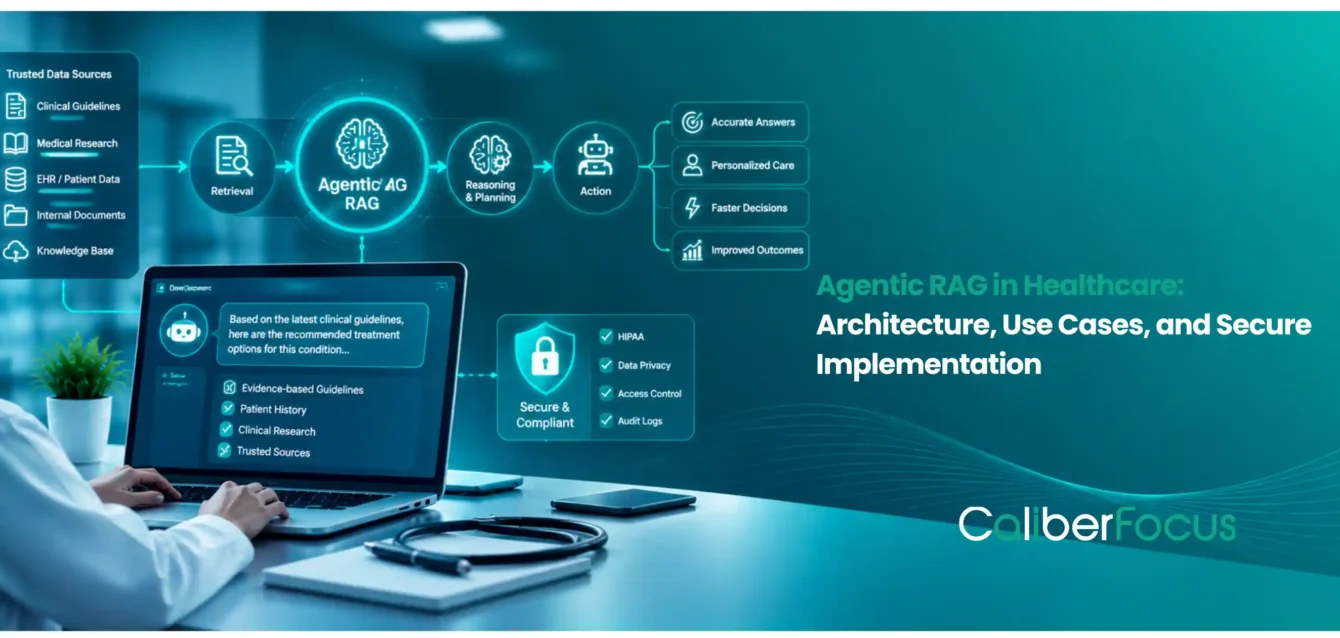
Healthcare organizations depend on information distributed across electronic health records (EHRs), clinical notes, treatment guidelines, payer policies, and internal knowledge systems. The challenge is not always finding information in one system, but bringing together relevant evidence from multiple sources while preserving clinical context, accuracy, and access controls.
Retrieval-augmented generation (RAG) helps address this challenge by grounding AI-generated responses in retrieved information. However, traditional RAG can become restrictive when healthcare workflows require:
- Cross-system retrieval: Gathering relevant information from EHRs, clinical repositories, and operational knowledge sources.
- Multi-step information gathering: Refining searches when initial results are incomplete or insufficient.
- Evidence verification: Checking source relevance, document currency, and conflicting information before generating a response.
Agentic RAG in healthcare extends conventional retrieval by using AI agents to coordinate these steps, select authorized knowledge sources, and gather additional evidence when necessary. This makes it relevant to complex healthcare information workflows, although greater retrieval flexibility also introduces additional security and governance requirements.
For healthcare technology leaders, the key question is where agentic RAG provides measurable value over traditional RAG and what it takes to implement it reliably. This article examines its architecture, healthcare applications, EHR integration, and the security and validation considerations required for production deployment.

Build Reliable RAG Solutions for Healthcare Workflows
Connect enterprise knowledge, intelligent retrieval, and AI-driven workflows with a RAG architecture designed around your data, integration, and security requirements.
Agentic RAG in Healthcare: At a Glance
-
Purpose: Coordinate multi-step information retrieval across authorized healthcare knowledge sources.
-
Difference: Traditional RAG generally follows a predefined retrieval pipeline; agentic RAG can dynamically adjust retrieval steps.
-
Applications: Clinical knowledge assistance, patient-record summarization, documentation review, prior authorization, and policy retrieval.
-
Architecture: Knowledge sources, retrieval tools, agent orchestration, language models, security controls, and monitoring.
-
Implementation priority: Validate information quality, retrieval accuracy, access permissions, and human oversight before scaling.
What Is Agentic AI in Healthcare?
Agentic AI in healthcare refers to AI systems that can plan and coordinate multiple tasks, interact with authorized healthcare applications, and make workflow-level decisions within defined operational boundaries. Unlike conventional AI applications that primarily respond to individual requests, agentic AI can determine the sequence of steps needed to complete a task and adapt when additional information or actions are required.
In healthcare, these capabilities are relevant because clinical and administrative workflows frequently involve multiple systems, changing information, and decisions that require human oversight.
For example, when a clinician needs a consolidated view of a patient’s treatment history, an AI agent may coordinate the following workflow:
- Interpret the request: Identify the relevant patient context and information required, including encounters, medications, laboratory results, and specialist notes.
- Plan the tasks: Determine which authorized EHR modules and clinical knowledge repositories need to be accessed.
- Retrieve information: Use approved tools to gather relevant records while enforcing access permissions.
- Evaluate the findings: Check information completeness, identify conflicting records, and initiate additional retrieval when necessary.
- Prepare the output: Organize the findings into a source-referenced summary that preserves clinical context and record dates.
- Route for review: Present the summary to an authorized clinician for verification before it informs clinical decisions.
Where does Agentic RAG fit?
Agentic AI describes the broader capability to coordinate tasks and interact with systems. Agentic RAG is a specific application of agentic AI focused on retrieving, evaluating, and synthesizing information from trusted knowledge sources.
In healthcare, this distinction matters: an AI agent may coordinate an administrative workflow, while an agentic RAG system focuses on assembling relevant clinical or operational evidence to support that workflow.
This distinguishes agentic retrieval from the broader category of AI agents in healthcare, which may also perform administrative or operational actions.
Agentic RAG vs. Traditional RAG in Healthcare
Traditional RAG and agentic RAG both connect AI-generated responses to external knowledge. The difference lies in how they retrieve, process, and validate information, particularly when healthcare questions involve multiple clinical records, changing patient information, or different knowledge systems.
| Comparison Factor | Traditional RAG in Healthcare | Agentic RAG in Healthcare |
| Retrieval approach | Retrieves information through a predefined search and retrieval pipeline. | Dynamically plans and executes multiple retrieval steps based on the clinical or operational request. |
| Clinical query handling | Retrieves relevant passages for a given question, with optional query rewriting. | Can divide complex questions into smaller tasks, such as reviewing medications, encounters, and laboratory findings separately. |
| Healthcare data sources | Searches configured EHR records, clinical documents, or policy repositories. | Selects among authorized EHR interfaces, clinical knowledge bases, and retrieval tools based on the information required. |
| Clinical context | Depends on retrieved context and predefined processing rules. | Can retrieve additional information to investigate missing clinical context or conflicting records. |
| Evidence validation | Uses configured retrieval ranking, grounding, and validation mechanisms. | Can evaluate evidence sufficiency and initiate further retrieval when relevant information is missing. |
| Workflow orchestration | Generally follows a fixed retrieval-to-generation sequence. | Coordinates retrieval tasks, tool calls, evidence checks, and response preparation. |
| EHR integration | Uses configured interfaces to retrieve relevant healthcare information. | Can coordinate multiple authorized EHR queries and retrieval tools within a single information workflow. |
| Security and governance | Requires access controls, data protection, auditability, and output validation. | Requires the same safeguards, plus controls over agent planning, tool selection, execution limits, and escalation. |
| Implementation complexity | Typically easier to develop, evaluate, and maintain. | Requires additional orchestration, monitoring, failure handling, and operational evaluation. |
| Suitable healthcare applications | Clinical guideline lookup, hospital policy Q&A, and document-based knowledge assistance. | Longitudinal patient record review, cross-source clinical information gathering, and complex documentation or prior authorization support. |
Which Approach Should Healthcare Organizations Choose?
Traditional RAG in healthcare is often sufficient when clinicians or administrative teams need reliable answers from a controlled knowledge repository, such as approved clinical protocols or hospital policies.
Agentic RAG becomes more relevant when a request requires information from several authorized systems, additional searches to resolve incomplete evidence, or coordinated retrieval across different clinical and operational records.
The deciding factor is retrieval complexity, not the level of automation an organization wants to introduce. Agentic RAG should demonstrate measurable improvements in information completeness, relevance, or workflow performance before healthcare organizations accept the additional latency, cost, and governance requirements.
Agentic RAG Architecture for Healthcare Systems
An agentic RAG architecture in healthcare must connect clinical knowledge, secure data retrieval, AI agent orchestration, and evidence-grounded response generation. Each component has a distinct role in ensuring that information retrieved from healthcare systems remains relevant, traceable, and accessible only to authorized users.
1. Healthcare Knowledge Sources
The architecture begins with approved healthcare information sources, including electronic health records (EHRs), clinical notes, laboratory reports, treatment guidelines, payer policies, and internal operational documentation.
These sources require consistent metadata, access permissions, document versioning, and data-quality controls. Maintaining the distinction between historical and current patient information is particularly important when retrieving records across multiple encounters.
2. Retrieval and Knowledge Processing
The retrieval layer identifies relevant clinical and operational information using semantic search, keyword search, hybrid retrieval, metadata filtering, and structured queries.
Healthcare records introduce additional challenges because clinical terminology, abbreviations, encounter dates, and document context can influence how information should be interpreted.
Techniques such as natural language processing in healthcare can support information extraction from unstructured clinical documentation, while metadata and structured retrieval help preserve the context needed for accurate responses.
3. Agent Orchestration and Retrieval Planning
The orchestration layer determines how an information request should be processed, which authorized sources need to be accessed, and whether additional retrieval steps are necessary.
For example, when preparing a patient’s treatment-history summary, an agent may retrieve encounter notes, medication records, and diagnostic findings separately before consolidating the information.
The agent can initiate further searches when evidence is incomplete, but its actions must remain within predefined tool permissions, execution limits, and escalation rules.
4. Multi-Agent RAG and Knowledge Graph RAG
More complex healthcare applications may require specialized retrieval architectures.
Multi-agent RAG distributes responsibilities among agents handling different information sources or tasks, such as structured EHR retrieval, clinical document search, and evidence verification.
Knowledge graph RAG, including Medical Graph RAG approaches, represents relationships among clinical concepts such as diagnoses, symptoms, medications, and procedures. It can support relationship-based retrieval when those connections are accurately modeled and maintained.
Neither approach is mandatory. Their adoption should depend on the complexity of the healthcare workflow, available data, and measurable improvements over simpler retrieval architectures.
5. Response Generation, Security, and Governance
Once relevant evidence has been retrieved, the language model organizes it into a response that preserves clinical context and references to the underlying information sources.
Healthcare implementations should also identify missing or conflicting evidence and route sensitive outputs for appropriate human review.
Security and governance must operate across the entire architecture, including authentication, retrieval-level authorization, audit logging, agent execution controls, and protection against prompt injection.
Before production deployment, these components should undergo structured testing for retrieval accuracy, source grounding, permission enforcement, and operational reliability. A RAG implementation checklist can help organize these validation requirements across the development and deployment process.
Agentic RAG Use Cases in Healthcare
The most relevant agentic RAG applications involve information-intensive workflows requiring coordinated retrieval from multiple approved sources.
1. Longitudinal Patient Record Review
Patient information may be distributed across years of encounters, specialist notes, medications, and diagnostic reports.
Agentic RAG could retrieve relevant records, organize information chronologically, and prepare a source-linked summary.
Key consideration: Patient identity, historical context, and completeness must be validated. Clinical review remains necessary.
2. Clinical Knowledge Assistance
Clinical teams may need to consult institutional protocols, approved guidelines, and patient-specific records.
Agentic retrieval could gather relevant references and present supporting information for clinician consideration.
For clinical decision support, organizations must evaluate evidence quality, guideline currency, intended use, clinical safety, and applicable regulatory requirements.
Retrieved evidence does not automatically make an AI-generated recommendation clinically valid.
3. Clinical Documentation Support
Important details can be dispersed across consultation notes, discharge summaries, and supporting records.
Agentic RAG could coordinate document retrieval and generate draft summaries with source references, complementing NLP-based clinical documentation workflows.
Key consideration: Outputs require checks for omissions, incorrect attribution, and unsupported clinical statements before use.
4. Prior Authorization Preparation
Prior authorization teams frequently review clinical documentation against payer-specific requirements.
An agentic RAG application could retrieve relevant policies, identify supporting clinical records, and flag missing documentation for authorized staff.
This connects retrieval with broader AI agents for prior authorization.
Key consideration: Payer policies change, and evidence preparation must remain separate from clinical necessity and coverage decisions.
5. Healthcare Policy and Compliance Assistance
Healthcare staff often consult policies across compliance manuals, departmental procedures, and internal repositories.
Agentic RAG could retrieve applicable documents, compare versions, and provide referenced explanations.
This can be a suitable starting point for evaluation when organizations use a bounded, approved knowledge base and establish clear escalation procedures.
Integrating Agentic RAG With Electronic Health Records
EHR integration is more complex than connecting a language model to a document repository.
Healthcare records contain structured and unstructured information, and different systems may represent clinical concepts differently.
Organizations should address three requirements.
Authorized interoperability: Use approved integration methods and interfaces. HL7 FHIR may support structured healthcare data exchange where implemented, but available resources and permissions vary by EHR environment.
Clinical context: Preserve encounter dates, record status, patient identity, and source provenance. Historical observations should not automatically be interpreted as current findings.
Data permissions: Enforce authorization before information reaches the model. An agent must not retrieve information merely because a user requests it.
When sources conflict, the system should identify the inconsistency or escalate it rather than silently selecting one record.
Security, Privacy, and HIPAA Considerations
Agentic RAG is not inherently HIPAA compliant. Compliance depends on the deployment, data handling, organizational responsibilities, safeguards, and applicable vendor arrangements.
Healthcare organizations processing electronic protected health information must evaluate the relevant requirements of the HIPAA Security Rule, including access control, audit controls, integrity, authentication, and transmission security.
The U.S. Department of Health and Human Services provides authoritative guidance.
| Security requirement | Agentic RAG consideration |
| Access control | Enforce user and tool permissions across every retrieval step |
| Data protection | Secure information during storage, transmission, and processing |
| Auditability | Record relevant retrieval, tool activity, and review events |
| Agent restrictions | Limit permitted tools, actions, and external destinations |
| Prompt injection protection | Prevent retrieved content from overriding trusted instructions |
| Human oversight | Escalate uncertain or consequential outputs for review |
Unlike a fixed retrieval pipeline, agentic RAG may make additional tool-selection decisions. Those decisions require explicit boundaries and monitoring.
For a broader discussion of healthcare AI safeguards, see HIPAA-compliant AI considerations.
Implementing Agentic RAG in Healthcare: Six Practical Steps
A controlled implementation should progress from a defined information problem to evaluated production use.
Step 1: Identify a Suitable Workflow
Select an information-intensive task with clear users, knowledge sources, expected outputs, and risk boundaries.
Determine whether conventional search or traditional RAG could solve the problem before introducing agent orchestration.
Step 2: Assess Data and Integration Readiness
Review knowledge-source quality, EHR access, document currency, permissions, and available integration methods.
Identify missing information, inconsistent records, and ownership responsibilities.
Step 3: Design the Retrieval Architecture
Choose retrieval methods, orchestration patterns, language models, and tool permissions.
Start with the simplest architecture capable of meeting the requirement. Multi-agent or graph-based approaches should have a specific justification.
Step 4: Validate Retrieval and Response Quality
Test representative healthcare questions, including incomplete evidence, conflicting records, outdated policies, and unauthorized requests.
Measure retrieval relevance, evidence completeness, groundedness, citation accuracy, agent reliability, and access-control effectiveness.
Clinical applications also require appropriate clinical SME evaluation.
Step 5: Deploy With Defined Oversight
Begin with approved users and bounded data sources.
Monitor retrieval failures, unsupported answers, agent actions, latency, and operational costs. Establish escalation, incident response, and rollback procedures.
Step 6: Scale Based on Evidence
Expand only when evaluation demonstrates acceptable performance and the organization can sustain the required governance.
Performance in administrative policy retrieval should not be assumed to transfer to higher-risk clinical applications.
When Should Healthcare Organizations Consider Agentic RAG?
The decision to adopt agentic RAG should begin with the information challenges healthcare teams encounter, not the complexity of the AI architecture. A hospital retrieving an approved clinical protocol has different requirements from a care team reviewing a patient’s history across multiple encounters, specialist notes, and diagnostic records.
The key consideration is whether the workflow requires the AI system to retrieve information dynamically, investigate missing evidence, or coordinate searches across multiple authorized healthcare sources.
Where Agentic RAG Adds Value and Where It May Not
| Healthcare Scenario | Information Challenge | Recommended Approach |
|---|---|---|
| Clinical guideline and policy lookup | Staff need answers from a controlled repository of approved clinical protocols or hospital policies. | Traditional RAG is generally sufficient when relevant documents can be retrieved through a predefined search process. |
| Longitudinal patient record review | Clinicians need to consolidate encounters, medication histories, laboratory findings, and specialist notes from different sources. | Agentic RAG may coordinate multiple authorized retrieval steps and organize the evidence for clinical review. |
| Clinical documentation review | Relevant details are distributed across consultation notes, discharge summaries, and diagnostic reports. | Agentic RAG may help when the system must retrieve related documents, investigate missing information, and preserve source references. |
| Prior authorization documentation | Teams must identify applicable payer criteria and retrieve supporting clinical records from separate systems. | Agentic RAG may support policy retrieval, documentation gathering, and evidence preparation for authorized review. |
| Medical knowledge relationship analysis | Information retrieval depends on relationships among diagnoses, medications, symptoms, and clinical terminology. | Knowledge graph RAG may be useful when validated relationships provide value beyond document-based retrieval. |
| Complex cross-system information gathering | A request requires different retrieval methods for structured EHR data, clinical documents, and operational knowledge. | Multi-agent RAG may be considered when specialized agents offer measurable advantages over a simpler architecture. |
Three Questions to Ask Before Choosing Agentic RAG
1. Does the workflow genuinely require multiple retrieval decisions?
If the required information can be retrieved reliably from a single knowledge repository, traditional RAG may provide the necessary functionality with less implementation effort. Agentic RAG becomes more relevant when the system must determine which sources to consult and whether additional searches are necessary.
2. Can the organization support secure, context-aware retrieval?
Access to multiple healthcare systems does not guarantee that the information is complete, current, or appropriate for the request. EHR permissions, patient identity, encounter dates, document provenance, and conflicting records must be addressed before introducing dynamic retrieval.
3. Can the additional complexity demonstrate measurable value?
Agentic orchestration introduces more tool calls, execution paths, monitoring requirements, and potential failure points. Healthcare organizations should compare traditional and agentic RAG using representative tasks, measuring evidence completeness, response reliability, latency, and operational cost.
The practical decision: Agentic RAG is worth considering when coordinated retrieval can improve how healthcare professionals access and review information across systems. If a simpler retrieval architecture already meets the workflow’s accuracy, security, and performance requirements, additional agents may offer little operational benefit.

Plan Your Next Move in Healthcare RCM with AI
Explore a structured roadmap to prioritize AI opportunities, assess readiness, validate implementation, and scale across revenue cycle workflows.
Key Takeaways
-
✓
Agentic RAG combines retrieval-augmented generation with agent-driven search planning and tool coordination.
-
✓
Its value is strongest in complex healthcare workflows requiring information from multiple authorized sources.
-
✓
EHR integration depends on reliable data access, clinical context, and source provenance.
-
✓
Multi-agent RAG and Medical Graph RAG are optional approaches, not implementation requirements.
-
✓
HIPAA safeguards, clinical validation, human oversight, and monitoring must be addressed before production deployment.
Frequently Asked Questions
Agentic RAG is worth considering when healthcare workflows require information from multiple authorized sources, iterative searches, or additional evidence gathering. For clinical guideline lookup or questions answered from a single controlled repository, traditional RAG may be sufficient. The choice should depend on retrieval complexity, accuracy requirements, and operational value.
Agentic RAG can retrieve information through supported EHR APIs, interoperability interfaces, and approved data-access services. Integration depends on the EHR environment, available interfaces, patient-context matching, and access permissions. Healthcare organizations must also preserve encounter dates, source references, and distinctions between historical and current clinical records.
Potential applications include longitudinal patient record review, clinical documentation support, prior authorization evidence gathering, and clinical knowledge assistance. These workflows may benefit when relevant information is distributed across EHR modules, clinical documents, payer policies, and other authorized repositories.
Agentic RAG can be designed to process PHI within an appropriately governed healthcare environment, but the architecture does not automatically ensure HIPAA compliance. Implementations require appropriate safeguards, including access controls, data protection, audit logging, restrictions on agent tool use, and applicable contractual arrangements with technology providers.
Agentic RAG may assist clinicians by retrieving relevant patient information, clinical guidelines, and supporting evidence. However, retrieved information can be incomplete, outdated, or incorrectly interpreted. Clinical applications require appropriate validation, source traceability, human oversight, and assessment of applicable regulatory requirements. Diagnosis and treatment decisions remain the responsibility of authorized healthcare professionals.

Build Agentic RAG for Healthcare Workflows
Connect healthcare knowledge sources with secure, context-aware retrieval and AI agent orchestration.