

Your Scheduling System Is Running. Your Revenue Cycle Is Still Bleeding.
Hospital revenue cycle leaders have spent years optimizing denials management, AR follow-up, and claims adjudication, while the break that feeds all three sits quietly at patient access.
A mid-size health system processing 400,000 outpatient visits annually can lose between $8M and $14M in scheduling-driven revenue leakage per year. Not from coding errors. Not from payer disputes. From the 90 seconds between when a patient books an appointment and when the system confirms it — without ever checking eligibility, payer-specific authorization requirements, or whether that slot maps to the right clinical pathway for clean claim submission.
Your healthcare finance, claims, and scheduling infrastructure may already handle the downstream. Automated patient scheduling with AI closes what leaks upstream.
What Is Automated Patient Scheduling?
Automated patient scheduling is an AI-driven layer that manages slot allocation, real-time insurance eligibility verification, prior authorization flagging, and patient self-scheduling across every inbound channel a hospital operates.
This is distinct from the scheduling module inside your EHR. Epic and Cerner were architected as systems of record, not systems of judgment. They confirm availability. AI appointment scheduling reasons across live payer rules, patient coverage, visit type requirements, and authorization triggers before confirmation is issued.
The clinical and financial implications of that difference are covered in detail across generative AI use cases in healthcare and EHR process automation best practices.
Five Scheduling Layers. Five Separate Revenue Risks.
Hospital scheduling does not operate as a single workflow. It runs as five concurrent processes, each with its own payer exposure and downstream RCM consequence.
Understanding these five layers is covered in depth within clinical workflow management for hospitals and AI-driven hospital operations and resource management. Here is where each layer breaks financially:
| Scheduling Layer | Where Revenue Leaks |
| Outpatient Clinic | Pre-registration gaps, eligibility failures at adjudication, auth misses on high-cost visits |
| OR Block | Underutilized surgical blocks, wrong procedure type confirmed, missing auth on elective cases |
| Inpatient Bed Coordination | Delayed admission due to scheduling misalignment, extended LOS from misrouted transitions |
| Ancillary and Diagnostic | Fragmented episode scheduling, charge capture gaps between order and execution |
| Discharge and Follow-up | 30-day readmission risk from unbooked follow-ups, CMS IPPS penalty exposure |
The Scheduling Error You Logged Monday Shows Up as a Denial on Day 31
In hospital RCM, the average time between a scheduling-stage error and its appearance in the AR queue is 28 to 35 days, long enough that the root cause is rarely traced back correctly.
Here is what that chain looks like in practice:
A surgical case is confirmed without a payer-specific authorization check. The case is delivered. The claim is filed. On day 31, the payer denies on authorization grounds. The RCM team opens an appeal. Two of three appeals on auth-related denials fail at the first level. Net revenue impact on a single orthopedic case: $18,000 to $60,000 written off or delayed beyond the 90-day collection window.
Multiply that across a 600-bed health system’s monthly surgical volume and the math changes how a CFO reads the denial dashboard.
How Dynamics 365 supports RCM and patient outcomes addresses parts of this at the back end. The scheduling layer catches it before it enters that pipeline at all.
- 34% of prior auth denials carry information that existed at the time of booking
- 1 in 5 confirmed appointments contain at least one active eligibility discrepancy
- Hospitals with scheduling-driven auth failure rates above 8% see net collection rates fall 3 to 5 percentage points below benchmark
What the Agent Does Between Booking Request and Appointment Confirmation
An autonomous scheduling agent does not replace your scheduling staff. It handles the verification and authorization decision loop that currently runs manually, inconsistently, or not at all.
Sequence inside a hospital deployment:
- Patient intent received across voice, online patient scheduling portal, SMS, or chat. AI-powered chatbots handle inbound scheduling interactions across all channels simultaneously
- Slot matched against provider availability, visit type requirements, and department-level care pathway rules in the EHR
- Insurance eligibility checked in real time against active payer data before confirmation is issued
- Prior authorization requirement identified and initiation triggered at point of booking, not at pre-certification three days before the visit
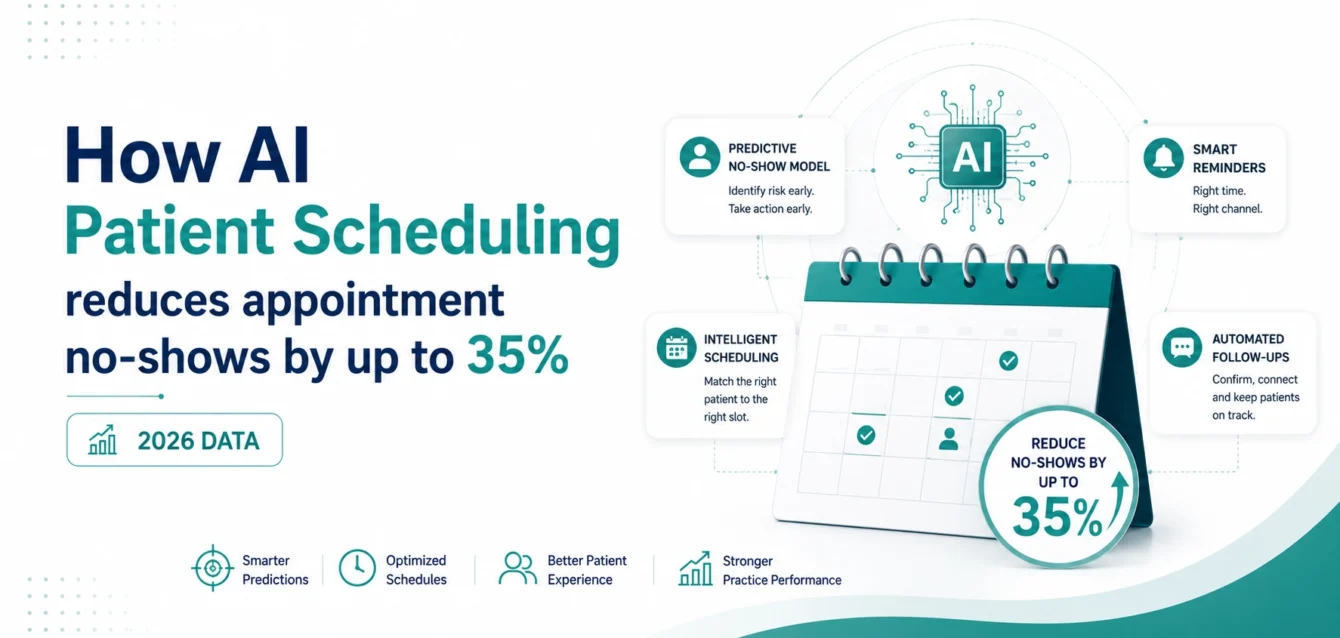
- Automated appointment reminders deployed with no-show risk scoring and intelligent reschedule loops for high-risk patient segments
- Discharge follow-up appointment booked before the patient exits, closing the CMS readmission exposure window
The workforce implications of deploying AI agents across healthcare operations go beyond scheduling alone, but scheduling is consistently the highest-impact starting point.
It Connects to Your EHR. It Meets Your Compliance Requirements.
HL7 FHIR-based integration means CaliberFocus scheduling agents write back to Epic and Cerner in real time, with no parallel system and no duplicate record management.
Three compliance requirements hospital IT and legal teams ask about first:
- HIPAA: Every scheduling interaction is encrypted, auditable, and built within a HIPAA compliant application framework
- Data security: Scheduling data handling meets the standards covered in healthcare application security testing
- RCM compliance: Authorization and eligibility workflows align with security and compliance requirements inside RCM operations
Phased deployment starts at the scheduling touchpoint with the highest denial concentration, typically outpatient or surgical, and expands from there without disrupting live operations.
90-Day Performance Benchmarks Across Hospital Deployments
| Metric | Result |
| No-show rate reduction | 40% average across outpatient and surgical scheduling |
| Auth-related denials traced to scheduling gaps | Down 60% within first two billing cycles |
| OR block utilization improvement | 22% increase in utilized versus allocated surgical time |
| Scheduling staff capacity freed for escalation handling | 28% of FTE hours redirected from routine booking to exceptions |
| Pre-service eligibility failure rate | Reduced from industry average of 18% to under 4% |
These metrics translate directly to the financial benchmarks in AI transformation outcomes for hospital operations.
Scheduling Is Where Your Revenue Cycle Actually Starts
Most RCM investments go into what happens after a claim is filed. Denial management platforms, AR follow-up automation, appeals workflow tools. CaliberFocus works at the point where most of that downstream work is created in the first place.
The scheduling layer is not an access problem or a patient experience problem. For a hospital carrying denial rates above 6% on scheduling-adjacent claim types, it is a revenue integrity problem. Autonomous scheduling agents close the eligibility gaps, catch the authorization misses, and eliminate the patient access failures that currently travel undetected through your EHR and surface as preventable denials 30 days later.
Health systems that have deployed this layer are not patching a broken process. They are removing the source of it. If your team is ready to stop recovering revenue that should never have been lost,
Frequently Asked Questions
Pre-certification workflows activate 3 to 5 days before the visit, after the slot is already confirmed. By that point, rescheduling carries its own revenue cost. Flagging authorization requirements at the booking stage gives clinical staff the full authorization window, which for complex surgical cases is the difference between a clean claim and a peer-to-peer appeal.
Scheduling-driven eligibility failures and auth denials are among the highest-volume, lowest-complexity denial categories. Closing them at the source reduces denial volume entering the AR queue, which shortens average days in AR on affected claim types by 12 to 18 days based on current hospital deployment data.
Integration is via HL7 FHIR APIs supported natively by Epic and Cerner. No middleware replacement, no parallel scheduling database. The agent layer reads from and writes back to the existing EHR scheduling module with a full audit trail. Implementation does not require downtime on live scheduling operations.
AI-powered patient self-scheduling increases portal adoption by removing the friction points that push patients back to call centers, primarily confusion around insurance requirements and appointment type selection. When the scheduling agent handles eligibility and visit type matching at the self-service layer, completion rates on digital scheduling increase and point-of-service collection opportunities improve because coverage is confirmed before the patient arrives.